

Imagine this: you’ve built a killer website that ranks on page one in Google, but when a customer asks ChatGPT or Siri for a recommendation, your brand name never comes up. That’s because AI-powered search works differently – it doesn’t just crawl pages, it reads and summarizes them. AI assistants may serve answers without ever showing a link to your site. In India’s fast-moving digital scene, that’s a major blind spot. LLM Optimization is the new playbook for this world: it means structuring your site and even adding an /llms.txt file so that AI models know which of your pages truly represent your brand. The figure below highlights how traditional search (left) and AI search (right) differ in approach.
Today’s smartphone-savvy Indians often ask their phones or chatbots questions rather than typing Google queries. That means even if you’re a big name on Google, you might be invisible in an AI answer. LLM Optimization helps your brand get noticed by these AI systems. For example, as SEO experts at thinkdmg explain, an LLMs.txt file is like a “guidance file” for large language models – it tells AI which content represents your brand, expertise, and authority. In practice, implementing LLM optimization is about curating your website so generative AI finds and cites the right information about you.
What Is LLMs.txt and Why Does It Matter?
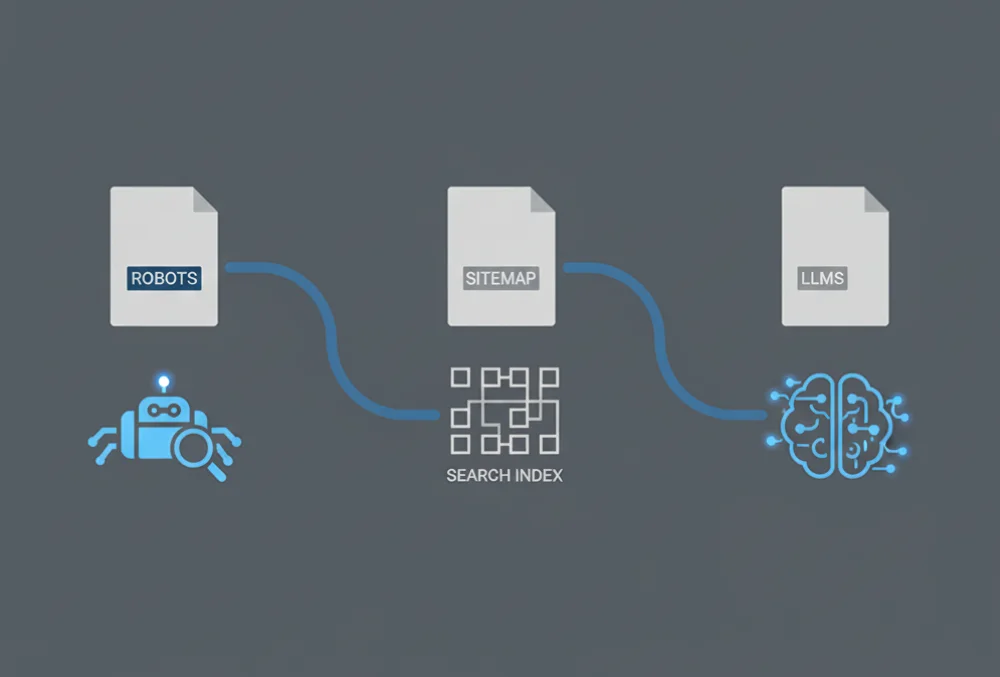
At its core, LLMs.txt is a simple text file you put in your website’s root directory (e.g., yourdomain.com/llms.txt). It’s similar to a sitemap, but specifically for AI. In Neil Patel’s words, LLMs.txt “lets you control how AI crawlers – such as GPTBot, ClaudeBot, and Google-Extended – use your content for model training”. Instead of saying “don’t go here” (like robots.txt), it says “this is my best stuff, start here when you’re answering questions about me.” Essentially, LLMs.txt tells ChatGPT and others, “These pages are priority for understanding our brand”.
Why does this matter for LLM Optimization? Without guidance, an AI might pull facts from an outdated blog post or ignore your key service pages. As one marketing blog puts it, AI assistants often rely on the “first thing they find,” which may not reflect your current offerings. By using LLMs.txt, you give AI a roadmap – think of it as a curated site map for AI to follow. This can help ensure that if an AI is summarizing your business (say, answering “What does YourBrand do?”), it points to the right, authoritative pages. In sum, LLM Optimization (which includes using LLMs.txt) adds a new layer of content strategy on top of SEO: one focused on AI comprehension and citation.
LLM SEO: Enhancing Brand Authority in AI Search
Traditional SEO targets search engines like Google. LLM SEO (or Answer Engine Optimization) targets AI-driven answers. While the two overlap, they’re not identical. For example, a robots.txt file tells Googlebot what to crawl, and a sitemap.xml lists all your pages for indexing (normal SEO). An LLMs.txt file guides AI models instead – highlighting which of those pages are best for summarizing your brand. The table below from thinkdmg shows the difference:
| File Type | Purpose | AI Search Impact |
|---|---|---|
robots.txt |
Crawl control | Minimal (AI may ignore) |
sitemap.xml |
Lists URLs | Indirect (helps AI find canonical pages) |
LLMs.txt |
Guide AI to key content | High (influences summaries, citations, brand recall) |
As the table suggests, LLMs.txt has a “High” impact on AI search by influencing which pages AI cites. Think of it this way: if Google is the librarian organizing books, ChatGPT is the reader skimming them. A well-crafted LLMs.txt file says, “Reader, start with chapter 1 and 2 – they best tell my story.” This kind of LLM Optimization doesn’t directly bump your Google rank, but it means AI assistants are more likely to see your content as the trustworthy source. In crowded markets (like fintech or fashion in India), that can make customers “hear” your brand in an AI answer instead of a competitor.
How LLM Optimization Builds Brand Authority
Why bother with LLM SEO? The answer is brand authority and visibility. When an AI answers a user’s question, being included in that answer reinforces your brand’s reputation. For instance, Brainz Digital notes that “users are getting what they need without ever visiting a website. For brands, that means you don’t just need to rank – you need to be the result”. If an AI cites your content or quotes your site, it’s like a mini endorsement: your brand enters the conversation.
Key benefits of LLM Optimization include:
-
Increased AI-generated exposure: By highlighting your best pages, you raise the chance an AI will “pull a quote” from your site. Brainz Digital reports that “websites adopting llms.txt have seen higher impressions and visibility in AI-generated overviews, which can translate to more brand awareness”. In other words, even if the user doesn’t click through, they now know your brand.
-
Better accuracy and trust: AI chatbots might otherwise grab info from a random blog or outdated page. By guiding them to your authoritative guides and FAQs, you help ensure “AI get[s] accurate info straight from you”. That positions your brand as an expert in the AI’s “mind,” increasing brand recall and trust.
-
Voice search and zero-click answers: Many Indians use voice assistants (60% by some reports) or mobile chatbots to search. If Siri or Google’s new AI mode answers in your niche, you want your company featured. LLM SEO targets those “zero-click” interactions, where being in the answer is as good as a click.
Put simply, LLM optimization is about making sure AI assistants can’t ignore you. If a competitor’s name appears on ChatGPT when answering questions about your industry, they’re building authority – and you’re missing out. As Neil Patel puts it, allowing AI to use your content may “strengthen your presence in AI-generated answers”, while blocking it might protect content but at the cost of visibility. For most brands, the goal will be to be included in those AI-driven conversations.
Best Practices for LLM Optimization
So how do you actually optimize? Here are practical steps to boost your AI relevance:
-
Create an
llms.txtfile at your domain root. Just likerobots.txt, placeyourdomain.com/llms.txt. In it, list your priority pages (services, cornerstone articles, product guides) and note any you want to exclude (login pages, thin blog posts). For example, you might allow AI bots full access to your/services/pages but disallow old/news/archives/. -
Highlight cornerstone content. Include lines like:
This tells GPTBot (OpenAI’s web crawler) to fetch your service pages first. (You can do similarly for Google-Extended or ClaudeBot.)
-
Embrace structure and clarity. AI loves well-structured content. Use clear headings, bullet lists, tables, and Q&A sections on your important pages. (In fact, one study found sites that added FAQs, tables, and structured comparisons saw more AI referrals.) This isn’t unique to AI – good for Google too – but it especially helps an LLM pick out facts.
-
Maintain fresh, authoritative content. Focus on in-depth articles, industry data, and unique insights. A bot scanning for “best practices” will trust a recent well-researched guide over a generic summary. If you have research, reports, or proprietary figures (especially India-relevant data), highlight them prominently.
-
Exclusions and privacy. If you have premium content (like gated articles) or anything you don’t want AI reusing, block it in
llms.txt. For example, financial firms might disallow internal doc paths. This way, you protect sensitive info while guiding AI to public assets. -
Tag and microformat data. Where relevant, use structured data (schema markup) on your pages. AI models often parse that too. For instance, mark up FAQ schema so an AI can easily extract Q&As.
-
Monitor and update.
LLMs.txtis easy to change. Periodically review your analytics: if certain pages become outdated or new flagship content emerges, update the file. Also, watch for announcements: as Neil Patel notes, “more organizations [are] asking for clarity around AI access”, so standards may evolve.
At Elevatech Digital, our IT and SEO specialists treat LLM optimization like any strategic project. We map our clients’ key offerings and ensure those URLs are favored in llms.txt. Then we audit content structure on those pages – adding tables, FAQ sections, and strong headings – to make them LLM optimization friendly. It’s a team effort: content strategists, developers, and even data analysts (to track AI traffic) all play a role.
Traditional SEO vs AI SEO: A New Landscape
You might wonder: isn’t this just SEO again? Partly yes, but think of LLM optimization as a new lane on the SEO highway. Traditional SEO still matters – Google’s ranking algorithms still reward E-E-A-T and mobile-friendly pages. But AI SEO (sometimes called AEO, Answer Engine Optimization) focuses on getting into the answer, not just the list.
Interestingly, the efforts overlap. Brainz Digital notes that content which ranks well on Google often becomes the source of ChatGPT answers. So by building great content, you often gain in both arenas. In fact, they say, “optimizing for AI and for Google…go hand-in-hand”. LLM optimization isn’t about skipping SEO; it’s a complement. You’re essentially saying: “Hey AI bot, here’s our best content—please include us in your answer.”
One analogy: imagine a popular blog post on Google. Without llms.txt, an AI might scan it and take one line out of context. With llms.txt and clear formatting, it’s more likely to take the correct lines or bullets. In practice, this means an AI’s answer might cite your brand directly. As one SEO expert quipped, without LLM guidance, your site is like a silent party guest – someone else might speak for you.
LLM Optimization in the Indian Context
In India’s booming digital market, optimizing for AI search is forward-thinking. Remember, Google’s native-language AI Search is already live here. In late 2025 Google announced 7 new Indian languages (Bengali, Marathi, Tamil, Telugu, etc.) for its AI Search Mode, citing “incredible” adoption by Indian users. This means millions more Indians are asking complex questions in their own tongue and expecting AI answers. If your content is only in English, or not localized, you could be missing out.
Plus, Indian internet users are almost exclusively on mobile. A condensed answer in a voice search is gold. A report even highlights that Indian startups are betting big on local-language SEO: for example, language tech startup Reverie (which helps websites SEO-enable in multiple Indian languages) raised ₹190 crore from Reliance to push regional content on the web. This tells us companies see massive value in speaking to Bharat in its native languages.
For local businesses and startups, LLM optimization means not just translating content, but also ensuring those translations are included in your LLMs.txt roadmap. Think about it: if someone asks an AI in Hindi about the best insurance plans, would it cite an English blog or a properly SEO’d Hindi guide? By adopting LLM SEO strategies now – adding LLMs.txt files, structuring content, and even creating Hindi/Marathi/Tamil versions of key pages – Indian brands can get ahead of the curve.
A Reality Check: Data and Expert Views
Before you get too excited, remember: LLM optimization is new. Does it really move the needle? The verdict is still out. A recent Search Engine Land study monitored 10 websites across industries. Only two sites saw any AI traffic bump after adding LLMs.txt, and those increases were due to big content upgrades and PR, not the file itself. The other eight sites saw no measurable change. In short, LLMs.txt wasn’t a magic bullet; it was the new content and fixes that drove results.
Even Google’s own experts are cautious. John Mueller has noted that “None of the AI services have said they’re using llms.txt… you can tell by server logs that they don’t even check for it.”. In other words, many AI bots today simply ignore LLMs.txt. This could change as the standard evolves, but for now it means LLM optimization is mostly about future-proofing.
Industry leaders summarize it well: use LLMs.txt and AI-friendly content as infrastructure, not a shortcut. One SEO analyst compares it to a sitemap: useful to have, but not a quick growth lever. As they advise, “The hour spent implementing llms.txt is often better spent restructuring pages with extractable data, publishing functional assets, fixing SEO issues, or earning press coverage”. In other words, focus first on great content, then add LLM optimizations on top.
The balanced approach? Adding an LLMs.txt file is low-cost and low-risk – it won’t hurt your existing SEO. But set your expectations: it’s one part of a broader strategy. The real ROI still comes from content that truly answers user questions (blogs, toolkits, comparison charts) and from building domain authority the old-fashioned way. In that sense, LLM Optimization is like planting seeds. It may take time before the AI garden grows.
Conclusion: Be the Brand They Mention
In an AI-powered world, being invisible is easy. But if you follow traditional SEO wisdom and adapt it for AI, you ensure your brand isn’t left out of the conversation. LLM Optimization – including a well-crafted LLMs.txt and AI-friendly content – doesn’t replace your core SEO efforts, but it strengthens them. It’s about securing your place in the AI-generated narratives that customers read or hear first, especially on mobile.
Have questions or experiences with LLM optimization? Drop a comment! Share how your brand is navigating this new SEO frontier. After all, the next big wave of traffic might just be a chatbot question away.
Read Also: AI & SEO: Expert Insights on Using AI Without Hurting Google Rankings
FAQs About LLM optimization
-
What is LLMs.txt and do I need one?
An LLMs.txt file (placed at
yourdomain.com/llms.txt) is a text file designed to guide AI crawlers (like OpenAI’s GPTBot or Google’s AI bots) to the most important content on your site. You specify which pages are allowed or disallowed for AI usage. It doesn’t affect Google rankings directly, but it gives you control over how your content enters AI training datasets and answers. Major AI companies support it as a consent standard. For most businesses, having an LLMs.txt is a good practice – it won’t hurt, and it could help AI cite your best material. -
How do I create an LLMs.txt file?
Simply create a plain text file named
llms.txtin your website’s root folder. Use directives similar to robots.txt, but for AI bots. For example:This tells GPTBot to use any public content, while Google’s AI should skip your “/private/” folder. In the file you can list all AI user-agents you care about (check AI providers’ docs for names). Include or exclude pages to match your brand priorities. Then upload it and it’s public – any AI (or person) can fetch it at
https://yourdomain.com/llms.txt. Keep it updated if your content strategy changes. -
Does LLM Optimization improve Google SEO rankings?
Not directly. LLM Optimization is about AI search visibility, not the traditional Google ranking factors. Google hasn’t made LLMs.txt a ranking signal. However, the process overlaps with SEO best practices. For example, cleaning up your site structure, creating helpful FAQs, and focusing on authoritative content (as part of LLM optimization) also align with Google’s Helpful Content and E-E-A-T guidelines. In sum, LLM Optimization complements SEO: it won’t magically boost your search rank, but it will make your content more AI-friendly, which could indirectly drive brand searches and citations.
-
How is LLMs.txt different from robots.txt?
Good question!
robots.txtis for search engines like Google or Bing – it tells them which pages to crawl or avoid.LLMs.txtis for AI models – it tells them which content you want them to use. Robots.txt says “Don’t crawl this page” or “Only crawl here.” LLMs.txt says “Start with these pages for understanding our brand”. Robots.txt controls indexing; LLMs.txt controls training and answer usage. You can (and should) have both files: one guides search engines, the other guides AI assistants. -
How can I measure success with LLM Optimization?