

Imagine asking Google a question in the morning, chatting with ChatGPT by lunchtime, and searching TikTok for answers by evening. It might sound confusing, but in today’s digital world, people really get information wherever they spend time – not just on Google. This shift has even led experts to coin a new term: Search Everywhere Optimization (sometimes dubbed SEOx). In a nutshell, it means optimizing your content to be found across all channels – social media, voice assistants, app stores, maps, generative AI chatbots, and traditional search engines. It’s the idea that your audience is searching everywhere, so your content should be easy to find everywhere
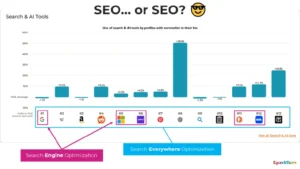
Search Everywhere Optimization expands on the classic SEO playbook. Instead of just worrying about Google rankings, you’re also thinking about visibility on YouTube, TikTok, TikTok Shop, voice assistants (like Siri or Alexa), generative AI tools (ChatGPT, Gemini), maps (Google Maps, Apple Maps), and more. In other words, you’re meeting your audience on every platform where they might “search” or browse. Think of it as SEO 2.0: the same core goal of getting found online, but supercharged for the era of AI and social search. As Rand Fishkin notes, “Search Everywhere Optimization = influence audiences in all the places they go to consume content about your topic”.
Why is this important? Well, search has already fractured. For example, Google research shows 40% of young people now go to apps like TikTok or Instagram for answers instead of a search engine. Meanwhile, generative AI is exploding – ChatGPT alone has about 800 million weekly users worldwide. Tools like Google’s new AI Overviews (Google’s experimental answers at the top of search results) have rolled out to hundreds of millions of users and will reach over a billion people by year’s end. Bottom line: your content needs to work on Instagram, TikTok, voice speakers, AI chatbots – everywhere your customers might look.
In this guide, we’ll break down what Search Everywhere Optimization really means, and how three pieces of the puzzle fit together: Traditional SEO (Search Engine Optimization), Answer Engine Optimization (AEO), and Generative Engine Optimization (GEO). You’ll learn why old-school SEO still matters, what AEO and GEO are, and how to weave them all into a strategy that works globally. Let’s dive in.
Traditional SEO: The Foundation of Being Found
First, let’s start with the basics. Search Engine Optimization (SEO) is the practice of optimizing your website and content to rank well in search engine results (like Google, Bing, DuckDuckGo, etc.). This involves things like choosing the right keywords, creating high-quality content, improving site speed, and earning backlinks. It’s been the bread and butter of online marketing for decades. Even as new platforms rise, traditional SEO remains crucial. After all, most people still begin some portion of their search journey on Google or a similar engine.
For global brands, this means applying good SEO practices for different regions and languages. That could involve optimizing for Baidu (China) or Yandex (Russia), or following Google’s standards in Europe. But the core idea doesn’t change: make your site technically sound, your content authoritative and useful, and your user experience smooth. On-page SEO factors like headings, meta tags, and structured data still help Google (and other engines) understand your content. Off-page signals like backlinks and social mentions continue to build your domain’s credibility. All these basics lay the groundwork so your brand can at least be in the mix when people search globally.
That said, the internet has changed. People don’t only type queries into Google anymore. They also ask their voice assistant at home, browse hashtags on social apps, and even have AI chatbots do the searching for them. The competition for attention is everywhere. This is where Search Everywhere Optimization comes in – it builds on SEO’s foundation and extends it to every corner of the web.
Answer Engine Optimization (AEO): Be the Answer
Enter Answer Engine Optimization (AEO). This is all about directly answering people’s questions on whatever platform they’re on. Think of voice assistants (like Siri, Alexa, Google Assistant) and search features (like Google’s “People Also Ask” or the new AI Overviews). These systems often give users quick answers without them having to click on a link. AEO means structuring your content so that it can be used directly as an answer by these engines.
In practice, that means writing your content to be clear, concise, and scannable. Bullet lists, FAQs, tables, and step-by-step instructions are gold for AEO. You want voice assistants and answer boxes to pick up your content. Key tactics include:
-
Direct answers first: Address common questions head-on. If someone asks “How do I tie a tie?” your content should answer that question in the first few sentences or a quick list.
-
Clear structure: Use headers, lists, and short paragraphs. This helps AI and voice systems “parse” your content easily.
-
Plain language: Use simple, machine-readable language. Avoid slang or overly clever phrasing, because assistants interpret content literally.
-
Schema and markup: Add FAQ or how-to schema markup on your pages. This tells Google and other engines that your content is formatted to answer questions, which can increase the chance it’s used in a snippet or voice answer.
For example, imagine you run a cooking blog. For the query “How to bake banana bread,” a smartly formatted AEO-optimized article would immediately list ingredients and steps. A voice assistant could recite that list. Or a Google AI Overview could extract bullet points as the summary. In fact, Google’s new AI Overviews often pull from pages that have clear, authoritative answers.
By focusing on AEO, you ensure your brand gets featured wherever people are looking for answers. This often means giving away more of the solution upfront (think FAQ sections and knowledge tables), but the payoff is appearing in those coveted answer snippets and voice replies. In many ways, AEO is a natural extension of SEO: instead of aiming solely for a “blue link,” you’re also aiming to be the blue text in the answer box.
Generative Engine Optimization (GEO): Optimizing for AI
If AEO is about answering queries directly, Generative Engine Optimization (GEO) is about being a trusted source for AI-generated answers. Tools like ChatGPT, Google’s Gemini (Bard), Bing Chat (Copilot), and Perplexity don’t give users a list of links; they synthesize answers from multiple sources. GEO means structuring your content so that these language models will cite your site when they generate an answer.
Think of GEO as SEO for a world where computers read and write the answers. Key GEO strategies include:
-
Authoritative content: Provide original research, data, and evidence-backed insights. AI systems tend to cite sources that show they’re credible. For example, Jasper.ai notes that “AI models prioritize factual, well-sourced information”. If you can pack your pages with unique statistics, charts, or case studies, you raise your chances of being the reference an AI model chooses.
-
Clear structure & metadata: Just like AEO, structuring content helps AI understand it. Use headings, bullet points, and schema. This isn’t just for humans – an AI will “look” at your headings and see it’s, say, a step-by-step guide, increasing the likelihood it will quote your list.
-
Citations and transparency: Show your sources and expertise. An AI is more likely to trust a site that clearly states its author, references, and data sources. If a model can verify your content, it’s more likely to include it in its response.
-
Relevance and clarity: Keep your content focused on specific topics or questions. A generative AI will look for the most relevant snippet for a query. If your page is tightly written around one subject, it has a better shot than a broad article.
In short, while traditional SEO competes for page ranking, GEO competes to be the content that AI pulls together. Jasper puts it this way: “Instead of competing for rankings, you’re competing to become the authoritative source that AI platforms trust enough to reference directly in their synthesized answers”.
For example, if someone asks ChatGPT, “What are the benefits of meditation?” a well-optimized article might be cited for its definition, bullet list of benefits, or research references. Every time the AI uses your content to generate an answer, you’re getting exposure (and credibility) — even if the user never clicks through to your site.
Search Everywhere in Action: Combining SEO, AEO, and GEO
Now that we have SEO, AEO, and GEO defined, let’s see how they fit together in Search Everywhere Optimization. Think of them as layers in one big strategy:
-
SEO (Search Engine Optimization): The classic layer. You still want strong keywords, quality backlinks, and fast pages so people can find you when they search on Google, Bing, or other engines.
-
AEO (Answer Engine Optimization): The next layer. You format and structure your content so that voice assistants, chat snippets, and answer boxes can pick it up instantly.
-
GEO (Generative Engine Optimization): The cutting-edge layer. You create highly credible, well-structured content so AI chatbots trust it enough to quote it in their responses.
These layers complement each other. In practice:
-
You write a thorough article on a topic (good for SEO).
-
Within it, you include a clear “definition” section or Q&A (good for AEO).
-
You also cite sources, add charts, and make it authoritative (good for GEO).
No one replaces the other. SEO is still the foundation, because an AI-generated summary often links back to high-ranking pages. GEO and AEO just expand the funnel of discovery. In fact, Semrush research shows using generative AI can expand overall search behavior – people try AI and then still go back to Google for more.
Below is a quick comparison:
-
SEO (Traditional) – Targets search engines (Google/Bing). Metrics: page rankings, organic traffic. Content: keyword-rich pages, backlinks.
-
AEO (Answer Engine) – Targets answer snippets and voice. Metrics: featured snippet appearances, voice search results. Content: direct answers, FAQ sections, structured lists.
-
GEO (Generative AI) – Targets chatbots and AI summaries. Metrics: citations by AI (e.g. how often ChatGPT cites you), mention in AI answers. Content: highly authoritative, evidence-based, well-structured content.
By treating all three as part of one strategy, you get the best of all worlds: your content ranks in search engines, shows up in quick-answer boxes, and even gets cited by AI helpers.
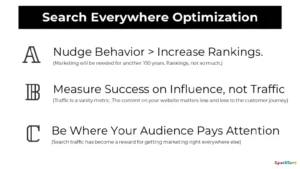
In fact, as one SEO thought leader quips, “Search Everywhere Optimization is good enough… the future we all know is coming”. In practice, that means shifting focus from “be number one on Google” to “be helpful everywhere”. According to SparkToro, the new mindset is less about chasing position one, and more about convincing your audience (and the algorithms across platforms) that your content is valuable no matter where it appears
Global Strategies for Search Everywhere
Because our audience is worldwide, a Search Everywhere strategy should be international. Here are some tips:
-
Think multilingual and regional. People in Asia, Europe, and the Middle East use different apps and languages. For instance, Baidu is big in China, Yandex in Russia, and even apps like WeChat or Kakao can be search platforms. Tailor content and keywords for each region.
-
Leverage local networks. Social search matters globally. Asians might search on LINE or Kakao, Europeans on Pinterest or Dailymotion. A brand on Instagram or LinkedIn in one region may find a different platform in another. Research where your target customers “hang out.”
-
Optimize for privacy-friendly search. Privacy-focused engines like DuckDuckGo have users worldwide. Ensure your content still shows up even when people are searching incognito.
-
Voice and AI in other languages. Voice assistants and AI chatbots are rolling out in many languages. Use natural, conversational language in each locale. For example, if you have a Spanish version of your site, structure FAQs so a Spanish-speaking Siri can read them easily.
-
Monitor global analytics. Use tools that track traffic from different regions and platforms. Google Analytics, similarweb, and even custom dashboards can show if traffic is coming from TikTok versus Google or ChatGPT referrals (yes, you can track some AI referrals via UTM links or GA4 data).
Remember, the principle of Search Everywhere is the same everywhere: be discoverable on every platform. Whether your reader is in North America browsing YouTube, in Europe asking Alexa, or in India chatting with Google’s Gemini, your content should feel at home.
Conclusion and Next Steps
In today’s world, search is everywhere, and your strategy needs to be too. Search Everywhere Optimization means broadening your thinking: keep your SEO fundamentals strong, but also make sure your content can be the answer no matter where people look. Use clear answers (AEO) and authoritative data (GEO) so voice assistants, AI chatbots, and social search tools send people your way.
It might feel like a lot, but take it one step at a time. Update one page with an FAQ list, optimize a video title on YouTube, or experiment with a smart speaker and see how it reads your site. The goal is simple: be helpful to you, your audience, whether they’re searching on Google, Siri, or ChatGPT.
Ready to reach customers in every corner of the web? Embrace Search Everywhere Optimization by making your content smart and versatile. For more tips on how AI is changing search, check out our AI Overviews blog post, and when you’re ready, connect with Elevatech Digital – we’ll help craft an omni-channel search strategy for your brand. The future of search is now, and it’s everywhere.
Frequently Asked Questions (FAQs)
-
What exactly is Search Everywhere Optimization?
It’s the strategy of making your content easy to find across all platforms where people search or browse – not just Google. This includes social media, voice assistants, app stores, maps, and AI chatbots. Think of it as “SEO on steroids” for today’s multi-channel world.
-
How do AEO and GEO fit into this?
AEO (Answer Engine Optimization) focuses on making your content answer-ready for voice assistants and answer boxes – clear Q&A format, FAQs, etc.. GEO (Generative Engine Optimization) focuses on building highly authoritative content that AI chatbots like ChatGPT and Bing Chat will cite when giving answers. Together with traditional SEO, they form a full-spectrum search strategy.
-
Is this just hype, or do people really search on other platforms?
It’s very real. For example, Google reports about 40% of young people now use apps like TikTok and Instagram as search engines. And a recent study by Nielsen Norman Group found users are already mixing ChatGPT and Google in their searches. The tools are there, and users are embracing them globally.
-
Does Search Everywhere Optimization replace traditional SEO?
Not at all – it builds on it. Traditional SEO remains crucial as the foundation. If your site doesn’t rank, it won’t be found by AI either. Search Everywhere simply says: once you have that foundation, expand your reach to include answers and AI. All three strategies work in concert.
-
What’s one quick thing I can do to start?
Begin by auditing your content for question-focused sections. Can you add a clear FAQ or step-by-step guide to your main pages? Are your headings and bullets formatted nicely? Also claim and optimize your profiles on platforms like Google Business, social media, and video sites. The key is to start thinking beyond Google.