

Imagine launching an amazing new app and watching it sink into obscurity. In a world where nearly 5 billion people owned smartphones by 2024 and millions of apps compete for attention, standing out isn’t optional, it’s survival. App Store Optimization (ASO) is the secret sauce that makes your app discoverable and enticing across the globe. ASO means fine-tuning your app’s title, keywords, visuals, and reviews so that when users search in app stores, your app pops up. It’s like SEO for apps: optimizing every detail of your App Store and Google Play listing to improve visibility, conversion rates, and ultimately downloads. In 2026’s hyper-competitive market, mastering ASO is a must-have growth strategy for any app developer or marketer.
What is App Store Optimization?
App Store Optimization is the ongoing process of improving an app’s store listing to increase its visibility and appeal, which in turn drives more organic downloads.
App store optimization involves optimizing metadata (app name, subtitle, keywords) and creative assets (icon, screenshots, promo video) so that the app ranks higher in store search results and convinces users to install it. Think of it as marketing your app inside the Apple App Store and Google Play Store. An optimized listing shows up for relevant searches, much like how a well-optimized website appears for Google queries. In fact, ASO is often described as the “SEO for apps”, because it focuses on organic discovery without paid ads. Unlike general SEO, which targets Google and Bing, ASO deals exclusively with app store search algorithms. Both ASO and SEO share one goal, helping people find your product – but each works in a different ecosystem.
Core Components of App Store Optimization
1. On-Page App Store Optimization
On Page ASO covers everything you put on your app listing, the title, subtitle, description, and keyword fields. For example, including high-volume keywords in your app’s name and description boosts search ranking. Other on-page factors include your app icon, screenshots, and promo video (if supported). Polished graphics and a compelling preview video increase conversion rates from store visitors to downloaders.
2. Off-Page App Store Optimization
Off Page ASO factors outside your control, like ratings and reviews. Apps with lots of positive reviews and high ratings rank better, as app stores view them as higher quality. Encouraging users to rate the app and responding to feedback can improve these off-page signals.
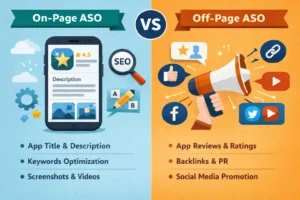
Ultimately, app store optimization is a mix of keyword strategy (like Modern SEO) and conversion optimization (like marketing). Small changes can produce big gains: even updating your title or screenshot can boost search position and downloads over time. As AppTweak explains, ASO is a holistic process spanning metadata, visuals, ratings, and A/B tests to maximize visibility and appeal. In short, ASO helps your app stand out in a crowded marketplace.
Why App Store Optimization (ASO) is Crucial for App Growth
App Store Optimization is essential because it directly impacts how many people find and install your app. Better App Store Optimization means higher search rankings, more downloads, and lower marketing costs.
-
Boosts Visibility and Downloads: As Adjust notes, “ASO is vital for your app’s discoverability, conversions, and user quality”. By optimizing keywords and listing content, your app is more likely to surface when users search in the App Store or Play Store. Apps that rank on page one get dramatically more installs. AppsFlyer uses a great analogy: being #1 in search is like having your store on the busiest street, while being on page 5 is like a hidden alley. You want to be on that busy corner!
-
Improves Conversion Rate: ASO isn’t just about being found – it’s also about convincing users to hit “Download.” High-quality screenshots, an engaging video, and a clear, benefit-focused description make your app look trustworthy and compelling. For example, updating your app icon or screenshot portfolio can significantly increase the percentage of store visitors who install the app. Better conversions mean every impression is more valuable.
-
Lowers User Acquisition Costs: Organic installs from app store optimization are “free” compared to paid ads. By funneling more users through search, you spend less on user acquisition budgets. Adjust highlights that good ASO leads to more impressions turning into paying users, while also reducing acquisition costs and improving lifetime value. In 2026, with stricter privacy rules (like limited tracking IDs) raising paid ad costs, organic growth via ASO is more important than ever.
-
Keeps You Competitive: The app marketplace is enormous and getting bigger. In 2024, developers earned a staggering $1.3 trillion in sales on the App Store, and hundreds of billions of apps are downloaded each year. Yet only a tiny fraction of apps gain real traction – TekRevol notes that for every 1,000 apps launched, only one gets significant attention. ASO is the tool that helps your app be that one in a thousand. Without it, even great apps can languish unseen.
It all adds up: optimizing for app store search is foundational to growth. As an ASO guide puts it, app stores now host millions of apps, and competition for those top spots is fiercer than ever. A solid app store optimization strategy ensures your app doesn’t get lost in the crowd.
Key App Store Optimization (ASO) Factors: Elements That Make or Break Your Listing
Effective App Store Optimization means paying attention to all the elements of your store listing. Here are the main factors to optimize:
-
App Title & Keywords: The app’s title (and subtitle on iOS) is the most important on-page signal. Include your primary keyword naturally in the title. Use all available keywords in your Play Store tags and iOS keyword field. Regular keyword research and competitor analysis will keep your keyword mix fresh.
-
Description Copy: Write a concise, clear description that highlights your app’s benefits. On Google Play, the full description also influences rankings, so sprinkle keywords here too. Structure the description to answer likely questions (What does the app do? Why is it better than others?). This helps with voice search and featured snippets in search results.
-
Icon and Screenshots: Eye-catching visuals are an ASO must. A distinctive app icon grabs attention in search results. High-quality, annotated screenshots show the app’s main features. Apps with well-designed screenshots see higher install rates. Consider showcasing the UI, positive reviews, or a ‘before/after’ usage scenario.
-
Promo Video: If possible, include a short video demo in your App Store listing. Videos can boost conversions by giving users a quick tour of the app experience.
-
Ratings & Reviews: Encourage happy users to leave positive reviews. High star ratings and recent reviews improve ranking and trust. Responding courteously to feedback (good or bad) shows engagement. In fact, App Store algorithms factor review frequency and sentiment into rankings.
-
Frequent Updates: Regularly update your app with new features and improvements. Updates reset the app’s relevancy clock in the store, and can bring a temporary boost in visibility. Mention updates in the “What’s New” text to re-engage existing users as well.
-
A/B Testing: Use built-in tools like Apple’s Product Page Optimization to test variations of icons or screenshots on small user groups. Data from these tests shows which assets lead to more downloads. The winner can then be rolled out to all users to maximize conversion.
By refining each of these factors, ASO works its magic: better keyword matches for more searches, and more persuasive listing elements for higher conversions. It’s a comprehensive approach, AppTweak advises focusing on metadata and creative elements together.
Global Mobile Market Trends Driving ASO
The world’s appetite for mobile apps continues to explode, and app store optimization lets you tap into this global user base. With billions of smartphone users worldwide, even a niche app can find an audience if optimized correctly.
-
Smartphone Adoption: Mobile is truly global. About 4.9 billion people owned smartphones in 2024, and projections hit 5.65 billion by 2026 According to global telecom data published by the U.S. government’s communications statistics portal. That’s over 70% of the planet’s population holding a device in their pocket. Every region is adding new users – for example, India added 120 million smartphone owners in 2024.
-
OS Market Share: Android dominates worldwide (around 73% of devices as of late 2025) while iOS holds about 27%. However, iOS is disproportionately strong in markets like North America and Western Europe. This means your app store optimization strategy must span both ecosystems. For Android apps, an effective ASO on Google Play is critical to reach the Asian and African markets, while on the App Store it’s key for markets with many iPhone users.
-
App Downloads & Revenue: Consumers downloaded an astounding over 137 billion apps in 2024, and Sensor Tower projects downloads will reach 324 billion by 2026. Apps generated roughly $935 billion in revenue in 2024, with growth toward a $1 trillion annual market expected by 2026. These figures underscore the sheer scale: an optimized app can capture its share of trillions of dollars in global spending. Apple alone facilitated $1.3 trillion in App Store sales in 2024, highlighting the opportunity.
-
User Engagement: People spend hours on apps each day (4.9 hours on average, with 89% of phone time in apps). The typical smartphone user interacts with 30 apps per month. This means high engagement – if your app ranks well, users will see it repeatedly, increasing downloads.
The takeaway: Mobile is everywhere. Each market (North America, Europe, APAC, Middle East, etc.) has unique trends (e.g. certain app categories or features), but all share a common dynamic: apps win attention via search. ASO leverages these trends. For example, offering localized keywords and descriptions can capture users searching in their native language. In emerging markets where data is cheaper and phones are cheaper, game and social apps might boom; in developed markets, productivity and streaming apps might dominate. Customizing your listing to these regional nuances – from keyword choice to screenshot style – is part of Generative Engine Optimization: structuring content so AI and users in each locale understand it.
Global App and Phone Market Highlights (2024–2026)
| Metric | 2024 | 2025 (proj) | 2026 (proj) |
|---|---|---|---|
| Smartphone Users | 4.88 billion | 5.28 billion | 5.65 billion |
| Global App Downloads | 277 billion | 299 billion | 324 billion |
| Mobile App Revenue | $935 billion | (rising) | >$1.0 trillion |
| Apple App Store (apps available) | 2.2 million (2022) | – | ~2.0 million |
| Google Play Store (apps) | 3.5 million (2022) | – | 2.87 million |
| Android OS Market Share (Worldwide) | 71.5% (2024) | – | ~73% (Nov 2025) |
| iOS Market Share (Worldwide) | 27.8% (2024) | – | ~26.8% (Nov 2025) |
This data shows how huge and fast-growing the app economy is. In practice, it means app makers in any region have a massive user base to target, if they rank well. app store optimization is the bridge between your app and those billions of potential users worldwide.
Emerging ASO Trends in 2026
The app store landscape evolves constantly. By 2026, several key trends are shaping ASO:
-
AI-Driven Optimization: Artificial intelligence and machine learning are increasingly used for ASO. For example, AI tools can analyze vast amounts of app store data to suggest high-performing keywords or design more effective screenshots. Even generative AI can draft app descriptions or simulate user reviews to guide improvements. Treat AI as a creative partner: use it to generate ideas, then validate them with real A/B tests. These “AI applications” speed up insight and make optimization data-driven.
-
User Intent and Voice Search: Modern app store search engines (and voice assistants) use intent signals. Users may ask Siri or Google Assistant for “best recipe apps” or “exercise tracker”. Make sure your app listing answers likely questions directly. Use natural, conversational phrases in descriptions, and structure text so that assistants can pull short answers. This is similar to optimizing for featured snippets or zero-click answers. Answer early – e.g. a subheading like “What this app does” can help voice assistants and snippet boxes parse your content.
-
Localization & Personalization: The global audience expects apps in their own language and tailored to their locale. Effective ASO now means fully localizing your title, description, keywords, and even screenshots for each country. For instance, an economy-focused tagline might resonate in one market, while a lifestyle hook works in another. Use geo-specific search terms (“AI photo editor app UK” vs “AI photo editor app India”) to capture regional trends. A one-size-fits-all listing misses half the market.
-
Creative A/B Testing: Stores now allow multiple creative assets (like iOS’s Custom Product Pages). Marketers should continuously test different icons, screenshots, and videos to see what converts best. Small changes (color, text overlay, image sequence) can yield big gains in download rate. In 2026, high-performing apps are those that relentlessly experiment and refine their creatives based on user response.
-
Privacy-First Strategies: With stricter privacy rules (like iOS’s App Tracking Transparency) many targeting signals are limited. App store optimization benefits from this shift because it relies on organic, first-party data (search and downloads you actually earn). Focus on building trust: highlight privacy and quality (e.g. “NSA-approved encryption” or “No ads”) in your copy if relevant. Apple’s forums even note that “privacy-first” is a top ASO trend, emphasizing genuine user value over intrusive tactics.
-
Analytics and Adaptation: Finally, ASO requires ongoing analytics. Use store analytics (App Store Connect, Google Play Console) and third-party tools to monitor search rankings, keyword performance, conversion rates, and user behavior. Regularly update your strategy based on these insights. For example, if you notice a spike in a new search term, integrate it quickly. The market moves fast, and app store optimization must move with it.
These trends show that app store optimization in 2026 is as much about technology and user experience as it is about keywords. Leveraging AI Overviews and data helps you stay ahead, while focusing on real users (intent, localization, privacy) earns trust and downloads. In short: good ASO is user-centric and adaptive.
Integrating ASO Into Your Growth Strategy
ASO should be part of every app’s growth plan from day one. Make it a continuous process, research keywords, optimize assets, and track metrics. Combine app store optimization with your marketing campaigns and product roadmap for the best results.
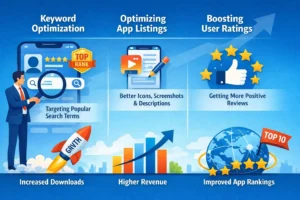
Implementing app store optimization effectively often follows these steps:
-
Research & Planning: Begin by researching relevant keywords and competitors. Tools like Google Play Console’s search console and App Store Connect suggest search terms, or use ASO platforms. Identify the high-volume keywords your potential users use (e.g. “photo editor”, “language learning”). Plan to update your app’s name, subtitle, and description around these terms.
-
Optimize Metadata: Apply your research to the listing. Craft a clear, compelling app title containing the main keyword. Fill out all subtitle/short description fields with secondary keywords. Write bullet-point descriptions of core features, then a paragraph of details. Remember to tailor this for each region’s language and style.
-
Improve Visuals: Refresh your icon and screenshots. For example, if early adopters didn’t respond well, try a new color scheme or imagery. Use captions on screenshots to highlight key features (“AI-powered filters”, “Offline mode”). Ensure your app preview video (if available) is short, punchy, and shows actual in-app footage.
-
Gather Reviews: Prompt satisfied users to leave a review. You could ask in-app at a natural point (“Enjoying the app? Tap here to rate us!”). Respond politely to reviews and fix critical issues mentioned. A stable 4+ star rating significantly boosts conversions and ranking.
-
Monitor & Test: After changes, monitor the results. Did your rank for target keywords improve? Are downloads increasing? Use A/B tests where possible (e.g. iOS Product Page Optimization tests) to compare creatives. Adjust your approach based on data – for instance, if one keyword isn’t working, try synonyms.
-
Stay Updated: ASO isn’t one-and-done. Whenever you update the app (new features, supports, content), treat it as another chance to tweak your listing. Also watch for store algorithm changes. Apple or Google may tweak search rules or introduce new features; staying informed (through developer news or forums) lets you pivot quickly.
By weaving app store optimization into your ongoing app marketing, you ensure continuous improvement. Many developers overlook ASO after launch, but that’s a missed opportunity. In contrast, apps that iteratively refine their listing (based on real user behavior and store trends) consistently gain more organic installs over time.
Conclusion
App Store Optimization isn’t a nice-to-have bonus – it’s essential for mobile app success in 2026. With billions of users out there and millions of apps vying for attention, the apps that grow fastest are those that master ASO. Key takeaways:
-
Optimize your listing globally: use the focus keyword “App Store Optimization” in your strategy, but more importantly use targeted keywords for your app’s niche.
-
Balance discovery and conversion: Improve search rankings through smart metadata, and make your app irresistible with great visuals and a compelling description.
-
Embrace data and technology: leverage AI tools, test creatives, and keep up with store trends to stay ahead.
-
Think globally: tailor your ASO for each region (language, culture, dominant platform) to reach worldwide audiences.
ASO requires patience and persistence, but the payoff is huge: more organic downloads, better user acquisition ROI, and ultimately a stronger, global user base. Don’t let your app be the hidden alley restaurant, put it on the busiest street of the app store!
Ready to level up your app’s visibility? Contact Elevatech Digital today, and start applying these ASO strategies. For expert guidance on optimizing your app store presence and crafting a winning app marketing plan, our team is here to help. We combine technical know-how with creative flair to ensure your app shines in every market.
Frequently Asked Questions
-
What is App Store Optimization (ASO)?
ASO stands for App Store Optimization. It’s the process of improving an app’s listing (title, description, keywords, visuals, etc.) so it ranks higher in app store searches and attracts more downloads. Think of it as search engine optimization but specifically for the Apple App Store and Google Play. By optimizing for relevant search terms and boosting your conversion elements (icon, screenshots), ASO drives organic growth.
-
How does ASO differ from SEO?
Both ASO and SEO aim to improve visibility, but ASO applies inside app stores, while SEO targets web search engines. ASO uses app-specific factors like app name keywords, ratings, and in-app purchase data. SEO, by contrast, involves website content, backlinks, and technical site factors. In practice, a web search for an app may even show app store listings, but the optimization techniques differ. For apps, ASO is primary; SEO complements it by ensuring your app’s website can be found on Google.
-
Why is ASO important for my app’s growth?
In 2026, discoverability is everything. ASO is important because it puts your app in front of users who are already searching for what you offer. Improved ASO leads to higher app store rankings, which means more visibility. More visibility + better listing = more downloads. According to industry experts, good ASO directly boosts installs and can lower your marketing costs. Without ASO, even great apps can remain invisible.
-
Can ASO help in different regions around the world?
Absolutely. ASO should be tailored to each target market. For example, you should use the local language and cultural nuances in your app’s title and description. Android dominates in Asia and emerging markets, while iOS leads in the US and Europe, so you might emphasize Google Play listing optimization in one region and App Store optimization in another. Also consider region-specific keywords and imagery. Apps that localize and optimize for each region see much stronger growth globally.
-
How often should I update my ASO strategy?
ASO is an ongoing process. You should revisit and tweak your listing whenever you release app updates or see changes in performance. Monitor your keyword rankings, download rates, and competitor moves regularly (monthly or quarterly). Use A/B tests to refine graphics, and adjust keywords if search trends shift. In short: continually. The app stores and user tastes evolve fast, so effective ASO is never “set it and forget it.”