

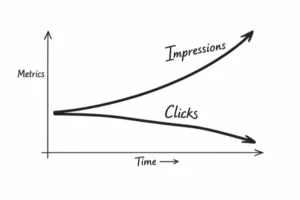
Imagine asking Google a question and instantly getting a clear answer without clicking any link. This is no sci-fi: by 2026 about 30% of search results pages feature an AI-generated answer box. For example, graph studies show search impressions rising while click-through rates fall, as more users see answers at the top of results. Modern SEO isn’t dead, it’s evolving. In fact, search engines now act like smart assistants, analyzing meaning, context, and user intent. In this new era, how algorithms work is very different from the past. Let’s explore the core of Modern SEO, unpack how today’s algorithms really rank content, and what you need to do to thrive in a world dominated by AI-driven search.
Search engines in 2026 don’t just match keywords – they understand topics. Instead of punishing sites that use AI or new tech, modern algorithms reward meaningful content. As one expert puts it, Modern SEO centers on the “people, places, concepts, and things” (entities) that give content real context. In practice this means focusing on semantic SEO – organizing your content around topics and intent, not just repeating exact phrases. For example, a page about “best CRM software” would cover customer relationship concepts, use cases, and related tools, rather than endlessly repeating that keyword. This broader approach helps AI-driven systems “understand” your page’s purpose, keeping it eligible for top results.
How Search Algorithms Work Today (Modern SEO in 2026)
At their core, search engines still aim to “organize the world’s information and make it universally accessible,” but the way they do this has shifted into overdrive with AI. Google’s Search Central explains that its automated ranking systems evaluate hundreds of factors and signals across billions of pages to deliver relevant results. This means the engine looks at everything from content quality and freshness to site performance and user satisfaction. In simple terms, modern search algorithms work on two levels:
Page-Level Signals in Modern SEO
Each page is analysed for:
- Relevance to search intent
- Contextual meaning
- Structured data
- Page speed
- Mobile usability
- Content clarity
- Semantic coverage
Modern SEO still requires:
- Crawlable content
- Indexable pages
- Clear hierarchy
A technically weak site cannot compete in Modern SEO, regardless of how strong its content is.
Site-Level Signals in Modern SEO
In 2026, Modern SEO prioritizes:
- Brand recognition
- Author credibility
- Real-world expertise
- Topical authority
- Trust signals
- Consistent publishing
Search engines now evaluate both:
- What you publish
- Who is publishing it
This shift is the backbone of Modern SEO strategy worldwide.
Key Modern SEO Ranking Signals in 2026
Unlike older SEO strategies, Modern SEO ranking signals now include:
| Modern SEO Signal | Why It Matters |
|---|---|
| Content Depth | Answers complete user intent |
| E-E-A-T | Demonstrates expertise |
| Technical Performance | Enables crawling |
| User Experience | Improves engagement |
| Structured Data | Helps AI understand meaning |
| Entity Relevance | Improves contextual accuracy |
In Modern SEO, nothing has changed more than how ranking signals are interpreted.
Semantic SEO & Entity-Based SEO in Modern SEO
Imagine search engines as librarians who have read every book in the world. They no longer look for exact words on a page; they look for understanding. This is the principle of semantic search. In practice, it means focusing on concepts and intent. Semantic SEO (often called context-driven SEO) ensures your content explains ideas clearly and connects them, rather than shoehorning keywords. As one expert summary notes: “Semantic SEO focuses on helping search engines understand what a page is about by covering topics, concepts, and intent instead of repeating keywords.”.
-
Entities: Modern search uses a knowledge graph of entities (distinct people, places, things). For instance, “Barack Obama” is an entity (person), “iPhone” is a product entity, “climate change” is a concept entity. Google and others use these to understand context. Entity-based SEO means clearly defining these core terms in your content. If you mention “iPhone”, explain it’s Apple’s smartphone, its features, history, etc. This signals authority to AI. As one source explains, optimizing for entities builds authority beyond keywords.
-
Intent: Effective SEO now demands a deep match to user intent. Algorithms interpret why someone searched, not just the literal words. A query like “best CRM software” has many intents: learning what it is, comparing tools, finding pricing, etc. You must deliver the specific answer the user is seeking. If your page doesn’t solve that exact need, AI signals (user behavior) will cause it to slip in visibility.
-
Context: Algorithms look at how ideas on your page relate to each other. Good content explains related concepts naturally. For instance, an article about “email marketing” might cover A/B testing, personalization, campaign metrics, and integration. When these topics appear together, AI sees depth and relevance. A page missing such context appears shallow, even if it uses the keyword.
Practical Steps for Semantic Modern SEO
To succeed in Modern SEO, you must:
- Cover all subtopics of your main subject
- Use structured schema markup
- Interlink related content
- Define entities clearly
- Answer related questions directly
In essence, Entity-Based SEO is the future: it ties together content around real-world subjects instead of just keywords. As noted by experts, moving to entity-focused optimization “will not future-proof SEO by 2026 with just keyword stuffing. Entities matter because they improve contextual relevance, support Google’s Knowledge Graph, and increase exposure in conversational search.”
The Rise of AI in Modern SEO (AEO & GEO)
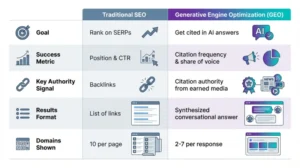
By 2026, you’re not just competing with 9 other websites for the #1 spot, you’re competing with the search engine itself and its AI assistants. We’ve entered the era of Answer Engines and Generative Search. Google’s new AI Overviews, ChatGPT, Perplexity, Claude, and others often provide direct answers by citing sources rather than showing many blue links. This shift has given rise to Answer Engine Optimization (AEO) and Generative Engine Optimization (GEO), as outlined by industry leaders.
-
Answer Engine Optimization (AEO): This means optimizing to get included in AI-generated answers. Microsoft’s AI research emphasizes that brands must be found and recommended by AI systems. In practice, AEO involves structuring content to directly answer common questions and ensuring accuracy so that AI tools pick you as a trusted source. For example, adding concise summaries and exact answers at the top of your pages improves AEO chances.
-
Generative Engine Optimization (GEO): GEO takes AEO a step further for systems like ChatGPT, Bing Chat, and Google’s AI Mode. Instead of being a link to click, GEO aims for your brand to be explicitly mentioned in the AI’s answer. Search Engine Land defines GEO as “structuring your content so that AI-powered search platforms…can retrieve, cite, and recommend your brand when answering user questions.”. In other words, you want to be one of the few sources an LLM cites in its response.
Best Practices for AI-Driven Modern SEO
-
Front-load answers: Begin articles with clear, concise answers or summaries of the main question. This lets AI quickly ingest and cite them.
-
Use structured formats: Lists, tables, bullet points, FAQs, and numbered steps are favored by LLMs. Write in a question-and-answer style where possible.
-
Cite authority: Since AI prefers authoritative sources, include credible data, case studies, and references within your content. Storytelling with real examples makes your content “quotable” to AI.
-
Diversify signals: Publish across multiple channels (blog, YouTube, social). AI engines often pull content from social platforms, forums, and news. For instance, AI answer boxes increasingly cite YouTube for product info. Also mark up your images and videos with schema, as multimodal search is now standard.
-
Optimize for metrics of the new era: Instead of just page views, track AI Presence Rate (share of queries where you appear in AI answers) and Citation Authority (how often you are named). These indicate success in a world where raw traffic may drop but influence grows.
An example analogy: Traditional SEO vs. GEO. Traditional SEO is like trying to be the top entry in a phone book for your industry; GEO is like being one of the trusted experts the operator suggests when someone asks a question.
Key Strategies for Modern SEO Success
Given these changes, what should you do to optimize effectively? Here are the core strategies every global site should employ in 2026:
-
Focus on quality and depth: Write as if you’re explaining the topic to a smart friend. High-ranking content now “feels written by someone who understands the topic deeply” and respects the reader’s time. Cover each subject comprehensively with clear language. Avoid filler and fluff.
-
Build topical authority (clusters): Instead of creating isolated pages for single keywords, create clusters of related articles that interlink and cover subtopics. Search engines evaluate topical authority across a site. A blog that consistently covers one theme (with a hub page linking to in-depth articles) sends stronger signals than scattered posts. Internal linking is your friend: it helps AI see how your content pieces connect.
-
Leverage structured data: Use schema markup extensively. Mark your business, products, events, FAQs, and reviews. As one guide notes, structured data is a fundamental building block of entity SEO. It literally tells AI, “This page is about [Entity], which has [attributes].” Rich results (knowledge panels, sitelinks, etc.) also help brand visibility.
-
Prioritize user experience: Continue improving page speed, mobile usability, accessibility, and on-page navigation. Core Web Vitals and mobile-friendliness are still direct ranking factors. Beyond that, they improve user satisfaction signals. If users swiftly find what they need on your site, algorithms detect that.
-
Maintain fresh, trustworthy content: Update important pages regularly to stay accurate. Freshness signals matter more for timely topics, and outdated info can hurt trust. Also, add clear date stamps and author info, algorithms in 2026 may de-prioritize content without evidence of real authorship or updates.
-
Earn authoritative citations: Traditional link-building still helps, but think beyond backlinks. Cultivate positive mentions in reputable news, industry sites, and social buzz. AI models increasingly factor in brand sentiment and mentions. As one report shows, ~34% of AI citations can come from PR/earned coverage. Aim to become the go-to expert quoted by others.
Remember: Technical SEO is still foundational. Nothing beats an error-free, lightning-fast site that search bots can crawl easily. Use tools like llms.txt (AI-friendly robots.txt) if needed to guide crawlers. But don’t get so caught up in the latest tool that you neglect the basics: If AI bots can’t reach or read your content, you can’t compete in AI search.
Global Optimization in Modern SEO
Modern SEO is a global game. Search engines worldwide (Google, Bing, Baidu, Yandex, Naver, etc.) are all layering AI into their results, and users in each market have specific needs. For international SEO in 2026, the key is clear differentiation and entity consistency across languages. Here’s what that means:
-
Localize with real differences: Simply translating content isn’t enough. AI can detect when multiple pages answer the same intent in different languages and will often choose one as the “master” answer. In fact, when two pages answer the same question, “AI systems detect semantic equivalence and select a single representative version, regardless of language”. If your site has English and Spanish versions of identical content, AI might only use one. To avoid this, add genuine market-specific details: local pricing, legal disclaimers, examples, or case studies. These signals tell AI, “This page serves a particular region,” so it will consider all versions.
-
Maintain entity clarity across markets: Your brand or organization should be clearly defined in every version. Search algorithms ask, “Who is this organization? Which market is this?”. Use consistent naming, maintain a recognizable logo and tagline, and describe local offices or representatives in each language. Structured data (Organization, LocalBusiness schema) should be accurate and locale-specific. Each local page must reinforce the global entity while expressing legitimate local distinctions (e.g., “Acme Corp – India Branch”). This helps AI know that www.example.com/in and www.example.com/us represent the same brand at different levels.
-
Use Hreflang but don’t over-rely: Implementing hreflang tags is still good practice for traditional search, but in AI-powered answers it may have limited effect. AI may pick content before applying hreflang signals. So, focus on making each language’s page strong on its own (good content, local signals) rather than expecting a tag to fix duplication.
-
Local credibility matters: In some countries, local expertise signals (authors with local credentials, reviews from local customers, partnerships with local organizations) can boost trust in AI’s eyes. In sensitive industries (health, finance, legal), emphasize local compliance and authority so AI knows your page is validated in that region.
In summary, Great global SEO means truly thinking local. AI unifies content across borders, so only genuinely unique, market-specific pages stand out. Pages must “signal their location” through content and data, not just language. When done right, you’ll be prepared to be the source AI cites in each region’s answers.
Conclusion
Modern SEO in 2026 is not about tricking algorithms, it’s about meeting them halfway. Search now understands language like a human: it values clear, coherent answers and trusted sources. The what of SEO remains the same (useful content that satisfies user queries) but the how has shifted. You must think in terms of topics, context, and credibility rather than isolated keywords. Technology like AI and voice assistants has become another way people search for information, so broadening your strategy to include AEO/GEO is critical.
To excel in Modern SEO, keep these takeaways in mind: focus on semantic richness (entities and context), build real authority (E‑E‑A‑T), maintain rock-solid technical health, and craft content that answers questions head-on. Remember that AI-driven results reward clarity and trust. As Google’s guidance shows, the foundation still lies in crawlability and serving the user.
In the end, SEO in 2026 is about being the trusted voice that both humans and AI assistants turn to. Keep refining your approach, and if you’re ready to elevate your global visibility, partner with Elevatech Digital to build a future-ready Modern SEO strategy that earns citations, drives authority, and wins in the AI-powered search era.
Frequently Asked Questions
-
What exactly is Modern SEO?
Modern SEO is optimizing content for today’s AI-powered search environment. It emphasizes topic depth, user intent, and entity clarity instead of just keywords. This means focusing on quality, context, and trust signals (E‑E‑A‑T) so that search engines understand and reward your content.
-
How do search algorithms work differently now?
Search engines now use advanced AI models to interpret queries and content. They analyze hundreds of signals – from page structure and semantic context to brand authority and user behavior. Importantly, modern algorithms often provide direct answers (AI Overviews) on the results page, so ranking #1 no longer guarantees traffic. The focus is on satisfying user needs, which AI measures through engagement and content relevance.
-
What is semantic SEO, and why should I care?
Semantic SEO means optimizing for meaning and intent. Instead of repeating exact keywords, you write content that thoroughly covers a topic (entities and subtopics) so the search AI “understands” your page. This makes your content eligible for voice search answers and AI summaries. In short, it’s the difference between matching words and actually teaching the subject – and teaching wins in 2026.
-
How does AI (like ChatGPT or Google’s AI) affect SEO?
AI changes both how people search and how rankings are calculated. Many users now get answers from AI chatbots or AI-enhanced results without clicking websites. So, SEO now includes Answer Engine Optimization (so your content is picked as the answer) and Generative SEO (so AI will cite your brand). Instead of chasing clicks, you optimize for AI systems to recognize and recommend your content.
-
What should I focus on first in 2026 SEO?
Begin with user intent and expertise. Identify the key questions your audience is asking, then answer them better than anyone else. Ensure your site passes technical muster (fast, secure, mobile). Build your brand’s authority by earning mentions in reputable places. And pay attention to AI trends: use structured data, publish across platforms, and monitor how often AI answers cite you. By blending classic SEO fundamentals with semantic, AI-aware tactics, you’ll succeed globally in the modern search landscape.