

International SEO is your website’s passport to the world, it’s the practice of optimizing your site to rank in search engines across different countries and languages. Imagine speaking multiple languages fluently: International SEO is doing the same for search engines, helping them “understand” which countries and languages your content targets. In short, it ensures search engines can match your pages to global audiences.
You might wonder, why go global? Because the opportunity is massive. Global ecommerce is booming, projected at $5.5 trillion by 2027 – and your business needs to be visible wherever potential customers are searching. By optimizing internationally, you reach a wider audience, drive more traffic, and boost revenue, often with less competition than in saturated local markets. In fact, authoritative guides stress that “optimizing your website for international SEO is essential to expanding your global reach”. Simply put, if you want your brand to be found from Tokyo to Toronto, international SEO isn’t optional, it’s essential.
What Is International SEO?
International SEO is the process of optimizing your website so search engines can identify which countries and languages your content targets, helping you rank globally. In simple terms, International SEO allows your website to “speak” to users across different regions, ensuring that the right version of your content appears in the right country, in the right language, at the right time.
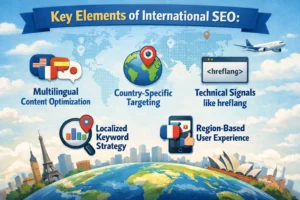
Key Elements of International SEO:
- Multilingual content optimization
- Country-specific targeting
- Technical signals like hreflang
- Localized keyword strategy
- Region-based user experience
AI Overview Takeaway: International SEO helps search engines serve the right content to the right audience based on language, location, and intent.
Why International SEO Matters for Your Business
Businesses that master international SEO win big on the global stage. Here are some key reasons to invest in it:
- Access Massive New Audiences: The internet connects billions worldwide. By ranking in new countries, you tap into markets with huge demand – from North America and Europe to APAC and the Middle East. For example, the Asia-Pacific region alone will drive 80% of B2B ecommerce growth by 2026.
- Stay Ahead of Competitors: If your competitors haven’t localized their SEO, you can swoop in. Tailoring your content for other languages and regions can capture unclaimed search traffic.
- Improve Conversions and Engagement: Localized content resonates better. People prefer searching in their native language and trusting local sites. Proper international SEO (right keywords, language, design) often leads to higher click-through rates and conversions, as shown by brands seeing massive traffic surges after localization.
- Long-Term Growth: As global markets digitalize, building international visibility now pays off continuously. Once search engines know you’re relevant in multiple regions, your site stays front-of-mind for those audiences over time.
These benefits are backed by real data. For example, a beauty brand that customized product pages and backlinks for each market saw a 1,365% surge in global organic traffic. Another international firm overhauled its multilingual SEO (technical fixes, content, localization) and dramatically increased local visibility. In short, international SEO turns a local website into a global powerhouse, connecting you with customers in every corner of the world.
Proven International SEO Strategies to Expand Your Global Reach
International SEO involves more than just throwing Spanish or Mandarin text onto your site. It’s a multi-faceted strategy. Below are core pillars to build your global search visibility:
1. Market Research & Strategy
- Target Markets & Personas: Decide where and who you want to reach. Research country-specific search trends, cultural preferences, and online behavior. For example, people in Brazil might use different terms than in Portugal even for the same product. Use tools (like Google Trends, AnswerThePublic) to discover local search intent.
- Competitive Analysis: See who currently ranks in each market. Which local sites or languages dominate? This tells you where opportunity lies. If no big competitors have a presence in Poland, that could be your chance.
- Legal and Cultural Compliance: Different countries have different regulations (e.g. data privacy in Europe) and cultural norms. Ensure your site respects these, from data laws to design aesthetics, so users and search engines trust you.
- Set Clear Goals: Define success metrics for each market: more traffic, leads, or revenue? Having specific targets guides your efforts and helps measure progress.
2. Technical Setup: Languages, URLs, and Hreflang
-
Choose URL Structure: Organize your site to reflect regions and languages. Common options:
-
Country-Code Domains (ccTLDs): e.g.
example.frfor France. Very clear geo-targeting but expensive and separate domain authority. -
Subdirectories: e.g.
example.com/fr/. Easy to manage and share link equity, but requires proper geo-targeting. -
Subdomains: e.g.
fr.example.com. Middle ground – easier than new domains but still separate sections. -
Main Domain with Language Parameters: e.g.
example.com?lang=fr. Generally discouraged for SEO (poor user and crawler experience). -
Table: Domain Structure Options
Site Structure Example Pros Cons Country TLD (ccTLD) example.fr,example.deHighly geotargeted; local trust signals High cost; no SEO authority carryover between countries Subdirectory example.com/fr/Shares domain authority; simpler to manage Can be complex to configure; requires correct hreflang tags Subdomain fr.example.comEasy segmentation; some authority reuse Slight SEO split vs subdirectory; more setup than ccTLD
-
-
Hreflang Tags: Use these HTML tags or XML sitemaps to explicitly tell search engines which language and country each page version is for. For example, a Spanish page for Mexico should have
hreflang="es-MX". This prevents Google from showing the wrong version to users. Proper hreflang implementation ensures the right content appears for each region. -
Geotargeting Settings: In Google Search Console, set country targets for domains or subdirectories (e.g. target France, not just French language). This extra signal reinforces your intended audience.
-
Server & UX Performance: Fast loading times and mobile-friendly design are crucial everywhere, but even more so internationally where device types and internet speeds vary. Use CDNs to improve global speed. For mobile markets (like APAC), ensure a smooth mobile experience.
3. Content Localization & Quality
- Native Translations vs. Transcreation: Always use professional translators or native content creators. Direct machine translation often misses nuance and local slang. For example, a phrase that’s catchy in English might flop in Japanese if translated literally. Tailor content to each culture’s tone and idioms.
- Localized Keywords: Don’t just translate your main keyword. People express the same idea differently. Use local keyword tools to find popular search terms in each language. For instance, “sneakers” in US vs “trainers” in UK, or different terms in Spanish for Latin America vs Spain. Avoid “keyword stuffing” – focus on intent and context instead.
- Local Content Topics: Create content around local events, holidays, or issues to engage each audience. For example, “Holiday gift ideas for parents in India” or “Guide to summer fashion in Australia.” This shows both users and search engines that you care about that region.
- Meta Tags and URLs: Translate or adapt title tags, meta descriptions, headers, and slugs (URLs). If your English title is “10 Tips for Healthy Living,” the Spanish version should say “10 Consejos para Vivir Saludablemente,” not just “10 Tips for Healthy Living” with “lang=es.”
- Avoid Automatic Redirects: Don’t auto-redirect based on IP. Always give users a choice via a language switcher. Some visitors may prefer English content even if they’re browsing from another country. Automatic redirects can hide content from search crawlers and annoy users.
- Content Structure: Maintain a logical structure across languages. If your English site has four main categories, mirror that for other languages so search engines can crawl consistently.
4. On-Page SEO and E-E-A-T
- Local Expertise: Show that each version of your site is authoritative. This could mean having local case studies, local leadership bios, or localized credentials (e.g. certifications recognized in that country). Google’s E-E-A-T (Experience, Expertise, Authoritativeness, Trust) applies globally, so demonstrate trustworthiness for each region’s audience.
- Semantic and Entity SEO: Modern SEO favors content that clearly signals meaning. Use schema markup (like Organization, Product, or FAQ schema) in each language. Reference local entities (brands, landmarks, laws) when relevant. For example, linking to a country’s government site or a local news source in your references can reinforce context. This helps Google’s Knowledge Graph and AI overviews understand what and where your content is about.
- Content Freshness: Keep regional blogs or news sections updated with local happenings. Fresh local content signals relevance and gives search engines new material to index in that market.
5. Off-Page and Link Building
- Earn Local Backlinks: Engage local influencers, bloggers, and media in each region. A backlink from a respected site in Brazil or Japan carries more weight for that country than a dozen U.S. links. Sponsor or collaborate with local events or charities to get mentions. For example, a Spanish-language outreach program could earn links from Spanish blogs and news outlets.
- Local Social & Listings: Create social media profiles and local directory listings for each market (e.g. Baidu Zhidao participation in China, Naver blog in Korea). Encourage reviews on country-specific platforms (like Google My Business in most countries or equivalent in markets like Russia). These boost credibility and local signals.
- Consistent Citations: Ensure your business name, address, and phone number (NAP) are formatted correctly and consistently on all sites. Use local formats (e.g., using local telephone codes). Consistent NAP across directories and sites is a trust signal globally.
6. Adapting to Regional Search Engines
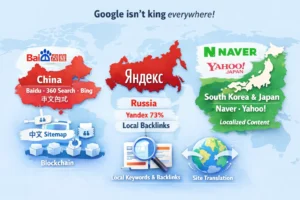
Remember, Google isn’t king everywhere. In China, for example, Baidu (≈51%), 360 Search (Haosou), and Bing dominate. In Russia, Yandex (≈73%) leads over Google. Even South Korea has Naver, and Japan uses Yahoo strongly. For each target market, understand the local engine’s guidelines: Baidu favors Chinese-language sitemaps and blockchains, Yandex cares about local backlinks and site translations, etc. Failing to optimize for that search engine is like ignoring a city’s primary newspaper in your PR efforts.
7. Monitoring & Analytics
- Country-Specific Analytics: Use tools like Google Analytics and Search Console filters for each country. Track metrics (traffic, bounce rate, conversions) per region-language.
- Local Keyword Rankings: Monitor keyword positions in each country’s search engine (e.g. Google.de vs Google.com). There are SEO tools (like SEMrush, Ahrefs) with geo-targeted rank tracking.
- User Feedback: For each locale, gather user feedback or do A/B testing on localized pages. What motivates users in Brazil may differ from users in Germany. Adapt accordingly.
Modern SEO Trends for Global Success
The SEO world is evolving fast. Here’s how international SEO strategies mesh with today’s trends:
Semantic and Entity SEO
Modern search (and AI) cares about meaning and entities, not just keywords. This means your content should clearly connect topics and real-world entities (people, brands, places). For example, an article about “best laptops” should mention specific models and brands (entities) with context. Using schema markup in each language to define these relationships helps search engines (and AI) grasp the content’s relevance. In practice, semantic SEO ensures your localized pages serve user intent, which is crucial in any region.
AI and Answer Engine Optimization (AEO)
Search engines are increasingly “answer engines” powered by AI. People use voice assistants and chatbots globally (for example, Google’s AI Search is now available in 98 languages across 200+ countries). To rank in voice or AI answers, your content needs to directly answer questions. That means adding clear definitions, bullet lists, FAQs, and structured data near the top of your pages. Answer Engine Optimization (AEO) is about making your content the answer, not just a link. For instance, begin each section with a crisp explanation of what, why, or how, so that AI snippets can pull it instantly. This benefits all users, whether they ask Google Home in France or Alexa in Dubai.
Entity-Based Focus
Big AI-driven features like Google’s “AI Overviews” pull data from the Knowledge Graph. They show concise answers about entities (like a company’s founding date or a country’s population). To appear here, highlight entity relationships: use infoboxes, lists of facts, or Q&A that mention clear entities. Keep terminology consistent (e.g. always refer to the same “person” or “place” in the same way across languages), so AI systems don’t get confused. Think of each market: if a business has slightly different names or legal forms in different countries, clarify that. The goal is to “feed” AI models the right info on your entities so your site is cited as a source.
Traditional vs. Modern SEO:
Traditional SEO focused on keywords and backlinks. Modern SEO (especially internationally) is more about user intent, content depth, and authority. You still need strong content and links, but the emphasis is on relevance and trust. For example, Google’s VP of Search has said optimizing for AI search is essentially the same as traditional SEO, meaning quality content and honest SEO are evergreen. However, today we also consider “generative engine optimization (GEO),” which structures content so large language models (ChatGPT, Google Gemini, etc.) can easily retrieve and present it. In practice, this means writing clearly, using standard formats (like FAQ lists), and ensuring your site is easily crawlable and mark-up-rich in every language.
Voice and Mobile
Mobile use varies by region (APAC is very mobile-heavy, for instance). Ensure content is voice-search friendly (using natural language queries and answers) in each language. For example, Portuguese users might say “Como trocar a capa de iPhone” when asking to change an iPhone case, so content should answer in a conversational way. Test voice queries in each target language to guide your phrasing.
Multimedia and Visuals
Don’t neglect images or videos. Use alt tags in local languages, and consider hosting videos on regionally popular platforms (like YouTube and possibly local alternatives). Visual schema (like image metadata) should reflect local language captions. For charts or infographics, localize the text and references too.
By blending these modern tactics with your international SEO strategy, you satisfy both global algorithms and global people. Remember: Context is king. Explicitly cover who, what, where in your pages so AI and human searchers alike find exactly what they need.
Conclusion
In today’s global marketplace, International SEO is the linchpin of expansion. By tailoring your technical setup, content, and outreach for each target country, you turn local SEO efforts into a worldwide growth engine. Remember the essentials: use the right domains or subfolders, implement hreflang tags, and create genuinely localized content (not just translations). Keep up with modern SEO too, focus on semantic relevance, entity data, and answer-focused formatting so that search engines and AI chatbots present you as the go-to answer.
International SEO is a journey, but the payoff is clear: a truly global reach. Take action now by auditing your site’s international structure and content. Start small by optimizing one new market, then build on that success. And if you need expert guidance, Elevatech Digital is here to help. With the strategies above, your brand can speak every searcher’s language and expand its global footprint – one keyword at a time.
Frequently Asked Questions (FAQs)
-
What is International SEO and how is it different from local SEO?
International SEO optimizes your site to rank in many countries and languages, whereas local SEO focuses on ranking within a specific city or region. International SEO involves multilingual content, country-targeted URLs (like
example.com/uk/orexample.fr), and global strategy. Local SEO might use Google My Business and local directories, while international SEO uses hreflang tags and global sitemaps. -
How do I implement hreflang tags correctly?
Add
hreflangannotations to tell search engines the language and country of each page. For example, a French page for France useshreflang="fr-FR". You can place these tags in the HTML header or XML sitemap. Each language version must reference every other version (including itself). This way Google won’t mistakenly show the Spanish page to a US user. Think of hreflang as a multilingual table of contents – use it on every global page to map languages and regions. -
Should I use .com, .local, or subfolders for each country?
Each approach has trade-offs. ccTLDs (like
.de,.jp) clearly target a country and build local trust, but require separate domains and budgets. Subfolders (like/de/,/jp/) keep SEO strength on one domain and are easier to manage, but need careful setup. Subdomains (likede.example.com) are a middle path. There is no one-size-fits-all – choose based on your resources, branding, and content volume. The key is consistency and proper setup (see table above). -
What is semantic SEO and why does it matter internationally?
Semantic SEO means optimizing for meaning and intent, not just keywords. It uses related terms, topics, and structured data (entities) so search engines truly understand your content. For international SEO, this means each localized page should fully cover the topic in that language, using local terms and schemas. This helps your content rank for intent-based searches (and appear in AI-powered answers) across all languages.
-
How should I measure success in International SEO?
Track organic traffic and conversions by country and language. Use Google Search Console’s Country report or Analytics segments. Monitor rankings on each country’s main search engine. Compare metrics against local benchmarks (e.g., click-through rates on Google.fr). Over time, look for rising impressions and sales in your new markets. Remember: even if organic traffic is initially smaller, focus on engagement: are those visitors reading your content, signing up, or buying? That indicates your localization is working.