

Digital marketing strategy is like a global puzzle to win, you must fit together five key pieces. In fact, the 5 C’s of digital marketing, Customer, Context, Content, Channel, and Conversion form a blueprint for success. By mastering each “C,” businesses worldwide can craft campaigns that truly connect with their audiences. This guide breaks down each C in clear, actionable terms. You’ll discover what each means, why it matters in today’s online landscape, and how to apply these principles whether you’re a startup, an enterprise, or looking to work with a digital marketing service or agency like Elevatech Digital.
Digital Marketing, at its core, is about meeting customers where they are and delivering value. The Customer is at the center of everything – knowing who they are, what they want, and how they behave. Context means understanding the customer’s situation (their device, location, intent) and tailoring your message accordingly. Content is the material you create (blogs, videos, social posts, etc.) to inform or entertain. Channels are the platforms or media (email, search, social, paid ads) used to distribute content. Finally, Conversion tracks how effectively visitors take desired actions (sign-ups, sales, shares). In the sections below, we’ll dive deep into each C, with real-world examples and best practices for a global audience.
What Are the 5 C’s of Digital Marketing?
The 5 C’s of Digital Marketing are a strategic framework that helps businesses create effective online marketing strategies by focusing on:
| The 5 C’s | What It Means | Why It Matters |
|---|---|---|
| Customer | Understanding your audience | Ensures marketing speaks to real needs |
| Context | Delivering the right message at the right time | Improves relevance and engagement |
| Content | Creating valuable digital material | Builds trust and brand authority |
| Channel | Choosing the right platforms | Reaches customers where they are |
| Conversion | Turning interest into action | Drives measurable business results |
Digital Marketing succeeds when the right message reaches the right person at the right moment on the right platform and inspires action.
1. Customer – Know Your Audience Inside Out
Definition: The “Customer” C means putting your ideal buyer or audience at the forefront. It’s about understanding who you are selling to their demographics, needs, preferences, and pain points.
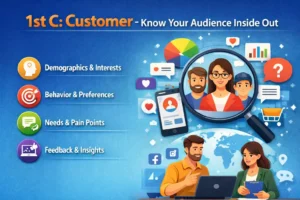
Every digital strategy starts by building detailed customer personas. Think of personas like vivid profiles of your target users: their age, location, challenges, and goals. For example, an online education company might create a persona named “Student Sara” who is an English-learning college student in India, and a persona “Career-Chaser Carlos” who is a mid-career professional in Brazil. Each persona has unique motivations and content preferences.
Why it matters: 79% of marketers say personalization and customer-focused messaging are very important for hitting top goals like loyalty and satisfaction. In other words, knowing your customer is not optional, it’s crucial. By analyzing data and feedback, you can deliver experiences that resonate. For instance, if most of your customers browse on mobile during their commute, you might optimize mobile-first content and quick-read formats.
- Audience Research: Use surveys, analytics, and market reports to learn your customers’ habits and preferences.
- Global Diversity: Remember, a global audience may have varied cultural backgrounds and languages. Segment personas by region or culture when needed.
- Customer Journey Mapping: Chart the steps a customer takes from first hearing about your brand to becoming a loyal buyer. Each stage reveals pain points you can solve with your digital marketing.
By centering every campaign on Customer intelligence, your digital marketing agency can craft messaging that truly speaks to people. As NowMediaGroup notes, “Keeping the customer front and center grounds all digital marketing decisions, allowing brands to make the biggest impact”.
2. Context – Delivering the Right Message at the Right Time
Definition: “Context” means the situation and intent surrounding your customer’s online behavior. In digital terms, it’s the device they’re on, the time of day, the type of content they’re consuming, and their current mindset. Contextual digital marketing is all about being relevant.
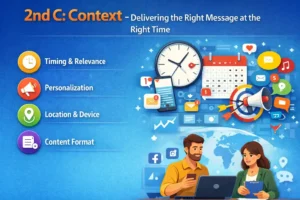
Imagine a user browsing on their phone at a coffee shop during lunch. They might prefer quick tips or social videos. The same person at home in the evening might be in a browsing mood and open to longer blog posts or in-depth guides. The context of location, device, and timing should shape your approach. For example:
- A Facebook ad with catchy visuals might engage someone scrolling on mobile during a break.
- A detailed how-to video or webinar might attract viewers in a relaxed evening setting on a laptop.
Adobe’s marketing blog explains it well: “context is a combination of what customers have done, where they’ve done it, and with whom”. By triangulating user actions, location, and related behavior, brands can serve truly personalized content. According to the World Advertising Research Center, contextually relevant ads significantly improve engagement and brand recall.
Key Practices:
- Behavioral Targeting: Use analytics and AI Overviews to segment audiences by behavior (e.g. previous purchases or page visits). Tailor content accordingly.
- Time & Location: Schedule posts or ads for when target regions are most active (e.g. morning for Asia, evening for Europe).
- Platform Mindset: Recognize that people use different platforms with different intentions (e.g. inspiration on Instagram, research on Google). Craft messages that fit each context.
Contextual targeting is so powerful that 89% of business leaders now believe personalization, deeply connected to context – is crucial to success. By aligning your content and channels to the user’s context, you boost relevance and engagement. Always ask: “Where is my customer right now, and what do they need?” Answering that will guide your content and channel choices effectively.
3. Content – Crafting Valuable, Engaging Material
Definition: “Content” is the fuel of digital marketing – the articles, videos, graphics, and posts that inform or entertain your audience. It’s often said that “content is king”, meaning high-quality content lies at the heart of successful campaigns.
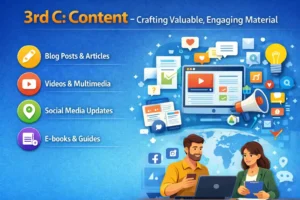
Today’s customers expect helpful and engaging content that solves their problems or answers their questions. Common content formats include:
- Blog Posts and Articles: In-depth guides, how-tos, and thought leadership pieces that boost SEO and brand authority.
- Social Media Updates: Short, catchy posts, images or reels tailored to each platform’s style. For example, snackable TikTok videos or carousel infographics on LinkedIn.
- Ebooks & Whitepapers: Long-form resources offered as gated downloads to generate leads.
- Webinars & Live Events: Interactive sessions with experts that build trust and collect leads through registrations.
- FAQs & Chatbots: Answers to common questions that both help users and improve SEO (voice assistants often pull from FAQ answers).
- Infographics & Visuals: Shareable visuals that make data or tips easy to digest.
Creating a content plan means aligning each piece with a goal in the customer journey. Early-stage prospects need awareness and education (blog posts, social tips), while later-stage prospects need detailed info or offers (webinars, case studies). High-quality content drives results: “well-optimized, high-quality content… drives measurable business results like website traffic, lead generation, and sales conversions”.
- Answer Engine Optimization (AEO): Write clear Q&A sections. Structured content (lists, definitions) helps voice assistants and zero-click search features pull answers directly.
- Storytelling & Authenticity: Weave real examples or anecdotes into your content to connect emotionally. A personal case study can make a global principle relatable.
- Localize for Global Audiences: When digital marketing internationally, adapt content for regional cultures and languages. Global brands often create region-specific blog series or translate key guides.
The data backs up content’s importance: Email content marketing alone yields about $36 in revenue for every $1 spent. And 54% of businesses planned to boost content budgets in 2024. In short, invest in original, helpful content, and search engines and customers will reward you.
4. Channel – Choosing the Right Platforms
Definition: “Channel” refers to the mediums you use to reach customers online. These include your own properties (website, email), social networks, search engines, and paid advertising. Each channel has unique strengths and audiences.
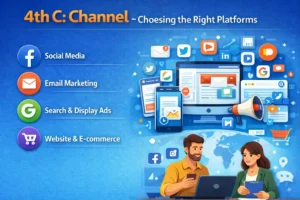
A well-rounded digital marketing plan uses a mix of channels:
- Owned Media: Your own website, blog, and branded social profiles. These are assets you control. A good website SEO and active social pages build long-term presence.
- Paid Search & Social Ads: Advertising on Google, Facebook, LinkedIn, etc., lets you target specific keywords or audience segments. For example, search ads capture high intent (someone actively looking for your product), while social ads build awareness among targeted demographics.
- Native Advertising: Sponsored articles or promoted content on news sites or social feeds. This blends in with editorial content and can drive engagement.
- Email Marketing: Sending newsletters or drip campaigns keeps your brand in front of subscribers. Email remains one of the highest-converting channels.
Every channel appeals to customers in different contexts. In fact, an Adobe report found 87% of firms personalize via email, but only 62% do so on social and 51% on mobile. Even fewer (38%) can deliver consistent messaging across all channels. The lesson: coordinate channels for an omnichannel experience. For example, a user might see a display ad (awareness), visit your site (interest), receive an email follow-up (consideration), and finally click a retargeted ad (decision). All touchpoints should feel connected.
Choosing Channels Globally: Channel popularity varies by region. For example, WeChat and Douyin dominate social in China, while WhatsApp marketing is huge in parts of Europe and Latin America. Search engines also vary: Google leads globally (90%+ share), but Yandex is big in Russia and Baidu in China. Tailor your channel mix to each market.
- Analytics & Attribution: Track which channels drive traffic and conversions. Tools like Google Analytics and attribution software can show, for instance, whether social or search brings more sales in APAC vs North America.
- Budget Allocation: The global digital ad market is huge (projected ~$834B in 2025). North America alone accounts for nearly half of it. Allocate spend where your audience is most active and where ROI is highest.
- Emerging Channels: Keep an eye on rising platforms (e.g. TikTok, podcasts, voice assistants). A channel suited to your brand’s style and audience can be a breakthrough.
Remember that “omnichannel” coordination turns disparate touchpoints into a seamless journey. In practice, that means consistent branding and messaging across mobile, desktop, social, email, and even offline if applicable. Use remarketing (like social or search retargeting) to remind visitors and guide them back. An integrated channel strategy ensures no lead slips through the cracks.
5. Conversion – Driving Real Business Results
Definition: Conversion is when a visitor takes a desired action that aligns with your goals – for example, making a purchase, filling out a form, downloading a guide, or signing up for a newsletter. In digital marketing, each action (or micro-action) can be a conversion metric.

Typical conversions include:
- Lead Generation: Forms filled out for ebooks, trials, or contact requests.
- Email Subscriptions: New newsletter or list sign-ups.
- Social Engagement: Shares, comments, follows – these can be soft conversions that build awareness.
- Sales: Purchasing products or services online.
- Offline Actions: Phone call inquiries or physical store visits driven by online campaigns.
Building effective conversion paths is key. That means clear calls-to-action (CTAs), landing pages that match ad or content messaging, and a smooth user experience. For instance, if a user clicks an ad for a “Free Webinar,” the landing page should instantly highlight the webinar sign-up form – no extra clicks.
- A/B Testing: Regularly test different headlines, images, button texts, and layouts to see what converts best. Small tweaks (like changing a CTA color or wording) can sometimes lift conversions significantly.
- Remove Friction: Identify and fix anything that stops a conversion. NowMediaGroup highlights common friction points: confusing navigation, complex checkout processes, or missing trust signals. Streamlining your funnel and adding testimonials or security badges can improve trust.
- Analytics: Use tools (Google Analytics, Facebook Pixel, etc.) to track conversion rates per channel and segment. This data helps you invest in what works (and cut what doesn’t).
Conversion Rate Optimization (CRO) is an ongoing process. Even after campaigns launch, continually refine based on data. For example, if mobile conversion lags behind desktop, perhaps your mobile checkout needs simplification.
Finally, measure your digital marketing ROI by tying conversions to revenue. If you spent $1,000 on ads and gained $5,000 in tracked sales, your ROI is clear. Conversion tracking also feeds back into the other C’s: by understanding which customers convert and in what context or channel, you sharpen your targeting and content.
Conclusion
In summary, the 5 C’s – Customer, Context, Content, Channel, Conversion – provide a structured way to plan and optimize any digital marketing strategy. Start with a deep understanding of your customers, tailor your content to their context, deliver that content on the right channels, and measure how effectively you’re converting interest into action. This approach works whether you operate in North America, Europe, APAC or the Middle East, because at its core it’s about meeting people’s needs wherever they are online.
As digital marketing evolves with AI voice search, and new platforms, the 5 C’s remain a steady compass. They ensure your efforts are customer-focused, relevant, valuable, and measurable – qualities that search engines and users reward. By following these principles, you create an omni-channel, answer-driven strategy that stands out in global search results and voice queries.