
Picture this: You ask Google a complex, conversational question on your phone (maybe over your morning coffee), and bam, an AI-powered summary pops up with the answer, complete with links. Welcome to the era of AI Search, where the keywords-only game no longer cuts it. For American businesses, cracking this new search code means embracing semantic SEO optimizing for meaning and context, not just words. In fact, Google now treats search queries as “things, not strings,” matching user intent to entities in its Knowledge Graph. No wonder by mid-2024 Google had rolled out AI Overviews to every U.S. user, serving AI-generated snapshots atop search results.
Given this shift, companies that stick to old-school keyword stuffing will fall behind. Instead, semantic SEO (a.k.a. Entity-Based SEO or Modern SEO) helps sites surface in Google’s new AI features by focusing on topics, questions, and relationships. It’s about teaching search engines what you mean, not just what words you use. For you, the business owner or marketer, that means tweaking your content to align with Google’s intelligence: writing in natural language, organizing around clear subjects (entities), and answering real questions. The payoff? Better visibility in zero-click AI results (like Knowledge Panels and AI Overviews) and even voice search answers, all without the user leaving Google.
Below, we’ll break down semantic SEO in simple terms, explain why it’s a big deal for ranking in Google’s AI-driven SERPs, and give you actionable tips (with bullet lists, tables, and FAQs) to win in the new search landscape. Let’s get started.
What Is Semantic SEO?
At its core, semantic SEO means optimizing for meaning instead of just keywords. Traditional SEO focused on matching exact word strings in queries. Semantic SEO, however, helps search engines understand the context and intent behind those queries. In practice, that means structuring content around entities (people, places, things, concepts) and topics, not just isolated keywords. Google’s own Knowledge Graph runs on this idea, linking billions of entities together.
- Entities & Context: Think of entities as the “nouns” of search (e.g. your business, products, or topics you cover). Each page should clearly center on one main entity or topic. For example, a page about “best running shoes” might tie into the entity Running Shoe (with attributes like brand, features, etc.).
- User Intent: Semantic SEO emphasizes why someone searched, not just what they searched. Google now infers intent (e.g. local purchase vs. general info) and looks for content that truly answers that question.
- Related Topics: Semantic search optimization means covering all related subtopics and questions. Instead of a thin page that just repeats “running shoes,” you’d include sections on sizing, best brands, training tips, etc. This comprehensive coverage signals to Google you’re the authority on the topic.
Example Breakdown
| Search Query | Traditional SEO Focus | Semantic SEO Focus |
|---|---|---|
| “best laptops” | Repeat keyword | Compare brands, specs, use-cases |
| “best laptops for remote work” | Add keyword variation | Cover productivity, battery, portability |
In sum, semantic SEO is like telling Google a story about your subject. You’re not just dropping breadcrumbs (keywords); you’re building a mini knowledge graph on your site by linking related ideas. As one guide puts it, “semantic SEO is the bridge between your content and users’ intent”.
Why Semantic SEO Matters for Google’s AI Search
Google has been moving toward AI and entity understanding for years. The Knowledge Graph (launched in 2012) revolutionized search by focusing on “things, not strings”. In just the past few years, Google added AI layers (RankBrain, BERT, MUM) to understand language nuances. Now with its Gemini AI and Search Generative Experience (SGE), Google is delivering direct answers (AI Overviews) on the SERP.
This has three big implications for your SEO strategy:
-
Answer-Focused Results: Over half of U.S. searchers now use AI tools (like Google’s AI Overviews or ChatGPT) for answers, often without clicking links. MarketingProfs notes that 64% of U.S. searches ended without a click in 2024. That means if you’re not in the featured answer, your audience might not reach your site at all. Semantic SEO + Answer Engine Optimization (AEO) ensures your content can be pulled as a concise, standalone answer.
-
Contextual Relevance: Google’s AI Overviews look for content that clearly matches entities and context. Search Engine Land reports that as of late 2023, AI Overviews appeared in 84% of queries (when SGE launched) and still show up on a significant share of searches. To be included, your content must tightly align with how Google interprets the topic (using its Knowledge Graph). In other words, simple keyword density won’t cut it; what matters is entity clarity and topical authority.
-
Voice and Conversational Search: With Siri, Alexa, Google Assistant, and GenAI-chatbots, people are talking to search more than ever. Voice queries are longer and more natural (“How do I…?” or “What’s the best way to…?”). Semantic SEO naturally complements voice search SEO: you write content that sounds natural, answers questions directly, and covers user intent comprehensively.
Quick Comparison Table: Old vs New SEO Reality
| Factor | Old SEO | Semantic SEO | AI SEO |
|---|---|---|---|
| Focus | Keywords | Intent + Entities | Answers + Context |
| Content Style | Repetitive | Informational | Conversational |
| Goal | Rank pages | Build authority | Get featured in AI |
Entities, schema markup, and well-structured content help ensure Google’s AI (and other AI assistants) recognize your pages as the right answers. Otherwise, your site risks being bypassed by AI summaries. As SchemaApp warns, semantic SEO is already “the future of search,” especially since AI-driven results have “propelled semantic technology to unprecedented heights”.
How Google’s AI Search Features Work
Before diving into tactics, it helps to know what we’re optimizing for:
-
Google AI Overviews (SGE): Google’s Search Labs launched AI Overviews (formerly SGE) to give users a quick summary of answers with sources. These overviews appear above organic results and include links to your site. (By mid-2024, Google began rolling AI Overviews out to all U.S. users.) Not every query triggers one, but when it does, it occupies prime real estate. Optimizing for them means writing content AI can snippet.
-
Knowledge Panels: These are the info boxes on the right (desktop) or top (mobile) that give facts about entities (brands, public figures, products). Being listed in the Knowledge Graph helps boost visibility in AI Powered Search. Google’s systems pull from the Knowledge Graph to answer queries, so having your business correctly represented (via structured data, a Wikipedia page, a Wikidata entry, etc.) is crucial.
-
Featured Snippets & People Also Ask: These “Position Zero” answers often feed voice assistants and AI chatbots. They’re a form of AEO: Google shows them directly on the SERP. Structuring content as Q&A (or lists) with clear headings can land your text here.
-
Traditional vs AI/Large Language Models: Note that AI Overviews (Google’s AI) are an augmented search feature, they include links to live sources. This differs from using ChatGPT-like LLMs alone (which may not cite sources). A big difference is: Google’s AI Overviews pull from Google’s index and likely from its Knowledge Graph, giving you a chance to rank through your site content.
AI Feature Breakdown Table
| Feature | What It Does | How to Optimize |
|---|---|---|
| AI Overviews | Summarizes answers with links | Clear, structured answers |
| Knowledge Panel | Displays entity data | Use schema + entity clarity |
| Featured Snippet | Shows quick answer | Use Q&A format |
| People Also Ask | Expands related queries | Cover related questions |
| Voice Search | Reads answers aloud | Conversational tone |
In summary, Google’s AI Search is essentially traditional search plus AI summaries. That means you still need to rank in web results, but you also want your content crafted so Google’s AI will pick it as the “answer.”
Semantic SEO Strategies for Google’s AI Search in US
Ready to get concrete? Here are key tactics to boost your site’s presence in Google’s AI-powered results:
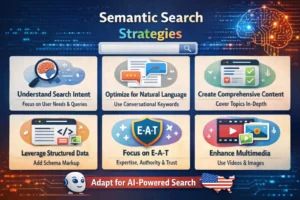
Focus on Entities & Intent (not just keywords)
Identify the main entity for each page (e.g. your product, service, location). Use that term in your title, H1, and schema markup as the mainEntityOfPage. Cover subtopics (attributes, related concepts, FAQs) that flesh out that entity. This builds “coverage” of the topic. For instance, a page on “Chicago plumbers” should mention “Chicago,” plumbing issues, neighborhoods, licensing info, etc., to reinforce relevant entities and search intent (service + location).
Use Schema & Structured Data
Schema markup (JSON-LD) is like a cheat sheet for Google’s AI. It explicitly defines entities on your page. For example, use Article, Product, or LocalBusiness schema with properties that point to a known entity ID (like a Wikidata Q-number) in mainEntityOfPage. Mark up FAQs and how-tos where possible. As Search Engine Land advises, “precision” and “sameAs” references (like links to Wikipedia or Wikidata) tell Google exactly who or what you are.
High-Quality, Comprehensive Content
Write full-sentence answers and lists, not just bullet points (unless listing is relevant). AI favors depth. SchemaApp notes that search engines reward content depth and meaning, especially as “people-first” content. So instead of a thin blog post repeating keywords, create a rich resource. Use subheadings with natural questions (e.g. “What is semantic SEO?”). Put key answers right after each heading. Google’s MarketingProfs guide warns that SERPs expect self-contained snippets of ~50 words after matching queries, so make your Q&A crisp and independent.
Optimize for Voice & Question Queries
Many AI/voice queries are phrased like questions. Sprinkle question-style phrases in your headings or content (“How to find the best running shoes” instead of just “best running shoes”). Writing in a conversational tone helps both voice assistants and featured snippets. Also, ensure your site is mobile-friendly and quick, since Google prioritizes mobile UX.
Link Internally with Context
Connect related pages on your site so Google’s AI sees the “network” of your content. According to Search Engine Land, internal links and sameAs references strengthen how entities connect. For example, link your “Chicago plumbing” page from your main “plumbing services” page. Mention your brand and link to your About page so Google knows these all point to your business as the entity.
Leverage the Knowledge Graph
Claim and update your Google Business Profile (for local SEO) and Wikipedia/Wikidata if applicable. The more accurate info Google has about your company (address, core topics, brand relationships), the more confidently its AI can use your data. SEO experts even suggest guiding AI by feeding the Knowledge Graph: e.g. ensure your Wikipedia and Wikidata entries are up-to-date, and use schema’s sameAs to link to them.
Answer Engine Optimization (AEO) & Generative Engine Optimization (GEO)
Think beyond SEO rankings. AEO/GEO means your content should be answer-ready. As one SEO article advises, put crucial info within the first 100 words of each section, and phrase subheads exactly like queries. Use lists and bullet points for step-by-step answers (nice for AI to cite). For example, a quick “Steps to fix a leaky faucet” list is prime snippet material. Also, as LLM-SEO guides note, LLM tools (ChatGPT/Gemini) pull from both training data and live search, so ranking for smaller query fragments matters. In practice, if ChatGPT breaks a question into sub-queries, make sure your content can rank for those fragments (e.g. “best project management 2026,” “tools for 50 users”).
SEO Approaches in 2026 (Traditional SEO vs. Entity/Semantic SEO vs. AI-Aware SEO):
| Aspect | Traditional SEO | Entity/Semantic SEO | AI/Voice SEO (AEO/GEO/LLMO) |
|---|---|---|---|
| Focus | Exact keywords & backlinks | Entities, topics, intent (Knowledge Graph) | Natural language queries & answers |
| Content | Short, keyword-dense pages | Comprehensive, context-rich resources | Q&A format, bullet lists, short concise answers |
| Optimization | Title tags, meta keywords | Schema markup, internal linking, “sameAs” references | FAQ schema, structured snippets, voice-friendly text |
| Goal | Rank for specific terms | Rank for query intent & appear in AI Overviews | Be featured in AI summaries & voice responses |
| Example query | “running shoes” | “best running shoes for trail races” | “Where is the best place to buy new running shoes?” |
USA-Focused Tips & Real-World Examples
Semantic SEO isn’t just theory, U.S. businesses are already reaping the benefits. For example, one local plumbing company saw a 27% bump in non-branded search visibility simply by updating its site to explicitly mention each neighborhood it serves and common plumbing problems. That’s pure entity optimization in action. Another case: an auto repair shop was stuck optimizing for the phrase “car won’t start battery” with no success, because the real user need was troubleshooting steps, not just batteries. By rewriting content to address “why my car won’t start” with clear answers, their traffic jumped 43% in a month.
These stories underline a key point: semantic SEO is about understanding customer queries. If someone in New York types “nearest urgent care open now,” Google knows from context they want a highly-rated facility that’s open (the entity Urgent Care plus geography) – not just pages containing the word “open.” As one SEO pro observes, modern search matches all parts of user intent, so pages must too.
Also, remember the readability golden rules (USA.gov’s advice fits here): break text into short paragraphs, use bold headings, bullets and numbered lists for key points, and keep language clear. This GEO (Generative Engine Optimization) best practice not only helps people skim your page, it makes it easier for AI to parse and extract answers.
Lastly, don’t forget E-E-A-T (Experience, Expertise, Authoritativeness, Trust). Google’s AI is picky: it prefers content from expert sources. Use your brand’s authoritative voice, add real examples or quotes, and if possible link to credible references (even a .gov or official site) to bolster trust.
Conclusion: Future-Proof Your SEO with Semantics
The search landscape is shifting under our feet, and under billions of smartphones. For U.S. companies, semantic SEO is no longer optional. By structuring your content around entities and real intent, using schema markup, and writing clear, user-focused answers, you stay on Google’s radar even as AI evolves. This means you’ll appear in more AI Overviews and voice results, reaching customers who may never click a traditional link.
In short: The better Google (and its AI) understands what you do, the more it can recommend you. Semantic SEO helps you tell that story clearly. Contact Elevatech Digital today, for example, helps businesses map their content to Google’s Knowledge Graph and build AI-friendly pages. If you’re ready to transform your SEO for the age of AI search, let’s chat and put these strategies to work for you.
FAQs about Semantic SEO and AI Search
-
What is Semantic SEO and why is it important for USA companies?
Semantic SEO is the practice of optimizing content around meaning, intent, and context rather than just keywords. For USA companies, it helps websites rank higher in Google’s AI Search Results by aligning content with user intent, improving visibility in AI Overviews and voice search results.
-
How does Semantic SEO improve rankings in Google’s AI Search Results?
Semantic SEO improves rankings by helping search engines understand relationships between topics, entities, and user intent. This allows your content to be featured in AI Search Results, including AI Overviews, where Google prioritizes context-rich and well-structured information.
-
What is the difference between traditional SEO and Semantic SEO?
Traditional SEO focuses on exact keywords, while Semantic SEO emphasizes topic relevance, entity-based SEO, and Natural Language Processing. Semantic SEO ensures your content answers broader queries, making it more suitable for AI-powered search engines and modern SEO strategies.
-
What role does Natural Language Processing play in Semantic Search Optimization?
Natural Language Processing (NLP) enables search engines to understand human language more accurately. Semantic Search Optimization leverages NLP to create content that matches conversational queries, helping businesses rank in voice search SEO and AI-driven search experiences.
-
How can Semantic SEO help with Voice Search SEO?
Semantic SEO focuses on conversational and intent-based queries, which are essential for Voice Search SEO. By optimizing for natural language and question-based content, USA companies can capture more voice-driven traffic and appear in AI-generated answers.