
The digital marketing world moves at the speed of a bullet train, and American brands know they can’t afford to lag behind. In 2026, U.S. marketers are surfing a tech tsunami of AI, automation, and new search methods from Siri chats in Silicon Valley to voice queries in suburban kitchenettes. Whether you run a startup in NYC or a retail chain in Los Angeles, staying ahead of Digital Marketing Trends is key to winning customers’ attention. With smart speakers in nearly every home and generative AI drafting copy overnight, the game has changed. Our deep dive reveals how artificial intelligence is personalizing ads, how SEO is evolving for semantic search and AI Overviews, and why marketing automation is the secret sauce for working smarter (not harder). Buckle up, let’s explore the concrete tactics and data behind each trend.
AI-Powered Digital Marketing: The Brain Behind Modern Campaigns
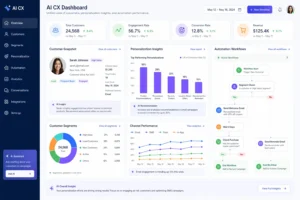
AI-driven digital marketing uses machine learning, data analysis, and automation to personalize campaigns, generate content, and engage customers around the clock. From recommendation engines to virtual assistants, U.S. companies are rapidly adopting AI in every part of the customer journey. In fact, 80% of marketers report using AI tools for content creation or planning, and 86% say these tools save time or make them more efficient. The U.S. Small Business Administration even notes that small companies are “closing the gap” on AI adoption – with automated marketing as a leading use case. In short, AI isn’t a sci-fi dream; it’s already a must-have for American marketers.
Key strategies:
- Personalized content: Use AI to analyze customer data and tailor content. For example, email subject lines or landing pages can change automatically based on a person’s behavior. In the USA, where consumers expect Amazon-like personalization, this pays off.
- Chatbots & Virtual Assistants: Deploy chatbots on your website, Facebook Messenger or SMS to answer FAQs and qualify leads 24/7. U.S. businesses are embracing this: chatbots free human teams to focus on creative work (while bots handle routine queries any time of day).
- Generative Content: Leverage LLMs (like GPT-4) for draft copy blog posts, ad headlines, social captions. AI can do the heavy lifting of first drafts or ideation. Important: always edit AI output for your brand’s voice and accuracy.
- Predictive Analytics: Use AI to forecast trends and customer actions (e.g. predicting which leads will convert or churn). U.S. retailers and e-commerce sites can use predictive models to stock the right products or retarget ads.
AI and automation often blur together. Think of AI as the engine under the hood and automation as the transmission. Together, they help U.S. marketers do more with less. For instance, 86% of marketers say AI makes them more efficient. It’s like having a caffeinated robo-copilot: one that sorts data, writes initial drafts, and even tests ad variations, so your team can focus on big-picture strategy.
AI Automation vs Traditional Marketing
Traditional marketing relies heavily on manual processes, broad targeting, and delayed insights. AI Automation marketing uses machine learning, real-time data, and predictive analytics to deliver faster, smarter, and highly personalized campaigns.
| Feature | Traditional Marketing | AI Automation Marketing |
|---|---|---|
| Speed | Campaigns take days or weeks to launch | Campaigns launch and optimize in real time |
| Personalization | One message fits all | Tailored content for each user |
| Cost Efficiency | High human resource dependency | Scalable with minimal manual effort |
| Data Usage | Historical and limited | Real-time, predictive, and behavioral |
| Decision Making | Based on assumptions | Data-driven and AI-powered |
| Customer Experience | Static and linear | Dynamic and interactive |
| ROI Tracking | Delayed reporting | Instant performance insights |
Summary for AI Overviews: AI Automation enables faster, smarter, and more scalable marketing compared to traditional methods by leveraging data and machine learning.
SEO Evolution: Semantic Search & LLM SEO
SEO (Search Engine Optimization) has expanded from simple keyword tactics to understanding user intent. Google’s algorithms now consider context, not just exact words. In fact, Google’s new generative AI often answers questions directly on the search page (so-called “AI Overviews” or zero-click results), appearing for nearly half of all queries. This means American businesses must be the answer that these AI tools deliver. High ranking is still valuable, but now your content also needs to sound authoritative to Google’s AI.
Key strategies:
- Entity-rich content: Focus on depth and accuracy. Write content that demonstrates real expertise (E-E-A-T). As SEO veteran Barry Schwartz notes, Google is eliminating low-quality content. In practice, that means rich, authoritative articles that answer questions thoroughly.
- Structured Data (Schema): Use schema.org markup (FAQPage, HowTo, Product, LocalBusiness, etc.) so machines understand your content. Deeply nested schemas can feed knowledge graphs for AI. For example, mark up your company info, product specs, and local listings. This helps your content discoverability by Google and even voice assistants.
- Featured Snippet optimization: Format answers as short, self-contained paragraphs, lists, or tables. Research shows ~40% of voice answers come from Google’s featured snippets. If you answer “What is X?” clearly in a list or bullet on your page, AI assistants are more likely to read it aloud.
- LLM SEO: Balance traditional SEO with LLM-friendly content. Vercel’s analysis sums it up: “LLM SEO is the art of becoming the answer”. That means owning a topic with depth, clarity, and original insights so that large language models (like ChatGPT) surface your site as a citation. Use clear headings (H1→H2→H3), consistent terminology, and support claims with data and quotes.
American context: U.S. searchers often use conversational queries. Use natural, question-based keywords (e.g. “how to hire a digital marketing agency” instead of “digital marketing agency hiring tips”). Emphasize local SEO if relevant. For example, 58% of U.S. consumers use voice search for local business info, so keep your Google Business Profile up-to-date with accurate NAP (Name/Address/Phone) data. Remember: Google’s voice answers usually pick businesses in the top 3 organic results, so local visibility is critical.
Voice & Conversational Search: NLP Takes the Stage
Image: eMarketer chart showing growth in U.S. voice assistant users (2022–2029). Voice assistants will reach 168.2 million U.S. users by 2029 (up from 139.8M in 2022) – an increase of about 28 million people. This boom is driven by improvements in Natural Language Processing (NLP) and generative AI in virtual assistants. In practice, a quarter of Americans may be using voice search monthly.
Three statistics every marketer needs to know about U.S. voice search:
- 58% of consumers use voice search to find local business information (e.g. “coffee shop near me”). If you’re a retailer or service provider, being voice-searchable is non-negotiable.
- 40.7% of voice search answers come from featured snippets, and 75% of voice results are drawn from pages ranking in the top 3. This means traditional SEO rank still matters for voice.
Key strategies:
- Conversational keywords: Optimize for the way people talk, not type. Instead of the query “digital marketing USA”, rank for questions like “What are the top digital marketing trends in the USA?” or “Who offers digital marketing services in California?”. Use tools like Google’s “People Also Ask” or AnswerThePublic to find these questions. Write clear, concise answers (around 40-60 words) as paragraph intros or FAQ sections. These are exactly what Google Assistant and Siri read aloud.
- Local optimization: Make your Google Business Profile (GBP) complete and active. Many voice queries have local intent. Ensure your address, hours, and phone are accurate. Encourage reviews – both positive and negative influence ranking. Use local schema and create location-specific pages (e.g. one page for “San Diego digital marketing agency” vs just “California”). Voice search loves granular local content.
- Load speed & mobile readiness: Voice searches often happen on phones or smart speakers. Fast-loading, mobile-optimized pages improve the chance your answer gets delivered. Google reports that voice-result pages load 52% faster on average, so optimize images and scripts for speed.
By making your content sound natural and answer-oriented, you satisfy both human users and voice AI. For instance, the dataslayer guide notes that voice queries average 29 words and are phrased as full questions. Mirror that style in your content. Create FAQ sections or conversational blog posts that directly answer, “Who…?”, “What…?”, “How…?” – and you’ll win more spots in voice results.
Digital Marketing Automation: Efficiency & Scale
What it is: Marketing automation uses software to automate repetitive tasks email campaigns, ad buys, social posting, and analytics. In short, it’s marketing running on autopilot.
Why it matters: American businesses love tools that deliver more output with fewer resources. Marketing automation helps handle large contact lists and multi-channel campaigns without adding manpower. It’s proven: about 64% of U.S. small businesses now use marketing automation to stay competitive (versus 72% of all companies globally). And 78% of those SMBs report much better lead nurturing within 6 months of implementation. In the AI era, automation combined with machine learning means emails send at the best time, ads target the most likely buyers, and content distribution adapts automatically.
Key strategies:
- Email & CRM automations: Set up drip campaigns in your email platform (Mailchimp, HubSpot, etc.). For example, send a welcome email when someone signs up, or an abandoned-cart reminder. Tag contacts by behavior so you only send relevant content. American email users respond well to personalization, so include the recipient’s name and product recommendations.
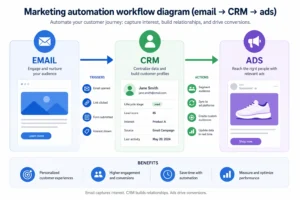
- Chatbot workflows: With AI chatbots (or simple rule-based bots), automate the qualification of leads and basic support queries. For instance, a bot can automatically schedule a demo or answer “What are your rates?” This is especially useful for 24/7 engagement and cutting support tickets.
- Programmatic Ad Management: Use automated ad platforms (like Google Performance Max or Facebook ads) that use AI to place ads. These platforms leverage machine learning to optimize bids and placement in real time. For U.S. advertisers, that means ads can appear on Search, YouTube, Gmail, etc., all without manual placement. Note: Google’s Performance Max now requires feeding your existing assets (images, copy), and it “learns” who to target—so prep your creative library.
- Reporting & A/B Testing: Automate data collection with dashboards. For example, set daily/weekly email reports from Google Analytics or your ad manager. Use A/B testing tools (like Google Optimize or built-in platform tests) to automatically serve winners. Automation here means you can test more variations with less effort.
Digital marketing automation has truly moved from “nice to have” to “must-have.” Nearly all companies report using or planning to use an automation platform. The result is efficiency: in a recent study, 71% of companies either used or actively adopted marketing automation, with 80% of them seeing increased leads and 77% higher conversions. In short, automation frees you to focus on strategy and creativity, knowing routine tasks are handled by the system.
Top Tools Powering Digital Marketing Trends
Let’s zoom in for a second, because tools aren’t just “nice-to-have” anymore. They’re your unfair advantage. The right stack can turn a small team into a high-performing Digital Marketing Agency overnight.
Here’s a deeper, more practical breakdown of the tools shaping Digital Marketing Trends in the USA:
Detailed Breakdown of Top Digital Marketing Tools
| Category | Popular Tools in USA | What They Do | Best For | Pro Tip |
|---|---|---|---|---|
| AI Content | ChatGPT, Jasper | Generate blog posts, ads, emails, social captions using AI | Content marketers, copywriters | Always human-edit for brand voice & accuracy |
| SEO Tools | SEMrush, Ahrefs | Keyword research, backlink analysis, competitor tracking | SEO specialists, agencies | Use competitor gap analysis to find easy wins |
| Automation | HubSpot, Mailchimp | Automate emails, CRM workflows, lead nurturing | Small businesses, SaaS companies | Set behavior-based triggers for higher conversions |
| Analytics | Google Analytics | Track traffic, user behavior, conversions | All marketers | Focus on conversion paths, not just traffic |
| Social Media Tools (Bonus) | Hootsuite, Buffer | Schedule posts, track engagement | Social media managers | Batch content weekly to save time |
| Ad Platforms (Bonus) | Google Ads, Meta Ads | Run paid campaigns across channels | Performance marketers | Use AI bidding for better ROI |
Takeaway: The right tools amplify your Digital Marketing Service performance.
Integrating Trends: AI-Driven Search & Best Practices
All these trends intersect. NLP powers semantic SEO and voice; AI fuels automation and content; automation collects data to feed better personalization. Together, they demand an agile strategy. For U.S. marketers, this means constantly learning and iterating.
One clear frontier is AI-powered search. Google’s Search Generative Experience (SGE) and similar features are giving instant answers to queries. Northwestern’s study found owned and earned content capture about half of AI-generated answer boxes. In practice, a lot of brand discovery happens via AI overviews. The lesson? Create content so good that it’s the source Google’s AI cites. Here’s how to do it: produce thorough guides or case studies on key topics (with stats, charts, bullet lists) and update them regularly. Structure pages with clear H2/H3 headings and relevant schema. The embedded images and tables you see here aren’t just for human readers they make content easy for AI to parse.
Privacy & Personalization: U.S. trends are also privacy-sensitive. With third-party cookies fading, focus on first-party data: newsletters, loyalty programs, or account logins to gather preferences. Use AI to analyze this data in-house. Always be transparent (e.g. “We use this data to improve your experience”), since trust is part of E-E-A-T.
Future watch: Keep an eye on emerging tools like AI video generators or AR experiences. Also watch regulation: U.S. policymakers are starting to talk about AI ethics in advertising. For now, concentrate on blending human creativity with AI-powered efficiency. Your brand’s voice, story, and customer relationships remain your advantage – amplified, not replaced, by technology.
Conclusion
The digital marketing landscape in the USA is changing faster than ever, but it all boils down to one principle: serve better answers, faster, to your audience. We’ve seen how AI and automation supercharge marketing, how SEO now revolves around semantic understanding, and how voice/NLP is making search more conversational. By embracing these emerging digital marketing trends from AI-powered chatbots to schema-marked FAQs you ensure your brand stays visible in search results and AI overviews alike.
At Elevatech Digital, we’re already helping clients ride this wave of innovation. Stay curious and experiment: try an AI writing tool, optimize a FAQ page with schema, or set up a simple email automation. The brands that adapt quickly will shine in the crowded U.S. market.
Ready to elevate your strategy? Contact our team at Elevatech Digital to integrate AI, advanced SEO, and smart automation into your marketing mix. Let’s harness these trends together and keep your business on the cutting edge.
FAQs on Digital Marketing Trends
-
What are the top emerging digital marketing trends in the USA?
Top U.S. trends include AI-driven personalization, voice search and NLP optimization, SEO for semantic/AI search, and marketing automation. In practice, this means using AI tools to create content and ads, optimizing for question-style queries, structuring data for Google’s AI, and automating campaigns via email/CRM platforms. American marketers also emphasize video, short-form content, and first-party data use, but the unifying theme is smarter, AI-powered marketing.
-
How is AI changing digital marketing?
AI is enabling hyper-personalization and automation in marketing. It analyzes customer data to target ads and tailor content, and it generates ideas or copy. For example, AI chatbots engage customers instantly, and predictive algorithms score leads. SBA research notes small businesses are rapidly adopting AI for tasks like automated email marketing. Overall, AI tools help U.S. marketers save time (86% say AI boosts efficiency) and gain insights they couldn’t manually.
-
What is semantic search and LLM SEO?
Semantic search means search engines understand context, intent, and concept clusters, not just keywords. Google’s AI-driven results look for meaning. LLM SEO is optimizing for this new environment: writing content that large language models (like ChatGPT) can use as the authoritative answer. In practice, it means structuring content with clear headings and schema, using complete answers to common questions, and covering topics in depth. As Vercel puts it, LLM SEO is “the art of becoming the answer”.
-
Why is marketing automation important?
Automation lets you scale personalized marketing without proportional effort. It handles email sequences, social posts, ads, and data workflows automatically. In the U.S., about 64% of small businesses use marketing automation – because it boosts leads and cuts costs. By automating routine tasks, your team can focus on creativity and strategy. Plus, automation improves accuracy (fewer manual errors) and consistency (customers get timely messages).
-
How can U.S. businesses adapt to these trends?
Start by auditing your current marketing stack: ensure you have basic SEO and an email/CRM platform in place. Experiment with one AI tool (like an AI writing assistant) on a small campaign, and measure the results. Update your website with structured data (schema) and conversational content (FAQs). Optimize for mobile and local search. Importantly, train your team: encourage marketers to learn about AI tools and voice SEO best practices. Stay flexible—these trends evolve fast.