

Imagine traveling in a new city and asking your phone for the nearest coffee shop, only to end up at a closed storefront or wrong address. Frustrating, right? In global local search, inconsistent business info causes that confusion. Keeping your business’s NAP Name, Address, Phone – identical across the web is the key to avoiding these dead-ends. In local SEO, a consistent NAP acts like a business’s digital ID card, building trust with search engines and customers alike. It’s the common-sense foundation (“table stakes” as marketers say) for local search optimization. Whether you’re in New York, London, or Tokyo, having matching NAP details on your website, Google Business Profile, and directories makes search engines more confident in showing your business. So let’s break down what NAP consistency means and why it’s so crucial for your local search rankings.
In practice, NAP stands for the Name, Address, and Phone number of a brick-and-mortar business. For example, if your café is officially “Sunrise Coffee,” you must use exactly that name (no extra taglines) on your website, social pages, and directory listings. The street address should be written the same way (e.g. “123 Main Street” vs “123 Main St.”) everywhere, and the phone number should match (including country/area codes if needed). Every time this NAP appears on another site – a Yelp page, local Chamber of Commerce site, Facebook, or industry directory – it’s called a local citation. Search engines cross-check all these citations: if Google sees your business listed as “Sunrise Coffee” at “123 Main St” on one site and “Sunrise Coffee House” at a different address on another, it flags a discrepancy. Consistency is literally data confidence for search algorithms. High NAP consistency boosts your “data confidence,” making search engines more likely to display your listing in the local Map Pack and local search results. In short, matching NAP across the web tells search engines “this business is real and up-to-date,” which directly improves local ranking potential.
Why NAP Consistency Impacts Your Local Search Rankings
Consistent NAP is a trust signal to search engines. Google’s mission is to give users “the most useful and relevant information”. When your Name, Address, and Phone are uniform across your site, Google Business Profile, and directory listings, it signals your business is legitimate and active. In fact, local SEO experts rank citation signals (which include NAP consistency) among the top factors for ranking in the Local Pack. For example, Moz’s Local Search Ranking Factors survey (2018) placed “Citation Signals” at #5 in importance for local pack results. While citation factors have shifted over time (some reports show their weight down in recent years), analysts emphasize that citations remain fundamentally important.
- Trust & Reputation: A flawless NAP profile assures Google and Bing that you’re a real business. For instance, the Local SEO pros at Digispot explain that search algorithms treat consistency as “data confidence.” High consistency translates to a higher chance of appearing in the Local Pack (the map results). Conversely, contradictory info (like an old phone number or wrong address) erodes confidence and can remove you from results. Studies show users also lose trust: 73% say they distrust brands with inaccurate listings.
- Voice & AI Search: With AI assistants and voice search on the rise, NAP consistency matters beyond maps. When someone asks Siri or ChatGPT for “best pizza near me,” these systems pull data from across the web. If your business data is “fragmented,” an AI might hallucinate details or skip you to avoid errors. In practice, that means inconsistent NAP could literally render your business invisible in voice answers and AI Overviews. Clean, uniform NAP is now a basic form of data hygiene and even defense against invisibility in AI-driven search.
- User Experience (UX): Local SEO isn’t just about algorithms; it’s about real people finding your store. Imagine a customer using a business listing: a wrong phone or address is a dead end. As CallRail notes, inconsistent info creates “a bad experience,” making users doubt your credibility. Google knows this too – its algorithms penalize listings with major inconsistencies, treating them like a reputational red flag. Keeping NAP accurate ensures customers easily find and contact you, which in turn signals positive engagement to search engines.
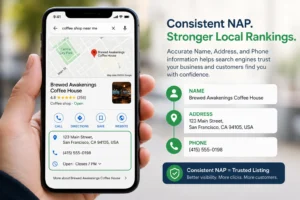
In essence, high citation consistency unlocks visibility in local results. One case study by Local SEO Guide (partnering with Yext) cleaned up NAP across 1,300 locations. They concluded: “Citation consistency is foundational – it’s one of the critical relevancy factors for determining if your business is even eligible to show up in a local pack”. Once businesses are already showing up, citation fixes had less impact on shifting ranks, but without that foundation, they might never appear at all. Google’s own ranking surveys echo this: an incorrect Google Business Profile listing (bad Name, Address, Phone) is among the top negative local factors. On the flip side, every consistent citation you build across directories and social channels is a positive ranking factor.
Building and Auditing Your NAP Citations
To turn NAP consistency into a competitive advantage, follow best practices:
- Exact Business Name: Use your real-world, legal business name consistently. Don’t append extra keywords or slogans. If your store is “Pioneer Consulting Group, Inc.” make sure every listing uses that exact phrasing. Google’s guidelines stress that your Business Profile name must reflect your business’s real-world name as known to customers. Avoid calling yourself “Pioneer Consulting – Best Accounting Services” on one site and “Pioneer Consulting Group” on another.
- Consistent Address Format: Write your address the same way everywhere. Include street type (Rd, St, Ave) uniformly and use or omit suite numbers consistently. Slight variations like “St.” vs “Street” are usually OK (search engines can normalize abbreviations), but avoid serious differences. For example, always list “Suite 200” if you include it at all. Also ensure the full address (city, state, postal code) is correct and up-to-date in Google Business Profile and all citations. Inaccurate addresses can cause Google to “self-correct” your listing using old data from aggregators, which can override your manual edits.
- Uniform Phone Number: Use one primary phone number for the location on all sites. Include the correct area or country code (e.g. +1 for US, +44 for UK) in directories that serve multiple countries. Don’t publish a call-tracking number on only some listings, as that fragments data. Again, exact formatting (spaces, dashes) isn’t critical if digits match, but the numeric sequence must be the same. When users click-to-call from Google Maps or voice devices, a wrong digit could lose the lead.
- Website URL: In addition to NAP, maintain the same Website URL on all listings. (Some SEOs call this NAPW when including Website.) Always point to the correct domain and homepage or specific location page. Mismatched URLs are a lesser issue than NAP mismatches, but they still signal inconsistency.
- Manage Key Listings: Prioritize creating/claiming your listing on the big players: Google Business Profile, Bing Places, Apple Maps Connect, and industry-specific directories. These serve as citation hubs. Then expand to sites like Yelp, TripAdvisor, Yellow Pages, local Chambers of Commerce, and relevant social profiles. Ensure each one has identical NAP information. Google and Bing often use data from these “tier-1” sources to verify your primary listing, so errors here can cascade.
- Use Tools & Audits: Periodically audit your NAP. Use tools like BrightLocal, Moz Local, SEMrush’s Listing Management, or just Google your business to spot discrepancies. The first step is diagnosis: find where your business is listed. Then systematically fix any variations. For multi-location brands, solutions like Yext or SkillDigital’s [Digital Agent] can sync NAP across dozens or hundreds of sites at scale.
Here’s a quick example of good vs. bad consistency:
| Listing | Good (Name, Address, Phone) | Bad/Inconsistent (Name, Address, Phone) |
|---|---|---|
| Google Business Profile | Paris Bistro, 45 Queen St, Sydney, NSW, AUS; +61 2 9999 1111 | “Paris Bistro Restaurant – Sydney” with a different phone |
| Yelp | Paris Bistro (same address) | Paris Bistro Cafe (wrong name) |
| Website | ParisBistro.com | ParisBistroCafeSydney.com (redirects) |
| Facebook Page | Paris Bistro (same address) | Paris Bistro (@facebook) (correct info) |
Google Business Profile and Structured Data
Your Google Business Profile (GBP, formerly Google My Business) listing is the central source of NAP for local search. As Google’s own guidelines state, your GBP name should match your real-world business name exactly, and your address must be accurate and precise. If you try to stuff keywords or use a slightly altered name on your GBP, Google may suspend or penalize you. Always use the official name as it appears on your storefront and stationary.
Moreover, keep your GBP address and hours updated – outdated info here is a top negative ranking factor. Google cross-references your GBP data with third-party sources (like data aggregators and directories). If those sources have an old address or phone, Google might override what you enter. For example, Digispot notes: “Information flows like a waterfall. Google doesn’t just trust what you type into your GBP; it verifies that data against third-party sources… If an aggregator holds old data, they feed that bad data to other services… Google may see this persistent ‘bad’ data and decide to correct your listing”. The solution is to maintain consistency everywhere – update your address or phone in all places so the entire “waterfall” of data is correct.
Beyond listings, adding Schema markup (structured data) on your website helps reinforce your NAP. Search Engine Land reports that in the AI-driven search world, schema “helps Google and other AI systems understand who you are, what you do, where you operate, and how confidently your information can be reused”. Mark up your business info with the LocalBusiness schema (including name, address, phone) to give Google another clear signal. When your on-page schema, website content, GBP, citations, and reviews all match, Google’s confidence in your info rises. Discrepancies cause it to ignore conflicting data. In practice, schema may not directly boost your rank, but it reduces confusion and helps AI agents show the right info about your business.
NAP in the AI and Answer Engine Age
Local SEO is evolving with AI-powered search. Voice assistants, chatbots, and conversational AI (ChatGPT, Google Gemini, etc.) increasingly pull local business info to answer questions. In this era of Answer Engine Optimization (AEO) and AI Overviews, your NAP consistency is more important than ever. Experts warn that fragmented NAP can lead AI to hallucinate or simply skip your business.
Think of it this way: AI and NLP models construct knowledge graphs of businesses. Each node (your business) has attributes (name, address, phone, categories, reviews). Consistent attributes strengthen your entity’s authority. Searchengineland notes that local search now relies on building a “stable, trustworthy local entity” across search, maps, and AI responses. If your NAP is consistent, an AI may confidently cite you in a voice answer (“Your query: Thai restaurant near me” → “Thai Garden is a Thai restaurant at 123 Elm Street, phone 555-1212.”). If your data is inconsistent, the AI might give another answer to be safe, or ask follow-up questions.
In fact, Whitespark’s 2026 Local Ranking Factors report highlights AI search signals as a new frontier. Today’s local visibility hinges on brand authority and engagement, not just keywords. That means your business needs to appear active and trusted: up-to-date GBP posts, fresh reviews, and yes – unwavering NAP data across all signals. AI systems aggregate signals like social activity, reviews, and citations to judge “is this brand alive and reliable?”. Consistent NAP is part of that reliability.
Likewise, modern Semantic SEO and entity-based SEO practices stress clarity. Use clear entity-rich language around your business (e.g., include “LocalBusiness” schema, category keywords) so AI understands your context. But always anchor it with consistent NAP attributes. For example, if a voice assistant reads out your address, it should come from a single, trusted source (your GBP or markup).
In summary, as AI Search Era unfolds, maintaining NAP consistency is akin to maintaining your business’s membership card in AI’s knowledge network. It ensures voice queries and AI overviews can find and use your info. Even if an AI pulls data from multiple sources, it will pick the one with the highest confidence – which comes from uniform NAP across those sources.
Key Takeaways and Best Practices
- Audit your NAP regularly: Use tools (BrightLocal, Moz Local, Yext, manual Google searches) to find and fix any NAP discrepancies across the web.
- Prioritize major platforms: Ensure your Google Business Profile, Bing Places, Apple Maps, Yelp, and main directories have exact NAP matches. These are the high-authority citation sources that influence local ranking the most.
- Leverage structured data: Implement LocalBusiness schema on your site to reinforce your NAP info for AI and search engines.
- Stay consistent over time: Whenever your phone number or address changes, update it everywhere immediately to prevent split citations.
- Think globally: If you operate in multiple countries, use local formatting (international dialing codes, region-specific address format) consistently. Each region’s search engines and maps require accuracy.
By treating your NAP as your digital identity, you improve your local search optimization across regions – from New York’s Google results to Europe’s Bing or Middle East’s mobile searches. Consistent NAP not only builds trust; it lays the groundwork for AI-driven engines to surface your business correctly.
Conclusion
In today’s AI-driven digital landscape, understanding NAP in Local SEO is no longer optional for businesses that want stronger Local Search Rankings. Your business name, address, and phone number act as core trust signals for search engines, AI systems, and potential customers across the web. Consistent NAP details strengthen your visibility in Google Business Profile results, local citations, AI Overviews, voice search, and map-based searches while reducing confusion for both users and search engines. As Modern SEO continues evolving through Semantic SEO, Entity Based SEO, AEO, and GEO strategies, businesses with accurate and unified NAP data will continue to outperform competitors in local search optimization. Simply put, if your business information stays consistent everywhere online, your authority, credibility, and discoverability grow together.
Ready to boost your local search presence? Start by auditing your business’s Name, Address, and Phone across the web today. Fix any discrepancies and watch your local rankings improve. At Elevatech Digital, we specialize in local SEO and business listing management – feel free to contact us for a comprehensive audit or more personalized advice on optimizing your local citations and NAP consistency.
Frequently Asked Questions
-
What does NAP stand for in Local SEO?
NAP stands for Name, Address, and Phone number of a business. In local SEO, it refers to having the exact same business name, street address, and phone number listed on your website, Google Business Profile, social media, and online directories. This consistency is crucial for local search performance
-
Why is NAP consistency important for local search rankings?
Consistent NAP across all listings acts as a signal of trust and legitimacy to search engines. Google and Bing use matching citations to verify your business. When your NAP is uniform, you gain higher “data confidence,” which helps your business rank better in local map packs and searches. In contrast, inconsistent NAP can confuse algorithms, leading to lower rankings or even removal from local results.
-
How do I audit and fix NAP inconsistencies?
Start by listing all places your business appears online (Google, Yelp, Bing, Facebook, etc.). Use local SEO tools like BrightLocal, Moz Local, or Whitespark to automate the check. Compare each listing’s name, address, and phone against your official info. Then correct any mismatches by editing profiles or contacting directories. For example, ensure “St.” vs “Street” usage is consistent, and eliminate old phone numbers. Periodic audits (every few months) help keep your NAP clean.
-
Does NAP consistency matter for Google Business Profile (GBP)?
Yes. Your GBP should mirror your exact business name and address as used offline. Google explicitly requires the name on GBP to match your real-world branding. If your NAP on GBP differs from other listings (or your website), Google may distrust the information. In fact, incorrect GBP info is a top negative local ranking factor. Always double-check that your GBP details match your official NAP exactly.
-
Do AI voice assistants use my NAP data?
Yes. Virtual assistants (Siri, Alexa, Google Assistant) and AI chatbots often pull from business directories and Google data to answer local queries. If your NAP is inconsistent or missing in those sources, the AI might give someone else’s information or skip your business. Keeping your NAP tight ensures that when someone asks “Hey Google, find me a plumber near me,” AI can correctly cite your business name, address, and phone.
-
What are local citations and how do they relate to NAP?
A local citation is any mention of your business’s name and contact details online – on directories, social media, blogs, etc. Citations are the building blocks of NAP consistency. The more sites that list your correct NAP, the stronger your citation profile. Consistent citations across many sites reassure search engines of your legitimacy. They essentially multiply your NAP signal, boosting local relevance.
-
What’s the biggest takeaway about NAP for local SEO?
Think of NAP as your business’s digital ID. Getting it right is non-negotiable. Consistent NAP across your site, Google Business Profile, and all directories lays the foundation for local visibility. It influences everything from search ranking to voice assistant answers. To succeed in local SEO, “table stakes” means locking in a consistent NAP – it’s basic, but it’s crucial.