
Optimizing for Google’s Search Generative Experience (SGE) in 2026 means rethinking SEO for an AI-driven world. In this new generative search experience, Google no longer just lists links, it often generates direct answers by synthesizing information from multiple sources. The focus shifts from “rank on page 1” to “be cited in the answer.” As Adobe’s 2026 SEO analysis explains, “visibility will depend less on page position and more on whether a brand is cited within AI-generated responses”. In practice, this means your content must be clear, factual, and structured so that AI systems can easily extract and trust it.
In this guide, we’ll break down SGE and AI search concepts and give you step-by-step SEO recommendations that work globally. We’ll cover Answer Engine Optimization (AEO) and Generative Engine Optimization (GEO) strategies, technical tips (schema, entities, metadata), and content tactics (FAQs, bullet points, clear answers) to ensure your site thrives in the AI-powered search era.
Understanding Google’s Search Generative Experience (SGE)
SGE (now often branded as “AI Overviews” or “AI mode” by Google) was first introduced at Google I/O 2023. It uses a custom Gemini AI model to generate summaries and answers right in the search results. By early 2024, Google began rolling out AI Overviews in the U.S., and by late 2024 had expanded to over 100 countries. As of March 2026, AI Overviews appear on ~48% of Google searches. In simple terms, instead of just listing web page links, Google may now present a synthesized answer (often with links to sources) at the top of the page.
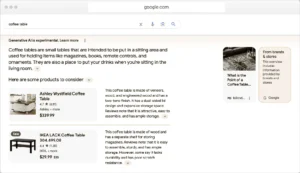
This image illustrates a classic SGE result: it provides an AI-generated answer (“Coffee tables are low tables…”), cites products (Ashley Wystfield Coffee Table, IKEA LACK) with images and prices, and lists sources. The key point: Google’s AI created new content from existing pages. SGE is experimental but expanding quickly, and Google emphasizes it responsibly (“bringing our new SGE to you first in Labs”).
Why SGE Changes SEO
SGE marks a transformative shift in how search works. Traditional SEO rewards content that ranks highest on a SERP. In the SGE era, SEO success means your content is used by the AI to form answers. As Adobe notes, “the goal is no longer just to rank first. The goal is to be cited within the answer”. In other words, Google’s generative AI extracts facts from your pages rather than listing your URL.
For example, Search Engine Land points out that entities (the clear topics or named things your pages are about) now matter more than exact keyword matching. Google’s AI “interprets meaning through entities and their relationships”. To them, being recognized as the correct entity (e.g. a company or concept) is critical for citation. Similarly, emarketer describes Generative Engine Optimization (GEO) as structuring content so AI platforms (ChatGPT, Google Overviews, etc.) “cite, recommend, or mention a brand when users ask questions”.
The practical upshot: Content must be unambiguous and authoritative. Answer search queries directly, use semantic (entity) clarity, and provide supporting details and sources. As Google Search Central advises, focus on accuracy, quality, and relevance – especially for AI-generated content. Keep E‑E‑A-T strong: be transparent, cite experts, and write clearly. Remember: AI overviews may reduce clicks on your pages, so to win visibility you need to earn citations and featured snippet-style answers.
SGE and AI Overviews in Different Regions
SGE/AI Overviews is global in scope. Originally in a few countries, by late 2024 it was available in 100+ countries and over 40 languages. By 2026, it covers the majority of major markets. This means your optimization efforts should consider international audiences: write in clear international English and use universal examples. Where possible, provide multilingual content or use hreflang for key markets. Local content still matters too – SGE shows “Places” modules for local queries, pulling from Google Business Profiles. That means maintain accurate business listings, reviews, and LocalBusiness schema for local visibility in SGE.
Core Strategies to Optimize for SGE (AEO & GEO)
To perform well in SGE, focus on both AEO (Answer Engine Optimization) and GEO (Generative Engine Optimization) techniques. These overlap heavily: both aim to make your content citable by AI. Here are the top strategies:
Key Differences: Traditional SEO vs SGE Optimization
| Aspect | Traditional SEO | SGE Optimization (2026) |
|---|---|---|
| Goal | Rank higher on SERPs | Get cited in AI-generated answers |
| Focus | Keywords & backlinks | Entities, context & structured data |
| Content Style | Long-form, keyword-rich | Clear, answer-first, structured |
| User Experience | Click-driven traffic | Zero-click visibility + authority |
| Metrics | Rankings, CTR | Citations, AI visibility, mentions |
| Search Interface | Static results pages | Conversational AI-driven responses |
1. Write Clear, Direct Answers (Answer-First Content)
- Lead with answers: Start each section (especially the first paragraph) with a concise answer to the user’s query. Limit it to ~40–60 words that directly respond to the question. Then expand with details. This “answer-first” style mimics featured snippet format and is easier for AI to parse.
- Use headings and FAQs: Structure content around common questions. Use H2/H3 headings that mirror search queries (e.g. “What is the Search Generative Experience?”). Include FAQ sections or Q&A blocks with schema (we cover schema below).
- Bullet lists and tables: Summarize key points in bullets or tables. AI systems latch onto lists for quick facts. For example, a comparison table or list of steps is easily cited by an AI answer.
- Definitions and modular blocks: If explaining a term, consider a “definition box” style: a short definition or description followed by examples. Reusable content blocks (defined in HubSpot’s AEO guide) help standardize answers and signal AI how to extract info.
- One question at a time: Break complex queries into parts. AI can handle nuance but clearly structured Q&A improves reliability. For multi-part questions, address each part explicitly with its own concise answer.
2. Emphasize Entities and Semantic Clarity
- Entity-first writing: Center each page on a single clear entity or topic. (An entity could be a product, person, concept, location, etc.) Align your title, H1, and schema
mainEntityOfPageto the same entity. This makes it obvious to Google AI what the content is about. - Precise vocabulary: Use synonyms, related terms, and context words that a global audience would recognize. Avoid slang or idioms that translate poorly. For example, say “soda” vs. “pop” depending on region or add both terms in content if relevant.
- Internal linking and context: Create topical clusters on your site. Each subpage should reinforce the main entity of the site. Use internal links and
sameAsschema to connect related pages. For example, link from a product page to its category, brand, and related topics. This “knowledge graph” built on your site signals AI systems about entity relationships. - Crosslink to authoritative sites: When relevant, link out to reputable sources (e.g. research studies, official docs). For global trust, linking to recognized organizations (e.g. WHO, UNESCO, or Google’s own documentation) can help AI verify facts.
3. Use Rich Schema Markup
Structured data helps AI understand your content’s meaning explicitly. At minimum, include schema for:
- FAQPage or QAPage: Mark up any FAQ sections or Q&A pairs. This signals question-and-answer format directly to Google. (They may even use this markup to generate AI answer content.)
- HowTo: If your content is instructional, use HowTo schema for each step. This breaks your guide into discrete, easy-to-parse steps.
- Article/BlogPosting: Use Article schema on content pages. Include author, datePublished, and images. This boosts credibility and timeliness.
- Product + Offer + Review: For e-commerce, mark up products with Offer (price, availability) and Review (ratings, count). SGE product modules often include these details. Clear pricing in schema can make it more likely your product shows up.
- Organization: Use Organization schema on your homepage and about page. Include your brand name, logo, and social media. This ties content to your brand identity.
- Speakable (optional): Mark key paragraphs with Speakable schema to help voice assistants (like Google Assistant) find and read answers aloud.
- LocalBusiness / PostalAddress: If relevant, use LocalBusiness schema to tag location, hours, contact info (especially important for local SGE queries).
In general, JSON-LD format is recommended. Always validate your markup with Google’s Rich Results Test. As BrightEdge notes, structured data won’t be used word-for-word by AI, but it “feeds the knowledge-graph and context layers that AI relies on”. Well-marked content is more likely to be correctly understood and cited by AI overviews.
4. Prioritize E‑E‑A-T and Credibility
- Authoritativeness: Make sure your author names and credentials are visible (use bylines or author bios if possible). If you quote facts or statistics, cite the source in-line. AI systems assess trust by recognizing authoritative names and sources.
- Original Research & Fresh Content: Unique insights or data can set you apart. Since AI often relies on what’s online, original case studies or research boost your chances. Also keep content updated: note publish dates.
- User Trust: Avoid vague claims. Instead of “Experts say…,” name the expert or study. Transparency builds trust for both readers and AI.
- Avoid Spammy AI Content: Google’s guidelines warn against low-quality generative content that adds no value. Always add human editing and fact-checking.
5. Optimize for Local and Voice Queries (Global Audience)
- Local SEO Alignment: Google’s SGE often displays a Places (local) module for queries like restaurants or services. Ensure your Google Business Profile is complete with up-to-date reviews and info. Use LocalBusiness schema to highlight your location and offerings. (BrightEdge found local modules appear in about half of SGE results for applicable queries.)
- Voice Search Tips: AI Overviews feed into voice assistants. Use concise “speakable” answers. Make sure your content answers natural-language questions exactly. HubSpot also recommends tailoring some content to voice: answer “Where is X?” or “How do I…?” clearly, as voice queries are conversational.
- International Content: For multi-region reach, consider multilingual versions of key pages. Use
hreflangtags so Google serves the right language. Even if you write only in English, avoid cultural references that confuse non-local readers.
6. Monitor and Adapt to AI Search Trends
- Track Citations: Traditional SEO tools track rankings; now track AI citations. Keep an eye on how often your content is used in AI Overviews or chat answers. If possible, use tools or services (some SEO platforms now offer “AI search visibility” metrics).
- Featured Snippets & PAA: SGE’s AI overviews often learn from Google’s Featured Snippets and “People Also Ask” boxes. Aim to win those by structuring content as Google expects (e.g. list answers if current snippet is a list). The HubSpot guide notes that if you rank in a snippet, you’ll likely get cited by AI. So treat snippet optimization and PAA research as part of your strategy.
- Core Web Vitals & Technical SEO: Ensure fast loading, mobile-friendly pages. Google’s AI still needs to crawl your site. Good performance and clear site structure (sitemaps, proper hreflang, HTTPS) remain fundamentals.
Technical Checklist for SGE (Bullets)
- Use clean HTML (Google’s AI won’t execute heavy scripts before extracting content).
- Include a well-written title and meta description (these still appear in SGE source citations).
- Ensure schema is valid and up-to-date for any featured formats (FAQ, HowTo, Product, etc.).
- Test pages with the Rich Results Test to see if your schema is working.
- Use internal linking to highlight related entity pages (helps AI build context).
- Maintain business and location data (for local SEO/SGE).
- Image alt text: Describe images clearly. AI can “see” images too, and alt text helps describe visuals.
- Avoid hidden text or tricks; focus on transparency (Google’s spam policy warns against “spammy AI-generated content”).
Conclusion
By 2026, Search Generative Experience (SGE) is mainstream. To win in this AI-first landscape, think beyond rankings: aim to be the answer. That means structuring your site and content so AI can interpret it accurately. Write with clear, concise answers; use schema to label key facts; reinforce your brand and topics as entities; and monitor how AI features impact visibility. This isn’t just a “tactic”, it’s a new SEO foundation.
Elevatech Digital’s take: view your site as an AI-compatible knowledge base. Every page should read like an authoritative answer to a question your audience cares about. With the strategies above – from entity-first content to robust schema and brand authority, you’ll be positioned to appear in Google’s AI Overviews (Search Generative Experience) across the globe. Stay adaptive, keep content quality high, and you’ll thrive in the next-gen search era.
Ready to dominate the Search Generative Experience (SGE) in 2026? Get in touch with Elevatech Digital today and transform your website into an AI-ready, high-performing search asset. Our experts specialize in AEO, GEO, and AI-powered SEO strategies that help your brand get discovered, cited, and trusted in the new search era.
Frequently Asked Questions
-
What is the Search Generative Experience (SGE)?
SGE is Google’s AI-powered search interface (now often called “AI Overviews”) that generates answers and summaries for queries. Instead of just showing links, it uses a custom Gemini model to create a concise answer box with information pulled from various web pages.
-
How does SGE change SEO?
Traditional SEO aimed to rank pages high. With SGE, success is measured by being cited in AI-generated answers. This means optimizing content for clarity and extractability (AEO/GEO) rather than just keyword density. For example, if Google can easily grab a fact from your page (thanks to good schema and structure), your brand may be mentioned in the answer.
-
How can I optimize content for SGE?
Focus on Answer Engine Optimization (AEO): write direct answers to user questions at the top of your content, use FAQs and lists, and format sections clearly. Use Generative Engine Optimization (GEO): ensure pages are entity-focused (clear topic, schema markup, internal links) so AI knows what each page is about. Include structured data (FAQ, HowTo, Product, etc.) to label information explicitly.
-
Does structured data help with SGE?
Yes. While Google says no new markup is required for AI Overviews, using schema improves AI interpretation. Schema tells search engines exactly what your content represents. For instance, marking Q&A with
FAQPageor product details withProductschema makes those facts more digestible to the AI. BrightEdge notes that schema “feeds the knowledge-graph and context layers that AI relies on”. -
How do I measure success in SGE?
In the AI era, look beyond clicks. Measure how often your content is cited by answer engines, share of AI-driven visibility, or traffic from “answer” queries. Keep an eye on Google Search Console for changes in featured snippet or “question” impressions, which can signal AI answer picks. Ultimately, if AI is using your content to answer questions, that’s a win.