
Imagine asking Google a natural question and instantly getting a perfect answer. That’s the power of semantic SEO, it’s like teaching search engines to understand your content’s meaning, not just spot keywords. In today’s global, AI-driven world, semantic SEO (also called contextual SEO or entity-based SEO) is a game-changer. It shifts focus from just matching words to understanding intent and related topics. In practice, this means crafting content that covers whole topics deeply, with related terms and clear connections (like an expert guide rather than a keyword-stuffed article). As search algorithms evolve, using semantic SEO strategies can dramatically increase your visibility and traffic worldwide.
Semantic SEO is about unlocking context and connections. For example, Google’s Knowledge Graph lets the engine know that “apple” can mean a fruit or a tech brand by the surrounding content
What is Semantic SEO? (Quick Answer for AI & Featured Snippets)
Semantic SEO is the process of optimizing content based on meaning, user intent, and topic relationships, rather than just individual keywords.
In simple terms:
- It focuses on context, not just keywords
- It uses related topics and entities
- It answers complete user questions
Think of Semantic SEO as teaching search engines to “understand” your content, not just read it.
Why Semantic SEO Matters Now
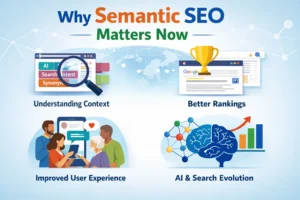
Search engines have gotten a lot smarter. Updates like Google’s Hummingbird (2013) and BERT (2019) taught them to interpret full phrases and context. Instead of just matching keywords, they analyze entities (people, places, brands, concepts) and user intent. For instance, Semantic SEO means your “laptop” article should also mention related things like graphics cards, RAM, or photo editing software if the topic is about graphic design laptops. This helps Google’s AI see the full picture.
In practical terms, semantic optimization ensures your content appears in more places: not only traditional search results but also in AI Overviews and voice assistants. Consider that today “zero-click” searches are skyrocketing: 69% of Google searches now end without a click, as answers are given directly on the results page. Chatbots and voice assistants (ChatGPT, Siri, Alexa) are also growing – ChatGPT has over 800 million weekly users. That means if you’re not optimizing for semantic understanding and Answer Engine Optimization (AEO), you risk being invisible.
Key Statistics:
- 69% of searches are zero-click (users get answers instantly)
- AI tools like ChatGPT serve millions of queries daily
- Voice search is growing rapidly across global markets
If you ignore Semantic SEO, you risk becoming invisible.
Core Elements of Semantic SEO
To implement semantic SEO, cover five key areas of modern optimization:
To succeed with Semantic SEO, you need a structured approach.
Semantic SEO Framework (Table)
| Element | What It Means | Why It Matters | Practical Example |
|---|---|---|---|
| Search Intent Optimization | Understanding why users search | Aligns content with real needs | Laptop page includes gaming, work, design use |
| Topic Clustering | Grouping related content | Builds authority | Coffee guide + brewing methods pages |
| Entity-Based SEO | Using identifiable concepts | Improves context understanding | Mentioning tools, brands, technologies |
| Content Depth | Covering topics fully | Boosts engagement & rankings | Adding FAQs, comparisons |
| Technical SEO & Schema | Structured backend optimization | Enables rich results | FAQ schema, internal linking |
-
Understand Search Intent (Context Over Keywords): Research why people search. Break topics into subtopics and related questions. For example, for a “Semiconductor” page, cover manufacturing processes, industry trends, materials, and future AI applications. Google’s own NLP (natural language processing) tries to match queries with the intent and meaning behind words. So give it clear context: use related terms, answer likely questions, and explain concepts fully.
-
Topic & Keyword Research: Instead of single keywords, gather clusters of related terms and questions. Tools like Google Search Console’s “people also ask” or NLP-based keyword tools can reveal semantically related phrases. For example, “coffee brewing” content should include espresso machines, pour-over methods, roast levels, etc.. Map these out in a content plan. This builds topical authority: a pillar page on a broad theme (e.g. “The Ultimate Guide to Coffee Brewing”) and linked cluster pages on niche aspects (espresso vs. drip, best beans, brewing tips).
-
Quality Content Development: Write in-depth, high-value content that naturally weaves in related topics and entities. Break your coverage into logical sections or FAQs, and use bullet lists or tables where helpful. This not only appeals to readers (good UX) but also to AI/voice. As Wired notes, chatbots love structured formats like bulleted lists and FAQs. For instance, include an FAQ section answering common questions; it’s ideal for featured snippets and AI answers. And update old posts by adding new semantic keywords and context rather than keyword-stuffing.
-
Technical SEO & Schema Markup: Behind the scenes, make sure crawlers can access and understand your content. Use structured data (Schema.org) to label entities: products, organizations, people, reviews, etc. This helps Google add your content to its Knowledge Graph and voice agents’ results. Also ensure fast site speed, mobile-friendly design, and secure connections. Remember, even the best content won’t rank if it’s behind an orphaned or slow page.
-
Internal Linking & Consistency: Create a clear site structure that reflects topic relationships. Link between related pages using descriptive anchor text so users (and Google) can easily navigate the full topic cluster. This distributes authority throughout your site and helps reinforce context. Don’t just drop random links – each link should add value. For example, if one page covers “AI in SEO” and another covers “Natural Language Processing,” link them when relevant. Consistent terminology (e.g. always call an entity by the same name) prevents confusion.
Semantic SEO Strategies to Boost Traffic
Here’s a proven, actionable framework:
1. Research Search Intent & Topics
- Use “People Also Ask”
- Analyze competitors
- Explore forums
2. Build Topic Clusters
- Create pillar + supporting content
- Interlink strategically
3. Optimize Content
- Use natural language
- Add semantic keywords
- Answer questions early
4. Add Schema Markup
- FAQ schema
- Article schema
5. Focus on E-E-A-T
- Show expertise
- Add real insights
- Build trust
6. Use AI & Tools
- Generate topic ideas
- Validate with human expertise
Semantic SEO Meets AI, Voice & AEO/GEO
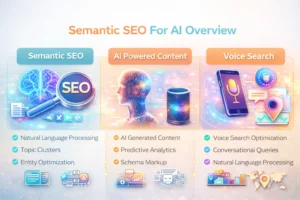
Semantic SEO is increasingly intertwined with AI-driven search. The new paradigm includes AEO (Answer Engine Optimization) and GEO (Generative Engine Optimization). Instead of obsessing over organic rank, you optimize to be the answer that AI tools serve directly to users.
-
AEO (Answer Engine Optimization): Focuses on featured snippets and AI answers. Structure your content so that it answers specific queries upfront. Use numbered lists, bullet points and direct “Q&A” sections. Stefan Maritz notes that AEO means “being the answer, not just a link”. For example, write a clear summary at the top of an FAQ answer that an assistant like Google’s might read aloud.
-
GEO (Generative Engine Optimization): Emerging trend from news like Wired’s report. As more users rely on chatbots for recommendations, brands craft very granular answers so that AI cites them. Chatbots often draw from content that is specific, authoritative, and structured. For instance, a bullet-list of product features or a well-labeled data table on your page can make it into a conversation. This isn’t just theoretical: retailers have seen a predicted “520% increase in traffic from chatbots” in 2025. So, think of creating content that answers a hundred specific questions (as one expert says, an FAQ can “answer a hundred different questions” for an AI engine).
-
Voice Search & Natural Language: Semantic SEO naturally caters to voice queries because it emphasizes conversational, user-focused language. People ask voice assistants full questions. By writing in a natural, accessible style (and including synonyms and related terms), you align with how voice searches work.
Proven Traffic Boosts & Case Examples
What kind of results can you expect? While every site is different, semantic SEO has delivered real wins. For example, by systematically creating topic clusters, Healthline dominates in health content. In e-commerce, companies aligning content to user intent have seen large traffic gains. One report cites Bankrate publishing hundreds of AI-assisted articles to drive ~125,000 organic visits a month (key takeaway: high-quality, intent-focused content, even AI-generated but well-edited, can be highly effective).
By improving user experience, semantic SEO also indirectly boosts metrics that signal quality: longer dwell time, lower bounce rates, and more social shares. Google rewards content that truly satisfies users. As Search Engine Land explains, Google now “indexes entities… and uses NLP to understand the search intent” so it can serve rich snippets. Websites that provide clear, context-rich answers are more likely to pop up in these rich features – driving both traffic and trust.
Metrics to watch: Track not only rankings but also visibility in featured snippets, voice search positions, and AI citations. Tools like Similarweb and Semrush indicate that with semantic SEO, you can climb not just in search results but also in AI-driven metrics (for example, Semrush’s Position Tracking can even track your brand’s mentions in ChatGPT results).
Conclusion & Next Steps
Semantic SEO is the modern way to optimize for search – one that’s inherently more user-friendly and future-proof. By focusing on the meaning behind searches, covering entire topics thoroughly, and integrating with AI-driven search trends (AEO/GEO/voice), you position your site to capture more high-intent traffic globally.
Key takeaways:
- Always aim to answer questions fully. Use clear language and cover related subtopics.
- Use lists, tables, and FAQs to make your content AI-friendly.
- Build internal links between related pages to strengthen topic clusters.
- Leverage schema markup to highlight key information for search engines.
Ready to elevate your SEO game? Contact Elevatech Digital today, for semantic SEO strategies that drive real results across regions, from New York to London, Dubai to Tokyo. Audit your content now with these principles, and watch your visibility grow.
Frequently Asked Questions
-
What’s the difference between semantic SEO and regular SEO?
Traditional SEO focused mainly on matching specific keywords. Semantic SEO broadens the view: it’s about topics, entities, and user intent. Instead of page-per-keyword, semantic SEO covers entire subject areas and uses related terms to show comprehensive relevance.
-
Does semantic SEO replace keywords?
No, keywords still matter as signals. But semantic SEO uses them smarter. You include your main keyword, but you also add context – synonyms, related phrases, and structured data – so the engine “gets” your page’s full meaning. Think broad and deep, not keyword-stuffed.
-
How do I find semantic keywords or entities?
Use tools and techniques that reveal related concepts: Google’s “People also ask”, related searches, keyword tools that show LSI/semantic suggestions. Explore knowledge bases (Wikipedia, industry glossaries) to identify relevant entities. For example, if you write about “sustainable fashion,” related entities might include eco-friendly fabrics, ethical brands, slow fashion movement. Adding these terms gives context.
-
Can AI help with semantic SEO?
Yes, AI tools can assist research (e.g. cluster analysis, content brief generation), but use human judgment. For instance, tools can suggest topics to cover, but you as the expert decide the narrative. Always fact-check AI content and ensure it aligns with true expertise (one case study noted AI content works well when carefully edited by humans).
-
How long until I see traffic improvement?
Semantic SEO is a long-term strategy. You’re building topical authority. You may see initial gains in engagement (people stick around longer), and over months watch rankings rise as Google indexes your comprehensive content. Using Google Analytics and SEO tools, measure increases in impressions for related keywords over 3–6 months.