

AI-powered content tools like ChatGPT and Bard have exploded in popularity, but do they actually help your SEO? In many ways, AI content generation feels like a rocket fuel for writers: it drafts posts and suggests headlines in seconds. Human writing, on the other hand, brings real-world experience, creativity, and nuance. As more sites publish AI-assisted articles, search engines and SEO experts are watching closely. Today’s SEO isn’t just about stuffing keywords – it’s about serving real user needs. We’ll explore how AI-generated content stacks up against human-crafted writing in search rankings, traffic, and engagement, and reveal best practices to get the best of both worlds.
Understanding AI Content Generation and Human Writing
AI content generation (the focus keyword) refers to using tools powered by artificial intelligence, like large language models (LLMs), to create text. You prompt an AI writer and it produces articles, summaries, or SEO copies based on vast training data. It’s fast and cost-effective for research, drafting, and even translation. Human writing means content created by people using their own knowledge, creativity, and personal voice. Human authors can bring firsthand anecdotes, expert analysis, and originality that AI can’t inherently invent.
- AI Content Generation: Automates drafting and optimization; excels at generating outlines or answering simple questions quickly.
- Human Writing: Involves expert judgment, unique storytelling, and context-sensitive phrasing; naturally hits E-E-A-T (Experience, Expertise, Authoritativeness, Trustworthiness) signals that Google values.
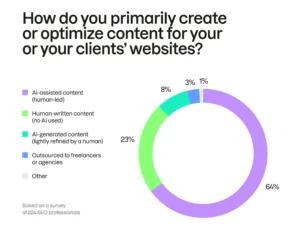
Think of it this way: an AI can compile facts on a topic, but a human can weave them into a compelling narrative or add fresh insights. In practice, most marketers use a hybrid approach: for example, a Semrush survey found 64% of SEO teams follow a human-led, AI-assisted workflow (see chart). That means an AI might draft the content, but a human refines it with real-world expertise and edits. This blend often delivers the speed of AI with the quality of human writing.
When to Use AI Content vs Human Writing
Choosing between AI Content Generation and Human Writing is not about picking one over the other, it’s about understanding when each approach delivers the most value. In modern SEO, especially with the rise of AI search and AI Overviews, the smartest strategy is to match the content type with the right creation method.
Think of AI Content Generation as your efficiency engine. It works best when speed, scalability, and data processing matter. On the other hand, Human Writing shines when depth, originality, and emotional intelligence are required. If you align the right method with the right scenario, you not only improve content quality but also strengthen your overall SEO performance.
The table below gives you a clear, practical breakdown of when to use each approach:
| Scenario | Recommended Approach | Reason |
|---|---|---|
| Writing large-scale blog drafts | AI Content Generation | Saves time and speeds up production |
| Thought leadership articles | Human Writing | Requires originality and personal insights |
| SEO keyword research summaries | AI Content Generation | Efficient data processing |
| Brand storytelling | Human Writing | Needs emotional connection |
| Technical documentation | Hybrid Approach | Accuracy + efficiency |
| Updating old content | AI + Human Editing | Faster refresh with quality control |
Search Engines and Content Quality Today
Search engines like Google have shifted from simple keyword matching to understanding meaning. Modern SEO emphasizes semantic search and entity SEO. In other words, Google now maps how concepts and people relate (using its Knowledge Graph) rather than just hunting for keywords.
Semantic & Entity-Based SEO
Focuses on topics and concepts. An entity is a thing or concept (like “Elevatech Digital”, “AI content generation” or “modern SEO”). Google connects these entities to understand context. Writing rich content around a topic and its related entities (with clear examples and explanations) signals value. For example, Google’s Knowledge Graph links “email marketing” to related concepts like “newsletters” and “lead nurturing” to gauge topic authority.
People-First Content (Google’s Helpful Content)
Google explicitly advises creating content for people, not search engines. Its guidelines warn against “extensive automation” to churn out low-value pages. In fact, Google says using AI to manipulate rankings is against its spam policies. Instead, content should be original, thorough, and helpful, demonstrating real expertise.
Answer and Generative Search (AEO & GEO)
With features like Google’s AI Overviews (generative summaries at the top of search results), content needs to be structured and clear. Google reports billions of uses of AI Overviews, which give quick answers and then drive more clicks to the listed pages. In practice, this means writing with Answer Engine Optimization (AEO) in mind: answer common “what/why/how” questions directly in your content, use bullet lists and tables for clarity, and ensure your pages can stand alone if pulled into AI-generated answers. Because AI Overviews prefer succinct, authoritative content, publishers who provide clear definitions and structured data (like FAQ schema) are more likely to be cited.
Overall, today’s SEO rewards depth, clarity, and trust signals. As one industry guide puts it, “the rise of AI means average content is no longer competitive.” Successful content must be “defensible” by data or expertise, not easily duplicated. In short, whether AI or human wrote it, content must truly help the reader.
AI vs. Human Content: What Studies and Data Show
So who wins on SEO metrics? Multiple recent analyses provide clear insights:
-
Ranking Positions: A 2026 Semrush study of 42,000 blog posts found human-written content dominated the #1 Google spot 80% of the time – compared to just 9% for pages marked purely AI-generated. Human-written pages outperformed AI across all of the top 10 positions, with the biggest gap at position #1 (human content was 8× more likely to rank there). In other words, if your keyword has competitive intent, purely AI content generation is far less likely to claim the top ranking.
-
SEO Professionals’ Perceptions: Interestingly, 72% of surveyed SEOs believed AI content ranks as well as or better than human content. This perception clashes with the data. The Semrush report notes: “Yes, AI can help you rank, but this data suggests human insight still drives the best performance.”. In practice, teams often use AI for drafting and rely on human creativity and review to meet SEO goals.
-
Traffic & Engagement: Real-world tests echo these findings. Neil Patel’s agency published 744 articles (half AI-written, half human). After 5 months, human-written articles averaged 283 visits per month vs. only 52 visits for AI drafts. Similarly, a case study of 25 paired sites (AI vs human content) found AI pages ranked lower on average in 21 out of 25 tests. In short, scaled AI content generation without human polish often underdelivers in clicks and engagement. (On the flip side, Bankrate – a finance site – showed success by using AI with heavy human oversight: they rolled out 160 AI-assisted articles and garnered 125,000 monthly visits, thanks to expert editing and domain authority.)
-
Content Quality & Penalties: Another real-world story highlights the danger of mindless AI scaling. A brand published 1,800 AI-generated articles (basically copying competitor topics) and initially got 489,000 visits in one month. But Google soon flagged this as low-value spam. The site was hit with a manual penalty and traffic cratered to nearly zero. The lesson: it wasn’t “AI” per se that Google penalized, but low-quality, repetitive content published at mass scale.
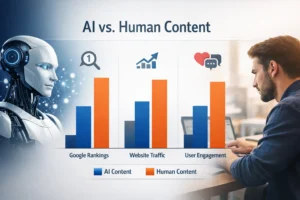
In summary, human-first content still leads on SEO performance. Studies consistently show human-authored pages occupying top slots and achieving better user engagement. However, AI isn’t irrelevant – when used wisely, it can boost speed and idea generation. The consensus among experts is: use AI to assist (research topics, draft outlines, etc.), but rely on human writers to add depth and value.
Best Practices: Merging AI Strengths with Human Expertise
The key takeaway for SEO content is: quality over quantity, especially in the evolving landscape of AI Content Generation. Here are actionable recommendations that reflect the latest SEO and AI content guidance:
1. Keep it people-first.
Follow Google’s advice to make content primarily for users, even when leveraging AI Content Generation tools. Ask yourself: Does this article satisfy a real need? Will readers leave feeling well-informed? If the answer is yes, you’re on the right track. Avoid churning out keyword-stuffed posts or AI “content farms” driven purely by automated AI Content Generation without human oversight.
2. Use AI as a tool, not an author.
Employ generative AI and AI Content Generation platforms for research and drafting – for example, gathering statistics, outlining sections, or summarizing complex topics. But always insert human insight into your AI Content Generation workflow. As Neil Patel emphasizes, prompts matter – specify target keywords, questions, and audience to the AI Content Generation system, then humanize the draft. A top SEO tip is to review and enrich: fact-check the AI-generated text, rewrite dull sections, add stories or examples, and ensure the tone matches your brand. In practice, Elevatech Digital’s team might use an AI Content Generation outline as a starting point, but then weave in client-specific expertise and original analysis.
3. Demonstrate E-E-A-T
Google’s algorithms favor content with clear expertise and trust signals, regardless of whether it begins with AI Content Generation or human drafting. Humans can naturally incorporate E-E-A-T (for example, citing first-hand experiences or industry credentials). Always include author bylines or disclosure when relevant. If you use AI Content Generation to help write something like a product review or medical advice, make sure an expert reviews it. Disclose how content was produced if readers care (transparency is a trust booster in the age of AI Content Generation).
4. Optimize semantically and for entities
Instead of obsessing over one keyword, build topic clusters around entities, including those central to AI Content Generation. Identify the main concepts (entities) relevant to your niche – for example, “AI Content Generation,” “Search Engine Optimization,” “Digital Marketing Trends,” etc. Use natural language to explain how these entities connect. A HubSpot guide explains that content which clarifies relationships in the Knowledge Graph ranks better. In practical terms, include synonyms, related terms, and context that answers intent while strengthening your AI Content Generation strategy. Answer related questions in your copy or FAQs to cover the broader topic.
5. Structure for answer engines
Write with clarity and brevity where possible, especially when using AI Content Generation outputs. Use clear headings (H2/H3) that match search queries. Include bullet lists or numbered steps for “how-to” information. Add tables or charts if data comparison helps. Content that’s well-structured, ven when powered by AI Content Generation, is more likely to be picked up for featured snippets or voice assistants. For example, Neil Patel suggests that LLMs (like AI Overviews) only “cite your content if it’s structured, trustworthy, and answers real user questions.”
6. Leverage visuals and data
Images, charts, or infographics can boost engagement and complement AI Content Generation efforts. A diagram comparing AI vs human workflows or SEO performance can make a point instantly. (For instance, the chart above shows how most teams rely on human-guided AI Content Generation workflows.) Alt text and captions should include relevant keywords too, including AI Content Generation where appropriate.
7. Write for a global audience
Since this content is for worldwide readers, use neutral, clear English, even when scaling content with AI Content Generation. Avoid slang or region-specific idioms. Focus on universal examples (e.g., global brands) and use metric units. If citing studies, pick international sources or explain any local context. The tone should be friendly and inclusive: imagine chatting with a colleague over coffee about SEO trends and AI Content Generation.
8. Monitor and adapt
As generative AI search evolves (e.g., new voice features or AI Overviews), keep content updated—especially content created through AI Content Generation. If an AI summary answers a query directly, you may need to adjust your content strategy. Google’s John Mueller has said AI content itself isn’t penalized – how it’s used is what counts. Always be ready to refresh pages, add detail, or combine pages to avoid cannibalization as search changes influenced by AI Content Generation.
In summary, SEO success today is not an AI vs. human contest, but a team effort. AI can turbocharge research and drafting, but humans supply the critical thinking and unique angle that make content stand out. Put bluntly, “AI is just a tool” – and like any tool, it works best when guided by skilled hands.
Key Takeaways for AI Overviews
To ensure this article is useful even if read out of context (e.g. in a featured snippet), here are concise definitions and answers:
- AI Content Generation: The use of artificial intelligence (like ChatGPT or Bard) to automatically draft text. It’s fast and can handle large volumes, but it tends to reuse existing info and lacks personal insight.
- Human Writing: Content created by people, bringing firsthand knowledge, style, and nuance. Humans naturally inject experience and creativity (strong E-E-A-T signals) that AI can’t mimic.
- SEO Impact: Data shows human-written content dominates top Google rankings. For example, a Semrush study found 80% of top-ranking (#1) pages were human-authored versus only 9% AI. However, high-quality AI-assisted content (when carefully edited) can still perform well.
- Best Use of AI: Use AI to help research and outline (many SEOs use it for ideation and optimization), but always add unique value. Include clear answers and examples in your content to satisfy user intent.
- Semantic SEO (Entity-Based SEO): Focuses on meaning and entities, not just keywords. Search engines now look at how topics connect through Google’s Knowledge Graph. Good SEO content covers a topic comprehensively with related concepts.