

In today’s digital landscape, simply ranking on Google isn’t enough. As a local business owner in America, you need to be everywhere your customers are searching: on smartphones, voice assistants, social media, maps, and even AI chatbots. Think of it like this: back in the day you only needed a big billboard on Main Street. Now, you need billboards on every highway, a presence on every social feed, and even an answer when someone asks Siri or Alexa. Search Everywhere Optimization (SEOx) is the strategy that makes this possible. It’s about expanding traditional SEO beyond web search to cover all modern channels and devices
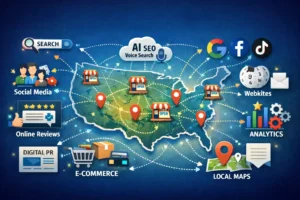
Search Everywhere Optimization means your business can be found and trusted everywhere people look online. Rather than targeting just Google’s search box, you optimize for AI assistants, voice queries, app stores, social searches, Google Maps, and more. In short, you make your brand “visible, understandable, and actionable” across the entire search ecosystem. This holistic approach recognizes that consumers in the U.S. might ask Google on their phone, shout a question to their smart speaker at home, scroll social media, or even consult a restaurant review app. Your business needs to show up on all of these paths.
What Is Search Everywhere Optimization?
Search Everywhere Optimization (SEOx) is essentially modern, omni-channel SEO. It builds on traditional SEO by adding layers for today’s search behavior. In practical terms, SEOx ensures your business appears on search engines and on social platforms, AI tools, apps, maps, and voice devices.
- Traditional SEO (Search Engine Optimization) focuses on ranking your website in organic search results on Google or Bing.
- Search Everywhere Optimization includes that and much more – optimizing for things like Google Maps, local directories (citations), social media profiles, review sites, and AI-driven answer engines.
- Voice Search SEO and Answer Engine Optimization (AEO) become part of SEOx too: you optimize content so that Siri, Google Assistant, Alexa, ChatGPT, or Gemini can easily retrieve and present it.
- Generative Engine Optimization (GEO) is another term for tweaking content so it’s cited by AI when it generates answers.

Think of SEOx as upgrading from a single flashlight (Google search) to a wide-beam lantern lighting up all corners of the web and apps. One industry guide puts it plainly: “if you’re not optimized everywhere, you’re basically invisible to a huge chunk of your audience”. In other words, limiting yourself to one channel (like a website) means missing customers who search elsewhere.
Key SEOx Channels You Must Cover
A modern SEOx strategy covers multiple platforms. For example, the Michigan Tech marketing lab lists optimizing for: traditional search, app stores, e-commerce sites, social/video platforms, AI & LLMs, voice assistants, local listings, and niche search engines. In practice, this means:
- Google/Bing SEO: High-quality website content, keywords, mobile speed and schema markup.
- Local Listings & Maps: Google Business Profile, Yelp, Apple Maps, and other directory entries with consistent NAP (Name-Address-Phone) info.
- Social Search: Active profiles and content on Facebook, Instagram, YouTube, etc. (people search brands on social too).
- App Stores: If you have an app, optimizing it so people find it in the Apple App Store or Google Play.
- Voice & AI Assistants: Content formatted to answer questions directly (FAQs, Q&A, short definitions) and building trust signals so virtual assistants recommend you.
Each channel is a piece of the puzzle. The goal is that no matter how a local customer searches – by text, voice, map pin, image search or AI query, your business pops up.
Traditional SEO vs. Search Everywhere Optimization
Let’s make this crystal clear:
- Traditional SEO (Search Engine Optimization) → Focuses on ranking your website on Google or Bing.
- Search Everywhere Optimization → Expands that visibility across every digital touchpoint.
Here’s a quick comparison:
| Aspect | Traditional SEO | Search Everywhere Optimization |
|---|---|---|
| Focus | Search engines only | Multi-platform visibility |
| Channels | Google, Bing | Google, social, maps, AI, apps |
| Strategy | Keywords & backlinks | Entities, context, omnichannel |
| User Behavior | Typed queries | Voice, visual, AI, social search |
| Goal | Website traffic | Total brand discoverability |
Takeaway: SEO is one piece of the puzzle. SEOx is the entire puzzle.
Why Search Everywhere Optimization Matters for Local Businesses in the USA
Local businesses in the USA especially need Search Everywhere Optimization. Here’s why:
Voice and Mobile Search Are Huge
Almost half of American adults (46%) use voice assistants on their phones or devices. In fact, voice searches tend to be local – according to industry data, 58% of consumers use voice search to find local businesses. Even more striking, 76% of local voice searches lead to a same-day visit or call. This means that if your business isn’t optimized for voice queries (like “Where’s the nearest pizza shop?”), you could miss out on dozens of walk-ins every month.
AI & Overviews Change Search
Google now offers AI-generated “Overviews” for complex queries. These provide a summary answer with links to sources. Early data shows that links in these AI Overviews get more clicks than traditional listings. In other words, if Google’s AI pulls snippets from your site, you can attract new visitors – but if it doesn’t include you, it’s as if you never ranked. As Google puts it, billions of users will soon see AI Overviews, and “people are visiting a greater diversity of websites for help with more complex questions”. For local businesses, that means content must be clearly written, factual, and up-to-date, so AI systems and Google’s Knowledge Graph pick it up.
Search Behavior is Multi-Channel
Today’s customers start searches everywhere. Pew Research finds that 46% of U.S. adults use voice assistants on phones or devices. Another survey shows over 80% of shoppers research online before buying. Google reports that local queries on Maps or Search often include “near me” or city names. Social media, review sites, and even TikTok are now search engines in their own right. If you’re only on page 1 of Google but not on Yelp, Facebook, or an FAQ on your site, you’re only getting a fraction of potential customers. One SEO expert explains it as “a bigger puzzle” – your website is one piece, but reviews, social content, directories and even offline community events add up to real proof you’re worth recommending.
Trust Signals (Citations & Mentions)
Search algorithms – and even AI assistants – look for signals that your business is real and reputable. Consistent citations (listings of your name, address, phone) on directories and local sites help confirm your legitimacy. As one guide notes, citations and brand mentions “help platforms confirm that your business is legitimate, consistent, and known”. For local firms, this means keeping every listing updated (same NAP everywhere) and earning mentions in local media or blogs. The more your business is cited accurately, the more search engines will trust showing you. Indeed, inconsistent info can reduce your visibility.
Competitive Edge
Many larger competitors already use advanced SEOx tactics. Local businesses that neglect these signals can be “invisible to a huge chunk” of their audience. The US Small Business Administration even highlights AI’s role in local search everywhere optimization: it says AI tools make it easier to attract nearby customers and improve visibility. In the USA’s crowded market, riding the SEOx wave gives you an edge. It’s like having a 24/7 salesperson everywhere: on social, on maps, on your customer’s voice assistant.
In short, Search Everywhere Optimization matters because American consumers search in dozens of ways, and you want to capture all the searches that could lead to your door. Ignoring voice, maps, AI and social means ceding those opportunities to someone else.
Key Elements of Search Everywhere Optimization
Search Everywhere Optimization relies on several core principles and tactics. A helpful way to remember them is the FACTS framework coined by SEO experts:
FACTS Framework for Search Everywhere Optimization
| Pillar | Description |
|---|---|
| Freshness | Keep all content and info up to date. New products, menus, and news should be posted promptly. |
| Authority | Build authority through quality links, mentions and press. Earn digital PR coverage in trusted media. |
| Consistency | Ensure business details (Name, Address, Phone) and branding are identical across all listings. |
| Trust | Collect positive reviews and ratings. Respond to feedback. Trust signals (stars, testimonials) matter. |
| Semantic Relevance | Create content covering your topics fully, using natural language and entities. Align with Google’s Knowledge Graph. |
Other Crucial Elements of Search Everywhere Optimization
1. Multi-Channel Content
Publish your key info everywhere customers look. Your website should have location pages and FAQs (for voice and snippet answers). Your Google Business Profile should be complete (hours, services, photos). Your social profiles (Facebook, Instagram, LinkedIn) should clearly list your business and link back. Even video or image content can rank, so think about YouTube descriptions or image captions. In short, adapt your Search Engine Optimization strategies to all discovery channels.
2. Answer & Generative Engine Optimization
As AI tools like ChatGPT and Google’s Bard become search interfaces, you must optimize for them. This involves creating machine-readable content – content that can be easily interpreted by AI agents. Write clear, factual sentences and use list/FAQ formats. Include relevant keywords naturally (Semantic SEO). Tools that monitor your brand’s share of AI ‘voice’ (how often AI uses your content) are emerging. Google’s Nick Fox (VP of Search) has emphasized that “optimizing for AI search is the same as optimizing for traditional search” – meaning fundamentals still apply. But you may need to provide more structured data and authoritative info so AI systems trust and cite you correctly.
3. Voice Search Tactics
Optimize for conversational, question-style queries. Americans say things like “best pizza near me” or “how to fix a leak”. Use long-tail keywords and include question-and-answer text on your pages. Add local modifiers (“NYC”, “Manhattan”) where appropriate. A useful stat: 75% of voice search answers come from the top 3 web results, so strong overall SEO helps voice as well. Also, including schema markup (e.g. QAPage or FAQPage) can help voice assistants pull a snippet of your answer.
4. Local Signals
Claim and verify your Google Business Profile (formerly “Google My Business”). Fill it out thoroughly – categories, description, photos. Ensure your business name, address and phone number (NAP) are identical on all local directories (Yellow Pages, Yelp, Bing Places, etc.). Local SEO experts stress that consistent citations on dozens of sites reduce confusion: mismatched info can cause ranking drops. Encourage customers to leave reviews on Google and Yelp; search algorithms and AI favor businesses with strong ratings and recent reviews. (In fact, one study found AI assistants often pick businesses with higher star ratings than what might be expected on Yelp or Google.)
5. Digital PR and Engagement
Get your business featured in local news, blogs, podcasts, or community roundups. Each mention is a signal to search systems that you’re notable. For local brands, this is especially powerful. As one marketing agency points out, “customers search for brands on social media during the purchase process,” so having active social engagement and community ties feeds into SEOx. In practice, that means posting local content, engaging with customers online (e.g. answering questions on forums like Reddit), and using any Digital PR you get as content on your site. Each of these adds to your online visibility and authority.
6. Monitoring and Analytics
Traditional SEO tools measure rankings and traffic. For SEOx, also track metrics like “AI visibility” or brand mentions in voice queries. Industry solutions (like the Adobe LLM Optimizer) now offer dashboards to see if AI models cite your site. You should monitor your share of voice in AI answers and adjust content. Remember that an AI “zero-click” answer (where the user doesn’t click your site) still spreads brand awareness; being present in those answers is a win even without a click.
By combining these elements, you create a powerful omni-channel presence. It’s not just about sprinkled keywords – it’s about being a trusted brand in every digital corner of your community.
How to Get Started: Practical Tips for Local Businesses
Getting SEOx right may sound complex, but here are concrete steps you can take now:
-
Optimize Your Website Like Traditional SEO: Make sure your site is mobile-friendly and fast (most local searches happen on phones). Use local keywords (city names, “near me”, etc.) in titles and headings. Add schema markup (for example, use LocalBusiness schema with your address and hours). If possible, structure content into Q&A or FAQ blocks – this helps voice assistants and featured snippets.
-
Claim and Clean Up Your Local Listings: Check Google Business Profile, Bing Places, Apple Maps, and key directories. Ensure Name, Address, Phone (NAP) are exactly the same everywhere. Use tools or manually fix duplicates and old listings. A consistent citation profile removes confusion and boosts local search presence.
-
Create Answer-Friendly Content: Identify common questions customers ask (e.g. “how do I fix…”, “best [service] in [city]”). Write clear, concise answers on your site, using the question as a heading. This helps with voice searches and AI Q&A. For example, a plumbing business might have a section “What to do if your sink is leaking” that directly answers a likely query.
-
Encourage Reviews and Mentions: Ask happy customers to leave Google/Yelp reviews or to mention you on social (Facebook check-ins, Instagram tags). Respond politely to all reviews. High ratings and positive sentiment are ‘trust’ factors that influence both search algorithms and AI recommendations.
-
Build Authority with Digital PR: Reach out to local newspapers, bloggers, or chambers of commerce. Offer to write a guest post or sponsor a local event. Each publication that mentions your business (with or without a link) is a citation that strengthens your local credibility. Over time, these mentions can help you rank not just on search results but also be favored by AI knowledge panels.
-
Leverage Social and App Platforms: Keep your social media profiles active and updated. Use the same business info everywhere. If your business has an app or listing in an app marketplace (like Uber Eats for a restaurant), treat that like another search engine – fill in keywords, descriptions, and encourage ratings there too.
-
Monitor and Iterate: Use Google Analytics and Search Console to track basic SEO performance. Additionally, consider tools or services that measure AI and voice visibility. Look for signs of improvement: are you getting more calls or traffic from mobile devices? Are you appearing in featured snippets or Google’s “People also ask” boxes? Adjust your content and tactics based on what queries are trending.
Getting started is about consistency and clarity. Make your business easy to find and understand no matter how people search. This often means writing as if you were answering a direct question to a customer. In fact, Google’s own Search Labs research shows that users like AI Overviews because they “can get both a quick overview of a topic and links to learn more”. So give AI and users both: start with a concise answer and then support it with helpful detail.
Conclusion & Next Steps
Search Everywhere Optimization isn’t a gimmick, it’s how modern search works. For local businesses in the USA, it means being discoverable whether a customer is on Google, a smartphone map, a voice assistant, or a social app. By focusing on fresh content, building authority (through reviews and PR), keeping information consistent, earning trust, and using semantic relevance (FACTS framework), you’ll cover all the bases.
At Elevatech Digital, we know how quickly search trends shift in the U.S. market. We recommend starting with a quick audit: check your Google Business Profile, update your website FAQs, and ensure your business data is uniform everywhere. From there, look at voice-friendly keywords and consider content that answers common local questions.
The payoff is worth it: more local foot traffic, phone calls and orders from the channels customers actually use. As one expert put it, in the age of AI and voice, the business that’s not visible everywhere is “basically invisible to a huge chunk of your audience”. Don’t be invisible. Embrace Search Everywhere Optimization today and let customers find you no matter where they ask. For more help optimizing your local presence, check out our resources or contact Elevatech Digital for a consultation.
FAQs
-
What is Search Everywhere Optimization (SEOx)?
SEOx is the practice of making your business visible across all search channels – not just Google search. It means optimizing your website, maps listings, social profiles, voice assistants, and AI answer engines so customers can find you no matter how they search. In simple terms, if SEO was a solo search, SEOx is an entire concert tour of search platforms.
-
How is SEOx different from traditional SEO?
Traditional SEO focuses on ranking in organic search engine results (like Google’s first page). SEOx includes that plus optimizing for local directories, voice search, social media, apps, and AI tools. For example, you’ll pay attention to Google Business Profile and Yelp (local signals), write FAQ content (for voice/AI), and maintain active social channels – whereas traditional SEO might not emphasize those. As one expert notes, classic SEO “is now one piece of a bigger puzzle” alongside reviews, social posts, and community signals.
-
Why should local US businesses care about Search Everywhere Optimization?
Because American consumers find businesses in many ways today. Nearly half of U.S. adults use voice assistants, and most shoppers research online before buying. SEOx helps you capture those customers whether they ask Siri, search on Google Maps, or look on Facebook. It also builds trust – Google and AI favor businesses with consistent info and strong reviews. In short, it drives foot traffic and sales by meeting customers in all the places they “search.”
-
How do I optimize for voice search and AI assistants?
Focus on natural, conversational content. Use full-sentence questions and answers on your site (e.g. “How late is your shop open on Sundays?”). Include long-tail keywords that people might speak. Ensure your business info is complete on your website and Google Business Profile. Use structured data (schema) so voice assistants can parse your address and hours. Remember, voice assistants often read out quick facts, so make your key details (hours, services, location) very clear and up-to-date. According to recent data, 46% of voice searches are local in nature, so including “near me” context and your location can help trigger results for your area.
-
What is digital PR and how does it fit into SEOx?
Digital PR means getting your business mentioned in reputable online outlets (news sites, industry blogs, podcasts). Each mention or interview is a signal to search algorithms and AI that your business is credible. These citations (even without links) help confirm your legitimacy. For local businesses, digital PR can mean a story in the local paper or a feature on a neighborhood blog. These increase authority and align with the Authority and Trust pillars of SEOx.
-
How do Google’s AI Overviews and the Knowledge Graph impact my visibility?
Google’s AI Overviews (rolled out in 2024) give users quick answers with links. If your content is included, it drives traffic. To get featured, you need concise, factual content and proper markup so Google’s AI knows where to find the answer. The Knowledge Graph, meanwhile, is Google’s database of entities and facts. By using semantic SEO (clearly defining what your business is and linking related concepts), you help Google place you correctly in that graph. For example, using schema tags for your business type and ensuring your NAP is consistent helps Google confidently show your business in local packs or knowledge panels.