

Blogs

Natural Language Processing (NLP)

Imagine a search engine that truly understands your content, not just its keywords. That’s the power of Natural Language Processing (NLP) in today’s SEO world. Search engines from North America to Asia now use NLP-based AI (like Google’s BERT, MUM, and Gemini models) to parse meaning, context, and intent in web pages. This means your website isn’t just competing on keywords anymore – it’s competing on meaningauthority, and clarity. In this era of AI-driven search, optimizing for NLP is no longer optional. Whether a user in London asks Google for “best running shoes for flat feet” or someone in Dubai uses a voice assistant, NLP helps the machine interpret these queries and match them to your content. Our global team at Elevatech Digital sees firsthand that SEO success now depends on writing with people (and AI) in mind, not just search bots.

What Is Natural Language Processing (NLP) and Why It Matters for SEO

Natural Language Processing (NLP) is the field of AI that teaches computers to understand human language. In SEO terms, it means search engines can “read” your articles much like a person would. As one SEO expert explains, NLP “allows computer programs to understand the meaning of words with respect to their use in sentences,” enabling search engines to gauge content quality. Gone are the days when engines merely spotted exact keywords – today they analyze entire sentences and paragraphs (syntax analysis), detect sentiment (is the tone positive or negative?), and identify important entities (people, places, products).

What Is NLP

For example, Google’s BERT update taught its AI to look at all words in a query together, not one-by-one, greatly improving its grasp of context using Natural Language Processing (NLP). Likewise, Google’s MUM model is multimodal and multilingual: it can process images and translate content across 75 languages, powered by advanced Natural Language Processing (NLP) capabilities. In practice, this means well-structured, context-rich content is favored. As Search Engine Land notes, understanding the “web of entities” (the topics and subtopics in your content) is crucial for aligning with user goals. In short, Natural Language Processing (NLP) forces us to write naturally and informatively: you can’t bluff with keyword stuffing anymore. Instead, your content must clearly convey its subject with the right context and depth.

Summary (for AI Overviews): Natural Language Processing (NLP) is the AI technology behind modern search engines’ ability to interpret and rank content. It examines the structure (syntax), sentiment, and key entities in your text. SEO now relies on NLP to match content with meaning, not just keywords

Understanding Search Intent with NLP

Search engines classify every query by search intent – why the user is searching. Natural Language Processing (NLP) plays a key role here by matching content to that intent. Google’s advanced NLP techniques literally match content with user intent, whether the intent is informational (“how to fix a cold”), navigational (“Amazon login”), transactional (“buy running shoes”), or commercial investigation (“best running shoes 2026”).

Understanding Search Intent with NLP

In practice, this means you must tailor your content to the intent. For example:

  • Informational intent: Provide thorough answers to “how” or “what” questions. Use clear headings and FAQs.
  • Transactional intent: Highlight product details, pricing, and calls-to-action for buyers.
  • Commercial intent: Offer comparisons, reviews, and trust signals (like testimonials).

We advise thinking from the user’s perspective. If someone in Japan (Japanese: “購入 シューズ フラット”) or Brazil searches for “running shoes for flat feet,” they’re looking for specific guidance. Natural Language Processing helps Google understand that query’s real need, so your content  should explicitly address it. Search intent optimization means using natural language to answer those needs. Tools that analyze queries (using NLP) often suggest related questions and synonyms; we use them to refine our content plans. Ultimately, content that satisfies the intended question will rank better. As one SEO analysis puts it, “understanding the user’s intent behind queries is more crucial than ever”

Semantic Content and Topic Coverage

With Natural Language Processing, search engines care about topics and semantics, not just exact keywords. Traditional SEO tactics like “LSI keywords” (a dated concept) are now replaced by true semantic analysis. Today’s SEO means covering your topic comprehensively. Google’s MUM update, for example, encourages “topic research” over single keywords. We focus on entity building: identifying the key subjects (entities) related to our content and making sure they’re well-covered. For instance, an article on “electric cars” should also touch on related concepts like battery technology, charging infrastructure, and environmental impact. This breadth of coverage signals to NLP-powered engines that your page truly understands the subject.

In practice:

  • Write in a conversational tone
  • Use structured headings
  • Add bullet points and summaries
  • Include semantic variations naturally

Remember: search engines ignore filler words and prioritize meaningful terms through Natural Language Processing (NLP). So your content should emphasize clarity, relevance, and topic depth.

Voice Search and Conversational Queries

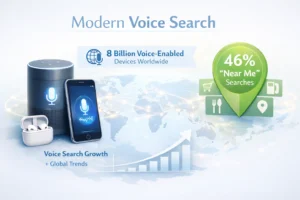
Globally, more users are speaking into devices, and NLP is what turns voice to text. To optimize for voice search, we write like we speak: in plain, concise language. Content geared for voice assistants often starts by answering the question directly (“The best running shoes for flat feet are X, Y, Z”), then expands.

We include question-and-answer segments (“Q: How do I choose running shoes for flat feet? A: Look for cushioning and arch support…”), which voice assistants can read back easily. Since Natural Language Processing handles different accents and phrasing, it’s important to use clear second-person narrative (“you”) and simple explanations.

Moreover, voice queries tend to be longer and more conversational (“Hey Siri, how do I find trending NLP in 2026?”). That’s why we incorporate likely long-tail questions into our headings and FAQs. This ensures that when someone asks an AI assistant, the answer can come directly from our content. Voice search also favors local results and short answers, but with NLP globalization (like MUM’s 75 languages), good content in one language can influence searches in many regions.

Answer Engine Optimization (AEO)

Search is shifting from link lists to direct answers. Answer Engine Optimization (AEO) is about making your content the AI’s answer. In other words, structure your pages so that AI-powered tools (ChatGPT, Google AI Overviews, voice assistants) can find and cite your content as the authoritative answer. Unlike traditional SEO’s focus on ranking positions, AEO focuses on being selected by AI.

To achieve this, we use the following AEO tactics:

  • Answer-first content: Provide clear answers immediately
  • Structured data: Use FAQs and schema
  • Credibility signals: Build trust and authority
  • Conversational tone: Match human queries

This evolution shows how Natural Language Processing (NLP) drives AI Search and AI Overviews, making structured, clear content essential.

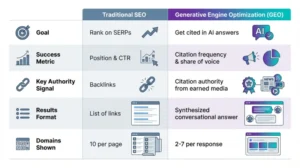
Table: Comparing Traditional SEO and AI-driven Optimization

Aspect Traditional SEO AI-Driven (AEO/GEO)
Primary goal Rank at top of SERPs for keywords. Be cited or mentioned by AI assistants (ChatGPT, Google AI, etc.).
Success metrics Rankings, organic clicks, traffic. Citations in AI answers, share of voice in AI tools.
Content style Long-form, keyword-rich content with traditional headings. Concise, well-structured answers (short paragraphs, bullet lists, schema).
User input Keyword searches. Conversational prompts, full questions, voice commands.
Authority signals Backlinks, domain rating. Authoritative citations, platform mentions, E-E-A-T.

Generative Engine Optimization (GEO)

Alongside AEO is Generative Engine Optimization (GEO) – optimizing so AI platforms include your brand in generative answers. The goal shifts from “rank” to “be referenced.” In practice, GEO involves:

Generative Engine Optimization (GEO)

  • Build brand presence across platforms
  • Structure content for AI extraction
  • Track AI visibility metrics

AI systems rely heavily on Natural Language Processing (NLP) to evaluate and select content, so clarity and authority become your biggest advantages.

Putting It All Together: Natural Language Processing Tools and Best Practices

To implement these strategies, we leverage Natural Language Processing tools at every step. For example, we use text-analyzers to extract entities and sentiment from competitors’ pages, revealing gaps in our content. We use readability tools (like SpaCy or proprietary scripts) to ensure our articles are clear and jargon-free. Keyword research is augmented with AI: instead of just a keyword list, we generate related questions and phrases from a large language model. The result is content that is highly relevant, well-structured, and ready for AI.

At Elevatech Digital, our content briefs now include an “AI-friendly” checklist: ensure the main question is answered early, include FAQ-format sections, add schema markup, and cite high-quality sources. We write with a mix of sentence lengths and a conversational tone (“you and we”), so that it sounds natural to both humans and AI. We also track emerging terms in regional markets – for instance, we note how speakers in Asia use different phrasing in English, and tailor our tone accordingly.

Conclusion

In summary, Natural Language Processing is indispensable for modern SEO and content strategy. It transforms how search engines evaluate relevance, pushing us to write for real users and AI alike. By focusing on search intent optimization, crafting clear answers for AI Overviews, and building an AI-friendly presence (GEO), you future-proof your content for all search formats. Remember, SEO is no longer just about keywords – it’s about language, context, and trust. At Elevatech Digital, we incorporate these global best practices into every content plan. Ready to level up your content? Whether you’re targeting New York, London, Dubai, or Mumbai, applying NLP-driven SEO and AEO/GEO strategies will help you stand out in the AI-powered search landscape.

We invite you to explore our SEO insights and try integrating NLP techniques into your content. The future of search is now – let’s get your content ready for it!

FAQs

  • What is NLP and how does it relate to SEO?

    Natural Language Processing (NLP) is the AI technique that allows search engines to understand human language. In SEO, NLP means engines like Google can interpret the meaning, context, and entities in your content. This shifts focus from just matching keywords to understanding intent and topic relevance. Well-written content that follows natural language patterns ranks better under NLP-based search algorithms.

  • How does NLP improve search intent optimization?

    NLP helps classify the intent of searches (informational, navigational, transactional, etc.) and match content that satisfies that intent. By analyzing synonyms and question phrases, NLP-driven tools guide us to answer real user questions directly. Optimizing for search intent means structuring content to clearly address those queries – for example, using headings that pose questions and paragraphs that give straightforward answers.

  • What are AI Overviews and why are they important?

    AI Overviews (like Google’s AI summaries or zero-click answers) are concise summaries generated by AI at the top of search results. They provide quick answers and link to sources. Being featured in an AI Overview drives brand exposure and clicks: Google reports that links in AI Overviews get more clicks than regular listings. To win an AI Overview spot, your content must have a clear, authoritative answer that AI can extract. This is why we emphasize answer-first paragraphs, bullet lists, and proper use of schema for FAQs and definitions.

  • Why is “keyword stuffing” ineffective with NLP-based search?

    Keyword stuffing (repeating a term unnaturally) used to trick old algorithms, but NLP-driven algorithms look at meaning. They analyze context and ignore common filler words (via TF-IDF). If your content is repetitive or irrelevant, NLP will detect low-quality writing. Instead, cover the topic naturally and thoroughly. Use related terms and synonyms in context. A good rule: if it doesn’t help a human reader, it won’t help SEO anymore.

  • How does NLP affect global or multilingual SEO?

    NLP models like Google’s MUM can process multiple languages and formats. This means content in one language can influence searches in another. For global audiences, write in clear, neutral English and consider translating content thoughtfully. Also, tailor content to regional queries (e.g., phrasing and examples relevant to each market). By aligning with NLP’s multilingual capabilities, you can reach users across North America, Europe, APAC, and the Middle East without confusion or cultural mismatches.

Semantic SEO

Imagine asking Google a natural question and instantly getting a perfect answer. That’s the power of semantic SEO, it’s like teaching search engines to understand your content’s meaning, not just spot keywords. In today’s global, AI-driven world, semantic SEO (also called contextual SEO or entity-based SEO) is a game-changer. It shifts focus from just matching words to understanding intent and related topics. In practice, this means crafting content that covers whole topics deeply, with related terms and clear connections (like an expert guide rather than a keyword-stuffed article). As search algorithms evolve, using semantic SEO strategies can dramatically increase your visibility and traffic worldwide.

Semantic SEO is about unlocking context and connections. For example, Google’s Knowledge Graph lets the engine know that “apple” can mean a fruit or a tech brand by the surrounding content

What is Semantic SEO? (Quick Answer for AI & Featured Snippets)

Semantic SEO is the process of optimizing content based on meaning, user intent, and topic relationships, rather than just individual keywords.

In simple terms:

  • It focuses on context, not just keywords
  • It uses related topics and entities
  • It answers complete user questions

Think of Semantic SEO as teaching search engines to “understand” your content, not just read it.

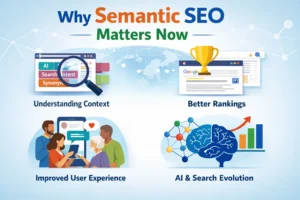
Why Semantic SEO Matters Now

Why Semantic SEO Matters Now

Search engines have gotten a lot smarter. Updates like Google’s Hummingbird (2013) and BERT (2019) taught them to interpret full phrases and context. Instead of just matching keywords, they analyze entities (people, places, brands, concepts) and user intent. For instance, Semantic SEO means your “laptop” article should also mention related things like graphics cardsRAM, or photo editing software if the topic is about graphic design laptops. This helps Google’s AI see the full picture.

In practical terms, semantic optimization ensures your content appears in more places: not only traditional search results but also in AI Overviews and voice assistants. Consider that today “zero-click” searches are skyrocketing: 69% of Google searches now end without a click, as answers are given directly on the results page. Chatbots and voice assistants (ChatGPT, Siri, Alexa) are also growing – ChatGPT has over 800 million weekly users. That means if you’re not optimizing for semantic understanding and Answer Engine Optimization (AEO), you risk being invisible.

Key Statistics:

  • 69% of searches are zero-click (users get answers instantly)
  • AI tools like ChatGPT serve millions of queries daily
  • Voice search is growing rapidly across global markets

If you ignore Semantic SEO, you risk becoming invisible.

Core Elements of Semantic SEO

To implement semantic SEO, cover five key areas of modern optimization:

To succeed with Semantic SEO, you need a structured approach.

Semantic SEO Framework (Table)

Element What It Means Why It Matters Practical Example
Search Intent Optimization Understanding why users search Aligns content with real needs Laptop page includes gaming, work, design use
Topic Clustering Grouping related content Builds authority Coffee guide + brewing methods pages
Entity-Based SEO Using identifiable concepts Improves context understanding Mentioning tools, brands, technologies
Content Depth Covering topics fully Boosts engagement & rankings Adding FAQs, comparisons
Technical SEO & Schema Structured backend optimization Enables rich results FAQ schema, internal linking
  • Understand Search Intent (Context Over Keywords): Research why people search. Break topics into subtopics and related questions. For example, for a “Semiconductor” page, cover manufacturing processes, industry trends, materials, and future AI applications. Google’s own NLP (natural language processing) tries to match queries with the intent and meaning behind words. So give it clear context: use related terms, answer likely questions, and explain concepts fully.

  • Topic & Keyword Research: Instead of single keywords, gather clusters of related terms and questions. Tools like Google Search Console’s “people also ask” or NLP-based keyword tools can reveal semantically related phrases. For example, “coffee brewing” content should include espresso machines, pour-over methods, roast levels, etc.. Map these out in a content plan. This builds topical authority: a pillar page on a broad theme (e.g. “The Ultimate Guide to Coffee Brewing”) and linked cluster pages on niche aspects (espresso vs. drip, best beans, brewing tips).

  • Quality Content Development: Write in-depth, high-value content that naturally weaves in related topics and entities. Break your coverage into logical sections or FAQs, and use bullet lists or tables where helpful. This not only appeals to readers (good UX) but also to AI/voice. As Wired notes, chatbots love structured formats like bulleted lists and FAQs. For instance, include an FAQ section answering common questions; it’s ideal for featured snippets and AI answers. And update old posts by adding new semantic keywords and context rather than keyword-stuffing.

  • Technical SEO & Schema Markup: Behind the scenes, make sure crawlers can access and understand your content. Use structured data (Schema.org) to label entities: products, organizations, people, reviews, etc. This helps Google add your content to its Knowledge Graph and voice agents’ results. Also ensure fast site speed, mobile-friendly design, and secure connections. Remember, even the best content won’t rank if it’s behind an orphaned or slow page.

  • Internal Linking & Consistency: Create a clear site structure that reflects topic relationships. Link between related pages using descriptive anchor text so users (and Google) can easily navigate the full topic cluster. This distributes authority throughout your site and helps reinforce context. Don’t just drop random links – each link should add value. For example, if one page covers “AI in SEO” and another covers “Natural Language Processing,” link them when relevant. Consistent terminology (e.g. always call an entity by the same name) prevents confusion.

Semantic SEO Strategies to Boost Traffic

Here’s a proven, actionable framework:

1. Research Search Intent & Topics

  • Use “People Also Ask”
  • Analyze competitors
  • Explore forums

2. Build Topic Clusters

  • Create pillar + supporting content
  • Interlink strategically

3. Optimize Content

  • Use natural language
  • Add semantic keywords
  • Answer questions early

4. Add Schema Markup

  • FAQ schema
  • Article schema

5. Focus on E-E-A-T

  • Show expertise
  • Add real insights
  • Build trust

6. Use AI & Tools

  • Generate topic ideas
  • Validate with human expertise

Semantic SEO Meets AI, Voice & AEO/GEO

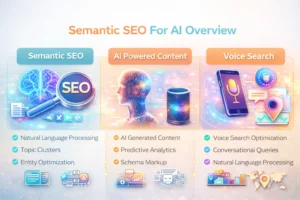
Semantic SEO is increasingly intertwined with AI-driven search. The new paradigm includes AEO (Answer Engine Optimization) and GEO (Generative Engine Optimization). Instead of obsessing over organic rank, you optimize to be the answer that AI tools serve directly to users.

Semantic SEO for AI Overviews

  • AEO (Answer Engine Optimization): Focuses on featured snippets and AI answers. Structure your content so that it answers specific queries upfront. Use numbered lists, bullet points and direct “Q&A” sections. Stefan Maritz notes that AEO means “being the answer, not just a link”. For example, write a clear summary at the top of an FAQ answer that an assistant like Google’s might read aloud.

  • GEO (Generative Engine Optimization): Emerging trend from news like Wired’s report. As more users rely on chatbots for recommendations, brands craft very granular answers so that AI cites them. Chatbots often draw from content that is specific, authoritative, and structured. For instance, a bullet-list of product features or a well-labeled data table on your page can make it into a conversation. This isn’t just theoretical: retailers have seen a predicted “520% increase in traffic from chatbots” in 2025. So, think of creating content that answers a hundred specific questions (as one expert says, an FAQ can “answer a hundred different questions” for an AI engine).

  • Voice Search & Natural Language: Semantic SEO naturally caters to voice queries because it emphasizes conversational, user-focused language. People ask voice assistants full questions. By writing in a natural, accessible style (and including synonyms and related terms), you align with how voice searches work.

Proven Traffic Boosts & Case Examples

What kind of results can you expect? While every site is different, semantic SEO has delivered real wins. For example, by systematically creating topic clusters, Healthline dominates in health content. In e-commerce, companies aligning content to user intent have seen large traffic gains. One report cites Bankrate publishing hundreds of AI-assisted articles to drive ~125,000 organic visits a month (key takeaway: high-quality, intent-focused content, even AI-generated but well-edited, can be highly effective).

By improving user experience, semantic SEO also indirectly boosts metrics that signal quality: longer dwell time, lower bounce rates, and more social shares. Google rewards content that truly satisfies users. As Search Engine Land explains, Google now “indexes entities… and uses NLP to understand the search intent” so it can serve rich snippets. Websites that provide clear, context-rich answers are more likely to pop up in these rich features – driving both traffic and trust.

Metrics to watch: Track not only rankings but also visibility in featured snippets, voice search positions, and AI citations. Tools like Similarweb and Semrush indicate that with semantic SEO, you can climb not just in search results but also in AI-driven metrics (for example, Semrush’s Position Tracking can even track your brand’s mentions in ChatGPT results).

Conclusion & Next Steps

Semantic SEO is the modern way to optimize for search – one that’s inherently more user-friendly and future-proof. By focusing on the meaning behind searches, covering entire topics thoroughly, and integrating with AI-driven search trends (AEO/GEO/voice), you position your site to capture more high-intent traffic globally.

Key takeaways:

  • Always aim to answer questions fully. Use clear language and cover related subtopics.
  • Use lists, tables, and FAQs to make your content AI-friendly.
  • Build internal links between related pages to strengthen topic clusters.
  • Leverage schema markup to highlight key information for search engines.

Ready to elevate your SEO game? Contact Elevatech Digital today, for semantic SEO strategies that drive real results across regions, from New York to London, Dubai to Tokyo. Audit your content now with these principles, and watch your visibility grow.

Frequently Asked Questions

  • What’s the difference between semantic SEO and regular SEO?

    Traditional SEO focused mainly on matching specific keywords. Semantic SEO broadens the view: it’s about topics, entities, and user intent. Instead of page-per-keyword, semantic SEO covers entire subject areas and uses related terms to show comprehensive relevance.

  • Does semantic SEO replace keywords?

    No, keywords still matter as signals. But semantic SEO uses them smarter. You include your main keyword, but you also add context – synonyms, related phrases, and structured data – so the engine “gets” your page’s full meaning. Think broad and deep, not keyword-stuffed.
  • How do I find semantic keywords or entities?

    Use tools and techniques that reveal related concepts: Google’s “People also ask”, related searches, keyword tools that show LSI/semantic suggestions. Explore knowledge bases (Wikipedia, industry glossaries) to identify relevant entities. For example, if you write about “sustainable fashion,” related entities might include eco-friendly fabricsethical brandsslow fashion movement. Adding these terms gives context.

  • Can AI help with semantic SEO?

    Yes, AI tools can assist research (e.g. cluster analysis, content brief generation), but use human judgment. For instance, tools can suggest topics to cover, but you as the expert decide the narrative. Always fact-check AI content and ensure it aligns with true expertise (one case study noted AI content works well when carefully edited by humans).

  • How long until I see traffic improvement?

    Semantic SEO is a long-term strategy. You’re building topical authority. You may see initial gains in engagement (people stick around longer), and over months watch rankings rise as Google indexes your comprehensive content. Using Google Analytics and SEO tools, measure increases in impressions for related keywords over 3–6 months.

Entity Based SEO

Search has changed. In 2025, from New York to New Delhi, search engines do far more than match keywords – they understand meaning. Google still dominates global search (nearly 90% market share), but generative AI tools like ChatGPT and Perplexity are booming with hundreds of millions of users. Instead of a list of blue links, many queries now yield AI Overviews (the Search Generative Experience) concise, sourced answers on the SERP. In this new world, Entity Based SEO focusing on topics and “things” rather than isolated keywords wins. It aligns with how Google’s Knowledge Graph and AI models interpret queries: by entities and relationships. This shift powers more intuitive, context-rich results worldwide.

raditional SEO still matters, but now it’s the entities (people, places, products, ideas) behind content that guide both Google and AI systems. This is where Entity Based SEO becomes essential. Optimizing for these entities, by structuring content, linking relevant topics, and using schema lets sites become known to search as authoritative “things.” In practice, Entity Based SEO helps you build content around clear entity definitions, supported by related subtopics and facts, so AI engines can easily connect the dots. The result: your pages can rank for all relevant questions about that entity, even ones you didn’t explicitly target through traditional SEO.

What Is Entity Based SEO?

Entity Based SEO is an information-architecture strategy that teaches search engines what each page (and your site) is about – in terms of real-world “things” rather than just which words appear. In Google’s view, an entity is “a thing or concept that is singular, unique, well-defined, and distinguishable”. That could be a person (like “Malcolm Gladwell”), place (“Paris”), product (“iPhone 15”), company, concept, event, etc. Instead of asking “Does this page use the right keywords?” Google now asks “Is this page about the same thing the user is searching for?”.

Put simply, entities are the atomic units of meaning in modern SEO. With Entity Based SEO, when you optimize around an entity, you organize your content as a cohesive, interlinked topic cluster centered on that subject. For example, a travel site might have a pillar page on “Portugal” with clearly defined schema, plus cluster articles on “Lisbon travel tips,” “Algarve beaches,” and “Portugal cuisine.” This approach, driven by Entity Based SEO, makes your site act like a mini Knowledge Graph, connecting people, places, attributes, and related ideas.

Google and AI systems rely on these entity signals to “fill in the blanks.” Once they know your page represents a specific entity and its attributes (dates, locations, facts), they can match it to any query about that entity even ones with different wording. For example, a clear page about the Eiffel Tower (entity) will rank for searches about “Paris landmarks,” “construction of Eiffel Tower,” or “how tall is it,” because all those queries connect to the same entity via the Knowledge Graph.

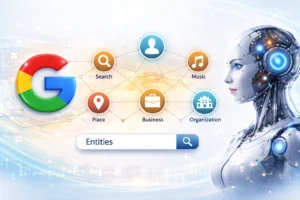
How Google and AI Use Entities

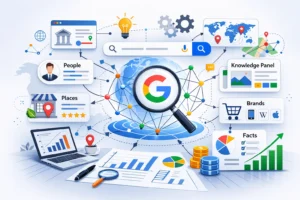
Google’s Knowledge Graph (its “brain” of 8+ billion entities and 800+ billion facts) powers this shift. Technologies like BERT, MUM and Google’s Gemini model look for entity patterns in text rather than exact words. For example, if you search “jaguar,” Google infers from your context whether you mean the car, the animal, or the operating system all entities in its system. It then presents contextually rich results or a Knowledge Panel for that specific entity. This “context-first” approach means relationships drive rankings more than simple keywords. Google itself says its goal is “delivering context-first, not word-first answers”.

How Google and AI Use Entities

Entities also make search global. Because each entity has a unique ID, Google can link synonyms and translations across languages. This is why Entity Based SEO performs well across regions and languages, making it a core strategy for global visibility.

Finally, entities enable the new AI-powered answer formats. Google’s AI Overviews use generative models to summarize content by entity. AI tools like ChatGPT and Perplexity also rely heavily on entity recognition. This means Entity Based SEO directly impacts whether your content gets cited in AI-generated answers.

Why Entity Based SEO Matters

  • Broader Visibility: When you build clear entity-focused pages, you become visible for all relevant queries about that topic, not just ones matching specific keywords. Google “knows” your page is the authority on that entity. Single Grain puts it this way: AI engines favor pages that “resolve a topic with structured context, references, and specific sub-answers” rather than just piling up keywords.

  • Semantic Relevance: Entities reduce ambiguity. If you cover the Apple entity with context (e.g. describing iPhones, technology, Apple Inc.), Google won’t confuse your page with the fruit. It uses attributes and linked concepts to understand meaning. As Neil Patel explains, entities carry built-in relationships (attributes, categories, synonyms) that let Google rank you on related searches even if you didn’t target them explicitly.

  • AI and Voice Optimization: AI answer engines (Google’s AI, ChatGPT, voice assistants) prefer entity based seo. AI Overviews and voice Q&A boxes rely on connected structured data. SchemaApp finds that “brands that invest in Entity SEO earn greater visibility and trust in AI search results”. Even a page without any clicks can build your authority by being cited in an AI-generated answer. In practice, optimizing for entities is optimizing for these voice and AI channels.

  • Mobile and Global Reach: Entities improve mobile and multi-language search. Entity Based SEO goes hand-in-hand with Google’s mobile-first indexing and the ability to handle synonyms and translations. A single well-defined entity page (with schema and consistent terminology) helps Google’s algorithms serve useful results on phones and in any language.

  • Future-Proofing: Search is evolving toward answer engines and AI. Per Single Grain, traditional SEO practices are still important, but entity-first content now “earns better citations in AI experiences.” AI models like ChatGPT use “clean internal links, consistent terminology, and references that agree with broader web knowledge” to find answers. By contrast, outdated keyword-stuffed pages get left behind. Optimizing for entities aligns directly with Google’s vision of AI-driven, context-rich search.

Table: Keyword SEO vs. Entity Based SEO

Aspect Traditional (Keyword) SEO Entity Based SEO
Focus Specific words and phrases Underlying concepts (entities)
Context Limited to page keywords Semantic context, knowledge graph links
Query matching Exact terms or synonyms Relationships & intent
Optimization strategy Keyword research, on-page density Topical clusters, schema, linking
Search features Page-rank, CTR Knowledge panels, AI summaries, voice

Key Strategies for Entity Based Optimization

Building a strong entity presence requires structure and clarity in your content. Here are core tactics:

  • Define One Main Entity per Page: Each page should be unambiguously about one core entity. Use that entity in your title, H1, and meta tags, and mark it up with schema (e.g. mainEntityOfPage). Search Engine Land advises this “Precision” – aligning all page signals to the same concept. For example, a blog titled “Ultimate Guide to Espresso Machines” should clearly represent the entity Espresso Machine (e.g. using Product schema).

  • Topic Clusters & Coverage: Organize your site into hub-and-spoke topic clusters. Your pillar page (hub) gives an overview of the main entity, and supporting pages (spokes) dive into subtopics (features, comparisons, how-tos). SEMrush data shows sites using topic clusters can see big traffic gains. This “Coverage” approach ensures you cover all facets of an entity. For example, a page on “Electric Cars” might cluster into “Battery technology,” “Eco impact,” and “Popular models.” Each cluster page should link back to the hub and to each other with descriptive, entity-rich anchor text.

  • Schema and Structured Data: Mark up your entities! Use Schema.org types (Organization, Person, Product, Event, etc.) to label the entities on each page. Schema acts like a mini knowledge graph on the page, helping Google and AI parse exactly which parts of your content refer to your entity and its attributes. For instance, marking up a recipe with Recipe schema tells systems it’s about a dish (the entity) and highlights ingredients, cooking time, etc. Schema is now essential: Google speakers and SEO pros at Search Central events stress that structured data is foundational to modern SEO. You can also explore official structured data guidelines here.

  • Consistent Linking and “SameAs”: Entities gain strength through context. Use internal links to show relationships: link your entity page to related topics on your site, and use sameAs references to trusted external sources (Wikipedia, Wikidata, Google’s Knowledge Graph URLs). This “Connectivity” tells Google how the dots connect. For example, a page on “Tesla Model S” might link to “Electric Vehicles” and “Elon Musk,” and sameAs to the Tesla company’s Wiki page. Consistent naming (using the same entity name everywhere) and author bios/personal details also reinforce authority.

  • Answer User Questions (AEO): Write content that directly answers common questions about the entity based seo. Structure pages with clear question headings and concise answers. As Blue Compass notes, answer engine optimization means formatting for quick answers. For example, an FAQ section on a page about “Photosynthesis” could answer “What is photosynthesis?” and “Why is it important?” right away. Google recommends answering questions early (within a few lines) so AI Overviews and voice assistants can pull them. This AEO approach naturally reinforces your entity’s definition and makes your content snippet-ready.

  • Topical Authority and Content Depth: Go deep on each entity. Thin pages won’t suffice. Instead, create comprehensive, value-added content that covers all angles: definitions, use cases, history, FAQs, comparisons, etc.. This not only helps readers, but it floods the entity’s “node” with facts. Search engines then see you as an authority on that entity. As Single Grain advises, “your goal is durable topical authority that performs in both classic listings and AI summaries”. In practice, this means more paragraphs, lists, and sections – but each should be clear and concise, focused on aspects of the same entity.

  • E‑E‑A-T and Citations: Experience/Expertise/Authoritativeness/Trust (E-E-A-T) signals boost entity based SEO. Include author bylines with credentials, and cite credible third-party sources (studies, official sites) to support claims. For example, if discussing a medical concept entity, reference WHO or academic research. This creates a network of trust around your entity. Google and AI models favor authoritative, well-sourced content. When your content is the entity experts cite, your entity becomes a stronger hub in the Knowledge Graph.

  • Monitor and Measure Entity Signals: Track not just traditional metrics, but entity-related outcomes. Count your topic clusters, internal links, schema usage, and completed entity coverage. More importantly, watch for real evidence of entity success: knowledge panel appearances, featured snippets (Q&A, HowTo, etc.), AI Overview inclusions, and clicks to your hub pages. These show that search engines are recognizing your content’s entity focus.

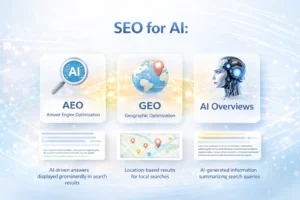
SEO for AI: AEO, GEO and AI Overviews

Entity Based SEO sits at the core of AEO and GEO strategies.

SEO for AI AEO, GEO and AI Overviews

AI Overviews prioritize:

  • Clear answers
  • Structured content
  • Entity-rich information

That means your content must:

  • Define entities clearly
  • Answer questions quickly
  • Provide structured context

This is how Entity SEO powers visibility across AI Search platforms.

Entity Based SEO for a Global Audience

One of the biggest advantages of Entity Based SEO is its global scalability.

Entities work across:

  • Languages
  • Regions
  • Devices

For example:
“Tokyo Tower” remains the same entity worldwide, regardless of language.

This allows brands to:

  • Build one strong entity profile
  • Rank globally
  • Maintain consistency

Structured data further strengthens this by giving search engines clear signals about your entity.

The result: Entity Based SEO creates a unified global presence, helping your brand appear in AI Overviews, search results, and voice queries worldwide.

Conclusion

The future of search is already here and it is built on Entity Based SEO. Search engines and AI platforms no longer reward content that simply targets keywords; they reward content that understands and owns a topic. If you want your brand to stand out in Google, dominate AI Overviews, and become a trusted source across global AI Search platforms, now is the time to act. Start building entity-driven content, structure your website with clarity, and position your brand as the authority behind the topics that matter. And if you are ready to turn strategy into real growth, contact Elevatech Digital today and let our experts help you build a powerful, future-proof SEO system that drives visibility, trust, and long-term success worldwide.

Frequently Asked Questions

  • What is the difference between entity-based SEO and traditional keyword SEO?

    Entity-based SEO focuses on who or what (the actual people, places, products, or concepts) your content is about, and builds a connected web of information around that entity. Traditional SEO focuses on ranking for individual keywords. With entity SEO, you structure content as a “knowledge hub” for one topic, use schema, and link related pages. This helps search engines understand the meaning and context, not just count word matches.

  • Why does Google care about entities in search?

    Google’s algorithms now aim to understand intent and context. Entities are the building blocks of this understanding. By identifying entities in pages and queries, Google (using its Knowledge Graph, BERT/MUM, Gemini models, etc.) can match users with precise answers. In practice, Google prefers content that clearly defines and connects entities, because it can then deliver more relevant results and AI-driven summaries.

  • How do I optimize my content for entities?

    Key steps include: pick one main entity per page and signal it through titles and schema; create topic clusters around that entity with helpful subpages; use structured data (schema markup) for things like Organization, Product, FAQ, etc. Also use descriptive internal linking (“connect X to Y”) and sameAs references to authoritative sources. Answer user questions directly and add FAQs. In short, treat your site as a mini Knowledge Graph for your entity.

  • What role do structured data and schema play in entity SEO?

    Schema is crucial. It’s the language of search engines for defining entities and their attributes. When you add schema markup (e.g. OrganizationPersonEventProduct), you’re literally tagging which words in your content are entities and what their values are. This helps Google’s AI accurately map your content to the Knowledge Graph. Simply put, schema gives machines explicit clues about what each page means. As Google engineers note, structured data is foundational for modern SEO as search becomes more AI-driven.

  • How does entity optimization help global visibility?

    Entities are language- and locale-agnostic. The same entity exists in every market (for example, “Pizza” or “Eiffel Tower”), so optimizing content around it benefits searchers worldwide. Google’s translation and disambiguation rely on entity context, so your optimized page can rank for equivalent queries in different regions or languages. Also, schema (like locationcurrency) lets you reach regional users (local SEO) while the entity framework ties everything to your overall brand topic globally.

  • How can I tell if entity SEO is working?

    Beyond traditional rankings and traffic, look for entity-specific signals: appearance of a Knowledge Panel for your brand/entity, inclusion in featured snippets or FAQs, and citations in AI Overviews or voice answers. Track the number of topic clusters you’ve built, schema coverage, and internal links per hub. If your entity-focused pages start generating answers for multiple related queries, and if branded queries trigger rich results, your entity strategy is paying off.

5C of Digital Marketing

Digital marketing strategy is like a global puzzle to win, you must fit together five key pieces. In fact, the 5 C’s of digital marketing, Customer, Context, Content, Channel, and Conversion form a blueprint for success. By mastering each “C,” businesses worldwide can craft campaigns that truly connect with their audiences. This guide breaks down each C in clear, actionable terms. You’ll discover what each means, why it matters in today’s online landscape, and how to apply these principles whether you’re a startup, an enterprise, or looking to work with a digital marketing service or agency like Elevatech Digital.

Digital Marketing, at its core, is about meeting customers where they are and delivering value. The Customer is at the center of everything – knowing who they are, what they want, and how they behave. Context means understanding the customer’s situation (their device, location, intent) and tailoring your message accordingly. Content is the material you create (blogs, videos, social posts, etc.) to inform or entertain. Channels are the platforms or media (email, search, social, paid ads) used to distribute content. Finally, Conversion tracks how effectively visitors take desired actions (sign-ups, sales, shares). In the sections below, we’ll dive deep into each C, with real-world examples and best practices for a global audience.

What Are the 5 C’s of Digital Marketing?

The 5 C’s of Digital Marketing are a strategic framework that helps businesses create effective online marketing strategies by focusing on:

The 5 C’s What It Means Why It Matters
Customer Understanding your audience Ensures marketing speaks to real needs
Context Delivering the right message at the right time Improves relevance and engagement
Content Creating valuable digital material Builds trust and brand authority
Channel Choosing the right platforms Reaches customers where they are
Conversion Turning interest into action Drives measurable business results

Digital Marketing succeeds when the right message reaches the right person at the right moment on the right platform and inspires action.

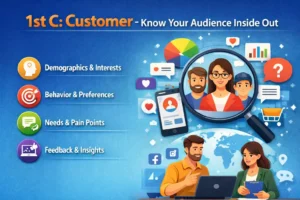
1. Customer – Know Your Audience Inside Out

Definition: The “Customer” C means putting your ideal buyer or audience at the forefront. It’s about understanding who you are selling to their demographics, needs, preferences, and pain points.

1st C of Digital Marketing - Customer

Every digital strategy starts by building detailed customer personas. Think of personas like vivid profiles of your target users: their age, location, challenges, and goals. For example, an online education company might create a persona named “Student Sara” who is an English-learning college student in India, and a persona “Career-Chaser Carlos” who is a mid-career professional in Brazil. Each persona has unique motivations and content preferences.

Why it matters: 79% of marketers say personalization and customer-focused messaging are very important for hitting top goals like loyalty and satisfaction. In other words, knowing your customer is not optional, it’s crucial. By analyzing data and feedback, you can deliver experiences that resonate. For instance, if most of your customers browse on mobile during their commute, you might optimize mobile-first content and quick-read formats.

  • Audience Research: Use surveys, analytics, and market reports to learn your customers’ habits and preferences.
  • Global Diversity: Remember, a global audience may have varied cultural backgrounds and languages. Segment personas by region or culture when needed.
  • Customer Journey Mapping: Chart the steps a customer takes from first hearing about your brand to becoming a loyal buyer. Each stage reveals pain points you can solve with your digital marketing.

By centering every campaign on Customer intelligence, your digital marketing agency can craft messaging that truly speaks to people. As NowMediaGroup notes, “Keeping the customer front and center grounds all digital marketing decisions, allowing brands to make the biggest impact”.

2. Context – Delivering the Right Message at the Right Time

Definition: “Context” means the situation and intent surrounding your customer’s online behavior. In digital terms, it’s the device they’re on, the time of day, the type of content they’re consuming, and their current mindset. Contextual digital marketing is all about being relevant.

2nd C of Digital Marketing - Context

Imagine a user browsing on their phone at a coffee shop during lunch. They might prefer quick tips or social videos. The same person at home in the evening might be in a browsing mood and open to longer blog posts or in-depth guides. The context of location, device, and timing should shape your approach. For example:

  • A Facebook ad with catchy visuals might engage someone scrolling on mobile during a break.
  • A detailed how-to video or webinar might attract viewers in a relaxed evening setting on a laptop.

Adobe’s marketing blog explains it well: “context is a combination of what customers have done, where they’ve done it, and with whom”. By triangulating user actions, location, and related behavior, brands can serve truly personalized content. According to the World Advertising Research Center, contextually relevant ads significantly improve engagement and brand recall.

Key Practices:

  • Behavioral Targeting: Use analytics and AI Overviews to segment audiences by behavior (e.g. previous purchases or page visits). Tailor content accordingly.
  • Time & Location: Schedule posts or ads for when target regions are most active (e.g. morning for Asia, evening for Europe).
  • Platform Mindset: Recognize that people use different platforms with different intentions (e.g. inspiration on Instagram, research on Google). Craft messages that fit each context.

Contextual targeting is so powerful that 89% of business leaders now believe personalization, deeply connected to context – is crucial to success. By aligning your content and channels to the user’s context, you boost relevance and engagement. Always ask: “Where is my customer right now, and what do they need?” Answering that will guide your content and channel choices effectively.

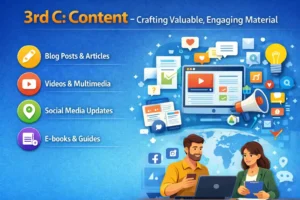
3. Content – Crafting Valuable, Engaging Material

Definition: “Content” is the fuel of digital marketing – the articles, videos, graphics, and posts that inform or entertain your audience. It’s often said that “content is king”, meaning high-quality content lies at the heart of successful campaigns.

3rd C of Digital Marketing - Content

Today’s customers expect helpful and engaging content that solves their problems or answers their questions. Common content formats include:

  • Blog Posts and Articles: In-depth guides, how-tos, and thought leadership pieces that boost SEO and brand authority.
  • Social Media Updates: Short, catchy posts, images or reels tailored to each platform’s style. For example, snackable TikTok videos or carousel infographics on LinkedIn.
  • Ebooks & Whitepapers: Long-form resources offered as gated downloads to generate leads.
  • Webinars & Live Events: Interactive sessions with experts that build trust and collect leads through registrations.
  • FAQs & Chatbots: Answers to common questions that both help users and improve SEO (voice assistants often pull from FAQ answers).
  • Infographics & Visuals: Shareable visuals that make data or tips easy to digest.

Creating a content plan means aligning each piece with a goal in the customer journey. Early-stage prospects need awareness and education (blog posts, social tips), while later-stage prospects need detailed info or offers (webinars, case studies). High-quality content drives results: “well-optimized, high-quality content… drives measurable business results like website traffic, lead generation, and sales conversions”.

  • Answer Engine Optimization (AEO): Write clear Q&A sections. Structured content (lists, definitions) helps voice assistants and zero-click search features pull answers directly.
  • Storytelling & Authenticity: Weave real examples or anecdotes into your content to connect emotionally. A personal case study can make a global principle relatable.
  • Localize for Global Audiences: When digital marketing internationally, adapt content for regional cultures and languages. Global brands often create region-specific blog series or translate key guides.

The data backs up content’s importance: Email content marketing alone yields about $36 in revenue for every $1 spent. And 54% of businesses planned to boost content budgets in 2024. In short, invest in original, helpful content, and search engines and customers will reward you.

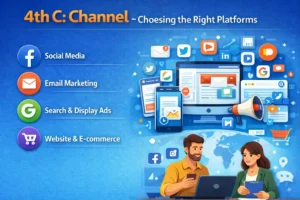
4. Channel – Choosing the Right Platforms

Definition: “Channel” refers to the mediums you use to reach customers online. These include your own properties (website, email), social networks, search engines, and paid advertising. Each channel has unique strengths and audiences.

4th C of Digital Marketing - Channel

A well-rounded digital marketing plan uses a mix of channels:

  • Owned Media: Your own website, blog, and branded social profiles. These are assets you control. A good website SEO and active social pages build long-term presence.
  • Paid Search & Social Ads: Advertising on Google, Facebook, LinkedIn, etc., lets you target specific keywords or audience segments. For example, search ads capture high intent (someone actively looking for your product), while social ads build awareness among targeted demographics.
  • Native Advertising: Sponsored articles or promoted content on news sites or social feeds. This blends in with editorial content and can drive engagement.
  • Email Marketing: Sending newsletters or drip campaigns keeps your brand in front of subscribers. Email remains one of the highest-converting channels.

Every channel appeals to customers in different contexts. In fact, an Adobe report found 87% of firms personalize via email, but only 62% do so on social and 51% on mobile. Even fewer (38%) can deliver consistent messaging across all channels. The lesson: coordinate channels for an omnichannel experience. For example, a user might see a display ad (awareness), visit your site (interest), receive an email follow-up (consideration), and finally click a retargeted ad (decision). All touchpoints should feel connected.

Choosing Channels Globally: Channel popularity varies by region. For example, WeChat and Douyin dominate social in China, while WhatsApp marketing is huge in parts of Europe and Latin America. Search engines also vary: Google leads globally (90%+ share), but Yandex is big in Russia and Baidu in China. Tailor your channel mix to each market.

  • Analytics & Attribution: Track which channels drive traffic and conversions. Tools like Google Analytics and attribution software can show, for instance, whether social or search brings more sales in APAC vs North America.
  • Budget Allocation: The global digital ad market is huge (projected ~$834B in 2025). North America alone accounts for nearly half of it. Allocate spend where your audience is most active and where ROI is highest.
  • Emerging Channels: Keep an eye on rising platforms (e.g. TikTok, podcasts, voice assistants). A channel suited to your brand’s style and audience can be a breakthrough.

Remember that “omnichannel” coordination turns disparate touchpoints into a seamless journey. In practice, that means consistent branding and messaging across mobile, desktop, social, email, and even offline if applicable. Use remarketing (like social or search retargeting) to remind visitors and guide them back. An integrated channel strategy ensures no lead slips through the cracks.

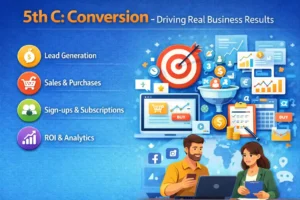
5. Conversion – Driving Real Business Results

Definition: Conversion is when a visitor takes a desired action that aligns with your goals – for example, making a purchase, filling out a form, downloading a guide, or signing up for a newsletter. In digital marketing, each action (or micro-action) can be a conversion metric.

5th C of Digital Marketing - Conversion

Typical conversions include:

  • Lead Generation: Forms filled out for ebooks, trials, or contact requests.
  • Email Subscriptions: New newsletter or list sign-ups.
  • Social Engagement: Shares, comments, follows – these can be soft conversions that build awareness.
  • Sales: Purchasing products or services online.
  • Offline Actions: Phone call inquiries or physical store visits driven by online campaigns.

Building effective conversion paths is key. That means clear calls-to-action (CTAs), landing pages that match ad or content messaging, and a smooth user experience. For instance, if a user clicks an ad for a “Free Webinar,” the landing page should instantly highlight the webinar sign-up form – no extra clicks.

  • A/B Testing: Regularly test different headlines, images, button texts, and layouts to see what converts best. Small tweaks (like changing a CTA color or wording) can sometimes lift conversions significantly.
  • Remove Friction: Identify and fix anything that stops a conversion. NowMediaGroup highlights common friction points: confusing navigation, complex checkout processes, or missing trust signals. Streamlining your funnel and adding testimonials or security badges can improve trust.

  • Analytics: Use tools (Google Analytics, Facebook Pixel, etc.) to track conversion rates per channel and segment. This data helps you invest in what works (and cut what doesn’t).

Conversion Rate Optimization (CRO) is an ongoing process. Even after campaigns launch, continually refine based on data. For example, if mobile conversion lags behind desktop, perhaps your mobile checkout needs simplification.

Finally, measure your digital marketing ROI by tying conversions to revenue. If you spent $1,000 on ads and gained $5,000 in tracked sales, your ROI is clear. Conversion tracking also feeds back into the other C’s: by understanding which customers convert and in what context or channel, you sharpen your targeting and content.

Conclusion

In summary, the 5 C’s – Customer, Context, Content, Channel, Conversion – provide a structured way to plan and optimize any digital marketing strategy. Start with a deep understanding of your customers, tailor your content to their context, deliver that content on the right channels, and measure how effectively you’re converting interest into action. This approach works whether you operate in North America, Europe, APAC or the Middle East, because at its core it’s about meeting people’s needs wherever they are online.

As digital marketing evolves with AI voice search, and new platforms, the 5 C’s remain a steady compass. They ensure your efforts are customer-focused, relevant, valuable, and measurable – qualities that search engines and users reward. By following these principles, you create an omni-channel, answer-driven strategy that stands out in global search results and voice queries.

Ready to grow your business with smarter Digital Marketing? At Elevatech Digital, we help businesses implement proven strategies like the 5 C’s, Customer, Context, Content, Channel, and Conversion to attract the right audience, build stronger engagement, and drive measurable results. Whether you need expert Digital Marketing Services, a reliable Digital Marketing Agency, or a strategic Digital Marketing Company to scale your brand online, our team is here to help. Contact Elevatech Digital today and let’s create a powerful Digital Marketing strategy that turns your online presence into real business growth.

App Store Optimization (ASO) Service

Imagine launching an amazing new app and watching it sink into obscurity. In a world where nearly 5 billion people owned smartphones by 2024 and millions of apps compete for attention, standing out isn’t optional, it’s survival. App Store Optimization (ASO) is the secret sauce that makes your app discoverable and enticing across the globe. ASO means fine-tuning your app’s title, keywords, visuals, and reviews so that when users search in app stores, your app pops up. It’s like SEO for apps: optimizing every detail of your App Store and Google Play listing to improve visibility, conversion rates, and ultimately downloads. In 2026’s hyper-competitive market, mastering ASO is a must-have growth strategy for any app developer or marketer.

What is App Store Optimization?

App Store Optimization is the ongoing process of improving an app’s store listing to increase its visibility and appeal, which in turn drives more organic downloads.

App store optimization involves optimizing metadata (app name, subtitle, keywords) and creative assets (icon, screenshots, promo video) so that the app ranks higher in store search results and convinces users to install it. Think of it as marketing your app inside the Apple App Store and Google Play Store. An optimized listing shows up for relevant searches, much like how a well-optimized website appears for Google queries. In fact, ASO is often described as the “SEO for apps”, because it focuses on organic discovery without paid ads. Unlike general SEO, which targets Google and Bing, ASO deals exclusively with app store search algorithms. Both ASO and SEO share one goal, helping people find your product – but each works in a different ecosystem.

Core Components of App Store Optimization

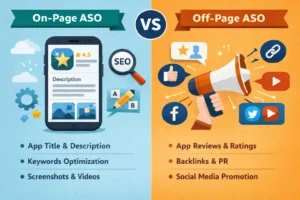
1. On-Page App Store Optimization

On Page ASO covers everything you put on your app listing, the title, subtitle, description, and keyword fields. For example, including high-volume keywords in your app’s name and description boosts search ranking. Other on-page factors include your app icon, screenshots, and promo video (if supported). Polished graphics and a compelling preview video increase conversion rates from store visitors to downloaders.

2. Off-Page App Store Optimization

Off Page ASO factors outside your control, like ratings and reviews. Apps with lots of positive reviews and high ratings rank better, as app stores view them as higher quality. Encouraging users to rate the app and responding to feedback can improve these off-page signals.
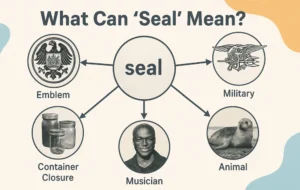
Difference between On-Page ASO and Off-Page ASO

Ultimately, app store optimization is a mix of keyword strategy (like Modern SEO) and conversion optimization (like marketing). Small changes can produce big gains: even updating your title or screenshot can boost search position and downloads over time. As AppTweak explains, ASO is a holistic process spanning metadata, visuals, ratings, and A/B tests to maximize visibility and appeal. In short, ASO helps your app stand out in a crowded marketplace.

Why App Store Optimization (ASO) is Crucial for App Growth

App Store Optimization is essential because it directly impacts how many people find and install your app. Better App Store Optimization means higher search rankings, more downloads, and lower marketing costs.

  • Boosts Visibility and Downloads: As Adjust notes, “ASO is vital for your app’s discoverability, conversions, and user quality”. By optimizing keywords and listing content, your app is more likely to surface when users search in the App Store or Play Store. Apps that rank on page one get dramatically more installs. AppsFlyer uses a great analogy: being #1 in search is like having your store on the busiest street, while being on page 5 is like a hidden alley. You want to be on that busy corner!

  • Improves Conversion Rate: ASO isn’t just about being found – it’s also about convincing users to hit “Download.” High-quality screenshots, an engaging video, and a clear, benefit-focused description make your app look trustworthy and compelling. For example, updating your app icon or screenshot portfolio can significantly increase the percentage of store visitors who install the app. Better conversions mean every impression is more valuable.

  • Lowers User Acquisition Costs: Organic installs from app store optimization are “free” compared to paid ads. By funneling more users through search, you spend less on user acquisition budgets. Adjust highlights that good ASO leads to more impressions turning into paying users, while also reducing acquisition costs and improving lifetime value. In 2026, with stricter privacy rules (like limited tracking IDs) raising paid ad costs, organic growth via ASO is more important than ever.

  • Keeps You Competitive: The app marketplace is enormous and getting bigger. In 2024, developers earned a staggering $1.3 trillion in sales on the App Store, and hundreds of billions of apps are downloaded each year. Yet only a tiny fraction of apps gain real traction – TekRevol notes that for every 1,000 apps launched, only one gets significant attention. ASO is the tool that helps your app be that one in a thousand. Without it, even great apps can languish unseen.

It all adds up: optimizing for app store search is foundational to growth. As an ASO guide puts it, app stores now host millions of apps, and competition for those top spots is fiercer than ever. A solid app store optimization strategy ensures your app doesn’t get lost in the crowd.

Key App Store Optimization (ASO) Factors: Elements That Make or Break Your Listing

Effective App Store Optimization means paying attention to all the elements of your store listing. Here are the main factors to optimize:

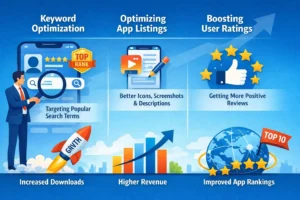
  • App Title & Keywords: The app’s title (and subtitle on iOS) is the most important on-page signal. Include your primary keyword naturally in the title. Use all available keywords in your Play Store tags and iOS keyword field. Regular keyword research and competitor analysis will keep your keyword mix fresh.

  • Description Copy: Write a concise, clear description that highlights your app’s benefits. On Google Play, the full description also influences rankings, so sprinkle keywords here too. Structure the description to answer likely questions (What does the app do? Why is it better than others?). This helps with voice search and featured snippets in search results.

  • Icon and Screenshots: Eye-catching visuals are an ASO must. A distinctive app icon grabs attention in search results. High-quality, annotated screenshots show the app’s main features. Apps with well-designed screenshots see higher install rates. Consider showcasing the UI, positive reviews, or a ‘before/after’ usage scenario.

  • Promo Video: If possible, include a short video demo in your App Store listing. Videos can boost conversions by giving users a quick tour of the app experience.

  • Ratings & Reviews: Encourage happy users to leave positive reviews. High star ratings and recent reviews improve ranking and trust. Responding courteously to feedback (good or bad) shows engagement. In fact, App Store algorithms factor review frequency and sentiment into rankings.

  • Frequent Updates: Regularly update your app with new features and improvements. Updates reset the app’s relevancy clock in the store, and can bring a temporary boost in visibility. Mention updates in the “What’s New” text to re-engage existing users as well.

  • A/B Testing: Use built-in tools like Apple’s Product Page Optimization to test variations of icons or screenshots on small user groups. Data from these tests shows which assets lead to more downloads. The winner can then be rolled out to all users to maximize conversion.

By refining each of these factors, ASO works its magic: better keyword matches for more searches, and more persuasive listing elements for higher conversions. It’s a comprehensive approach, AppTweak advises focusing on metadata and creative elements together.

Global Mobile Market Trends Driving ASO

The world’s appetite for mobile apps continues to explode, and app store optimization lets you tap into this global user base. With billions of smartphone users worldwide, even a niche app can find an audience if optimized correctly.

  • Smartphone Adoption: Mobile is truly global. About 4.9 billion people owned smartphones in 2024, and projections hit 5.65 billion by 2026 According to global telecom data published by the U.S. government’s communications statistics portal. That’s over 70% of the planet’s population holding a device in their pocket. Every region is adding new users – for example, India added 120 million smartphone owners in 2024.

  • OS Market Share: Android dominates worldwide (around 73% of devices as of late 2025) while iOS holds about 27%. However, iOS is disproportionately strong in markets like North America and Western Europe. This means your app store optimization strategy must span both ecosystems. For Android apps, an effective ASO on Google Play is critical to reach the Asian and African markets, while on the App Store it’s key for markets with many iPhone users.

  • App Downloads & Revenue: Consumers downloaded an astounding over 137 billion apps in 2024, and Sensor Tower projects downloads will reach 324 billion by 2026. Apps generated roughly $935 billion in revenue in 2024, with growth toward a $1 trillion annual market expected by 2026. These figures underscore the sheer scale: an optimized app can capture its share of trillions of dollars in global spending. Apple alone facilitated $1.3 trillion in App Store sales in 2024, highlighting the opportunity.

  • User Engagement: People spend hours on apps each day (4.9 hours on average, with 89% of phone time in apps). The typical smartphone user interacts with 30 apps per month. This means high engagement – if your app ranks well, users will see it repeatedly, increasing downloads.

The takeaway: Mobile is everywhere. Each market (North America, Europe, APAC, Middle East, etc.) has unique trends (e.g. certain app categories or features), but all share a common dynamic: apps win attention via search. ASO leverages these trends. For example, offering localized keywords and descriptions can capture users searching in their native language. In emerging markets where data is cheaper and phones are cheaper, game and social apps might boom; in developed markets, productivity and streaming apps might dominate. Customizing your listing to these regional nuances – from keyword choice to screenshot style – is part of Generative Engine Optimization: structuring content so AI and users in each locale understand it.

Global App and Phone Market Highlights (2024–2026)

Metric 2024 2025 (proj) 2026 (proj)
Smartphone Users 4.88 billion 5.28 billion 5.65 billion
Global App Downloads 277 billion 299 billion 324 billion
Mobile App Revenue $935 billion (rising) >$1.0 trillion
Apple App Store (apps available) 2.2 million (2022) ~2.0 million
Google Play Store (apps) 3.5 million (2022) 2.87 million
Android OS Market Share (Worldwide) 71.5% (2024) ~73% (Nov 2025)
iOS Market Share (Worldwide) 27.8% (2024) ~26.8% (Nov 2025)

This data shows how huge and fast-growing the app economy is. In practice, it means app makers in any region have a massive user base to target, if they rank well. app store optimization is the bridge between your app and those billions of potential users worldwide.

Emerging ASO Trends in 2026

The app store landscape evolves constantly. By 2026, several key trends are shaping ASO:

  • AI-Driven Optimization: Artificial intelligence and machine learning are increasingly used for ASO. For example, AI tools can analyze vast amounts of app store data to suggest high-performing keywords or design more effective screenshots. Even generative AI can draft app descriptions or simulate user reviews to guide improvements. Treat AI as a creative partner: use it to generate ideas, then validate them with real A/B tests. These “AI applications” speed up insight and make optimization data-driven.

  • User Intent and Voice Search: Modern app store search engines (and voice assistants) use intent signals. Users may ask Siri or Google Assistant for “best recipe apps” or “exercise tracker”. Make sure your app listing answers likely questions directly. Use natural, conversational phrases in descriptions, and structure text so that assistants can pull short answers. This is similar to optimizing for featured snippets or zero-click answers. Answer early – e.g. a subheading like “What this app does” can help voice assistants and snippet boxes parse your content.
  • Localization & Personalization: The global audience expects apps in their own language and tailored to their locale. Effective ASO now means fully localizing your title, description, keywords, and even screenshots for each country. For instance, an economy-focused tagline might resonate in one market, while a lifestyle hook works in another. Use geo-specific search terms (“AI photo editor app UK” vs “AI photo editor app India”) to capture regional trends. A one-size-fits-all listing misses half the market.

  • Creative A/B Testing: Stores now allow multiple creative assets (like iOS’s Custom Product Pages). Marketers should continuously test different icons, screenshots, and videos to see what converts best. Small changes (color, text overlay, image sequence) can yield big gains in download rate. In 2026, high-performing apps are those that relentlessly experiment and refine their creatives based on user response.

  • Privacy-First Strategies: With stricter privacy rules (like iOS’s App Tracking Transparency) many targeting signals are limited. App store optimization benefits from this shift because it relies on organic, first-party data (search and downloads you actually earn). Focus on building trust: highlight privacy and quality (e.g. “NSA-approved encryption” or “No ads”) in your copy if relevant. Apple’s forums even note that “privacy-first” is a top ASO trend, emphasizing genuine user value over intrusive tactics.

  • Analytics and Adaptation: Finally, ASO requires ongoing analytics. Use store analytics (App Store Connect, Google Play Console) and third-party tools to monitor search rankings, keyword performance, conversion rates, and user behavior. Regularly update your strategy based on these insights. For example, if you notice a spike in a new search term, integrate it quickly. The market moves fast, and app store optimization must move with it.

These trends show that app store optimization in 2026 is as much about technology and user experience as it is about keywords. Leveraging AI Overviews and data helps you stay ahead, while focusing on real users (intent, localization, privacy) earns trust and downloads. In short: good ASO is user-centric and adaptive.

Integrating ASO Into Your Growth Strategy

ASO should be part of every app’s growth plan from day one. Make it a continuous process, research keywords, optimize assets, and track metrics. Combine app store optimization with your marketing campaigns and product roadmap for the best results.

Integrating ASO Into Your Growth Strategy

Implementing app store optimization effectively often follows these steps:

  1. Research & Planning: Begin by researching relevant keywords and competitors. Tools like Google Play Console’s search console and App Store Connect suggest search terms, or use ASO platforms. Identify the high-volume keywords your potential users use (e.g. “photo editor”, “language learning”). Plan to update your app’s name, subtitle, and description around these terms.

  2. Optimize Metadata: Apply your research to the listing. Craft a clear, compelling app title containing the main keyword. Fill out all subtitle/short description fields with secondary keywords. Write bullet-point descriptions of core features, then a paragraph of details. Remember to tailor this for each region’s language and style.

  3. Improve Visuals: Refresh your icon and screenshots. For example, if early adopters didn’t respond well, try a new color scheme or imagery. Use captions on screenshots to highlight key features (“AI-powered filters”, “Offline mode”). Ensure your app preview video (if available) is short, punchy, and shows actual in-app footage.

  4. Gather Reviews: Prompt satisfied users to leave a review. You could ask in-app at a natural point (“Enjoying the app? Tap here to rate us!”). Respond politely to reviews and fix critical issues mentioned. A stable 4+ star rating significantly boosts conversions and ranking.

  5. Monitor & Test: After changes, monitor the results. Did your rank for target keywords improve? Are downloads increasing? Use A/B tests where possible (e.g. iOS Product Page Optimization tests) to compare creatives. Adjust your approach based on data – for instance, if one keyword isn’t working, try synonyms.

  6. Stay Updated: ASO isn’t one-and-done. Whenever you update the app (new features, supports, content), treat it as another chance to tweak your listing. Also watch for store algorithm changes. Apple or Google may tweak search rules or introduce new features; staying informed (through developer news or forums) lets you pivot quickly.

By weaving app store optimization into your ongoing app marketing, you ensure continuous improvement. Many developers overlook ASO after launch, but that’s a missed opportunity. In contrast, apps that iteratively refine their listing (based on real user behavior and store trends) consistently gain more organic installs over time.

Conclusion

App Store Optimization isn’t a nice-to-have bonus – it’s essential for mobile app success in 2026. With billions of users out there and millions of apps vying for attention, the apps that grow fastest are those that master ASO. Key takeaways:

  • Optimize your listing globally: use the focus keyword “App Store Optimization” in your strategy, but more importantly use targeted keywords for your app’s niche.

  • Balance discovery and conversion: Improve search rankings through smart metadata, and make your app irresistible with great visuals and a compelling description.

  • Embrace data and technology: leverage AI tools, test creatives, and keep up with store trends to stay ahead.

  • Think globally: tailor your ASO for each region (language, culture, dominant platform) to reach worldwide audiences.

ASO requires patience and persistence, but the payoff is huge: more organic downloads, better user acquisition ROI, and ultimately a stronger, global user base. Don’t let your app be the hidden alley restaurant, put it on the busiest street of the app store!

Ready to level up your app’s visibility? Contact Elevatech Digital today, and start applying these ASO strategies. For expert guidance on optimizing your app store presence and crafting a winning app marketing plan, our team is here to help. We combine technical know-how with creative flair to ensure your app shines in every market.

Frequently Asked Questions

  • What is App Store Optimization (ASO)?

    ASO stands for App Store Optimization. It’s the process of improving an app’s listing (title, description, keywords, visuals, etc.) so it ranks higher in app store searches and attracts more downloads. Think of it as search engine optimization but specifically for the Apple App Store and Google Play. By optimizing for relevant search terms and boosting your conversion elements (icon, screenshots), ASO drives organic growth.

  • How does ASO differ from SEO?

    Both ASO and SEO aim to improve visibility, but ASO applies inside app stores, while SEO targets web search engines. ASO uses app-specific factors like app name keywords, ratings, and in-app purchase data. SEO, by contrast, involves website content, backlinks, and technical site factors. In practice, a web search for an app may even show app store listings, but the optimization techniques differ. For apps, ASO is primary; SEO complements it by ensuring your app’s website can be found on Google.

  • Why is ASO important for my app’s growth?

    In 2026, discoverability is everything. ASO is important because it puts your app in front of users who are already searching for what you offer. Improved ASO leads to higher app store rankings, which means more visibility. More visibility + better listing = more downloads. According to industry experts, good ASO directly boosts installs and can lower your marketing costs. Without ASO, even great apps can remain invisible.

  • Can ASO help in different regions around the world?

    Absolutely. ASO should be tailored to each target market. For example, you should use the local language and cultural nuances in your app’s title and description. Android dominates in Asia and emerging markets, while iOS leads in the US and Europe, so you might emphasize Google Play listing optimization in one region and App Store optimization in another. Also consider region-specific keywords and imagery. Apps that localize and optimize for each region see much stronger growth globally.

  • How often should I update my ASO strategy?

    ASO is an ongoing process. You should revisit and tweak your listing whenever you release app updates or see changes in performance. Monitor your keyword rankings, download rates, and competitor moves regularly (monthly or quarterly). Use A/B tests to refine graphics, and adjust keywords if search trends shift. In short: continually. The app stores and user tastes evolve fast, so effective ASO is never “set it and forget it.”

Modern SEO

Imagine asking Google a question and instantly getting a clear answer without clicking any link. This is no sci-fi: by 2026 about 30% of search results pages feature an AI-generated answer box. For example, graph studies show search impressions rising while click-through rates fall, as more users see answers at the top of results. Modern SEO isn’t dead, it’s evolving. In fact, search engines now act like smart assistants, analyzing meaning, context, and user intent. In this new era, how algorithms work is very different from the past. Let’s explore the core of Modern SEO, unpack how today’s algorithms really rank content, and what you need to do to thrive in a world dominated by AI-driven search.

zero-click search in the AI era

Search engines in 2026 don’t just match keywords – they understand topics. Instead of punishing sites that use AI or new tech, modern algorithms reward meaningful content. As one expert puts it, Modern SEO centers on the “people, places, concepts, and things” (entities) that give content real context. In practice this means focusing on semantic SEO – organizing your content around topics and intent, not just repeating exact phrases. For example, a page about “best CRM software” would cover customer relationship concepts, use cases, and related tools, rather than endlessly repeating that keyword. This broader approach helps AI-driven systems “understand” your page’s purpose, keeping it eligible for top results.

How Search Algorithms Work Today (Modern SEO in 2026)

At their core, search engines still aim to “organize the world’s information and make it universally accessible,” but the way they do this has shifted into overdrive with AI. Google’s Search Central explains that its automated ranking systems evaluate hundreds of factors and signals across billions of pages to deliver relevant results. This means the engine looks at everything from content quality and freshness to site performance and user satisfaction. In simple terms, modern search algorithms work on two levels:

Page-Level Signals in Modern SEO

Each page is analysed for:

  • Relevance to search intent
  • Contextual meaning
  • Structured data
  • Page speed
  • Mobile usability
  • Content clarity
  • Semantic coverage

Modern SEO still requires:

  • Crawlable content
  • Indexable pages
  • Clear hierarchy

A technically weak site cannot compete in Modern SEO, regardless of how strong its content is.

Site-Level Signals in Modern SEO

In 2026, Modern SEO prioritizes:

  • Brand recognition
  • Author credibility
  • Real-world expertise
  • Topical authority
  • Trust signals
  • Consistent publishing

Search engines now evaluate both:

  • What you publish
  • Who is publishing it

This shift is the backbone of Modern SEO strategy worldwide.

Key Modern SEO Ranking Signals in 2026

Unlike older SEO strategies, Modern SEO ranking signals now include:

Modern SEO Signal Why It Matters
Content Depth Answers complete user intent
E-E-A-T Demonstrates expertise
Technical Performance Enables crawling
User Experience Improves engagement
Structured Data Helps AI understand meaning
Entity Relevance Improves contextual accuracy

In Modern SEO, nothing has changed more than how ranking signals are interpreted.

Semantic SEO & Entity-Based SEO in Modern SEO

Imagine search engines as librarians who have read every book in the world. They no longer look for exact words on a page; they look for understanding. This is the principle of semantic search. In practice, it means focusing on concepts and intent. Semantic SEO (often called context-driven SEO) ensures your content explains ideas clearly and connects them, rather than shoehorning keywords. As one expert summary notes: “Semantic SEO focuses on helping search engines understand what a page is about by covering topics, concepts, and intent instead of repeating keywords.”.

  • Entities: Modern search uses a knowledge graph of entities (distinct people, places, things). For instance, “Barack Obama” is an entity (person), “iPhone” is a product entity, “climate change” is a concept entity. Google and others use these to understand context. Entity-based SEO means clearly defining these core terms in your content. If you mention “iPhone”, explain it’s Apple’s smartphone, its features, history, etc. This signals authority to AI. As one source explains, optimizing for entities builds authority beyond keywords.

  • Intent: Effective SEO now demands a deep match to user intent. Algorithms interpret why someone searched, not just the literal words. A query like “best CRM software” has many intents: learning what it is, comparing tools, finding pricing, etc. You must deliver the specific answer the user is seeking. If your page doesn’t solve that exact need, AI signals (user behavior) will cause it to slip in visibility.

  • Context: Algorithms look at how ideas on your page relate to each other. Good content explains related concepts naturally. For instance, an article about “email marketing” might cover A/B testing, personalization, campaign metrics, and integration. When these topics appear together, AI sees depth and relevance. A page missing such context appears shallow, even if it uses the keyword.

Practical Steps for Semantic Modern SEO

To succeed in Modern SEO, you must:

  • Cover all subtopics of your main subject
  • Use structured schema markup
  • Interlink related content
  • Define entities clearly
  • Answer related questions directly

In essence, Entity-Based SEO is the future: it ties together content around real-world subjects instead of just keywords. As noted by experts, moving to entity-focused optimization “will not future-proof SEO by 2026 with just keyword stuffing. Entities matter because they improve contextual relevance, support Google’s Knowledge Graph, and increase exposure in conversational search.”

The Rise of AI in Modern SEO (AEO & GEO)

By 2026, you’re not just competing with 9 other websites for the #1 spot, you’re competing with the search engine itself and its AI assistants. We’ve entered the era of Answer Engines and Generative Search. Google’s new AI Overviews, ChatGPT, Perplexity, Claude, and others often provide direct answers by citing sources rather than showing many blue links. This shift has given rise to Answer Engine Optimization (AEO) and Generative Engine Optimization (GEO), as outlined by industry leaders.

  • Answer Engine Optimization (AEO): This means optimizing to get included in AI-generated answers. Microsoft’s AI research emphasizes that brands must be found and recommended by AI systems. In practice, AEO involves structuring content to directly answer common questions and ensuring accuracy so that AI tools pick you as a trusted source. For example, adding concise summaries and exact answers at the top of your pages improves AEO chances.

  • Generative Engine Optimization (GEO): GEO takes AEO a step further for systems like ChatGPT, Bing Chat, and Google’s AI Mode. Instead of being a link to click, GEO aims for your brand to be explicitly mentioned in the AI’s answer. Search Engine Land defines GEO as “structuring your content so that AI-powered search platforms…can retrieve, cite, and recommend your brand when answering user questions.”. In other words, you want to be one of the few sources an LLM cites in its response.

traditional SEO and generative engine optimization (GEO)

Why does this matter? A recent study predicted a 25% drop in traditional search volume as users shift to AI answers. ChatGPT alone serves 800 million users weekly, and tools like Perplexity handle hundreds of millions of queries per month. Essentially, many users get their answers within the search interface or chat interface without clicking through to websites. Being #1 on Google no longer guarantees visits.

Best Practices for AI-Driven Modern SEO

  • Front-load answers: Begin articles with clear, concise answers or summaries of the main question. This lets AI quickly ingest and cite them.

  • Use structured formats: Lists, tables, bullet points, FAQs, and numbered steps are favored by LLMs. Write in a question-and-answer style where possible.

  • Cite authority: Since AI prefers authoritative sources, include credible data, case studies, and references within your content. Storytelling with real examples makes your content “quotable” to AI.

  • Diversify signals: Publish across multiple channels (blog, YouTube, social). AI engines often pull content from social platforms, forums, and news. For instance, AI answer boxes increasingly cite YouTube for product info. Also mark up your images and videos with schema, as multimodal search is now standard.

  • Optimize for metrics of the new era: Instead of just page views, track AI Presence Rate (share of queries where you appear in AI answers) and Citation Authority (how often you are named). These indicate success in a world where raw traffic may drop but influence grows.

An example analogy: Traditional SEO vs. GEO. Traditional SEO is like trying to be the top entry in a phone book for your industry; GEO is like being one of the trusted experts the operator suggests when someone asks a question.

Key Strategies for Modern SEO Success

Given these changes, what should you do to optimize effectively? Here are the core strategies every global site should employ in 2026:

  • Focus on quality and depth: Write as if you’re explaining the topic to a smart friend. High-ranking content now “feels written by someone who understands the topic deeply” and respects the reader’s time. Cover each subject comprehensively with clear language. Avoid filler and fluff.

  • Build topical authority (clusters): Instead of creating isolated pages for single keywords, create clusters of related articles that interlink and cover subtopics. Search engines evaluate topical authority across a site. A blog that consistently covers one theme (with a hub page linking to in-depth articles) sends stronger signals than scattered posts. Internal linking is your friend: it helps AI see how your content pieces connect.

  • Leverage structured data: Use schema markup extensively. Mark your business, products, events, FAQs, and reviews. As one guide notes, structured data is a fundamental building block of entity SEO. It literally tells AI, “This page is about [Entity], which has [attributes].” Rich results (knowledge panels, sitelinks, etc.) also help brand visibility.

  • Prioritize user experience: Continue improving page speed, mobile usability, accessibility, and on-page navigation. Core Web Vitals and mobile-friendliness are still direct ranking factors. Beyond that, they improve user satisfaction signals. If users swiftly find what they need on your site, algorithms detect that.

  • Maintain fresh, trustworthy content: Update important pages regularly to stay accurate. Freshness signals matter more for timely topics, and outdated info can hurt trust. Also, add clear date stamps and author info, algorithms in 2026 may de-prioritize content without evidence of real authorship or updates.

  • Earn authoritative citations: Traditional link-building still helps, but think beyond backlinks. Cultivate positive mentions in reputable news, industry sites, and social buzz. AI models increasingly factor in brand sentiment and mentions. As one report shows, ~34% of AI citations can come from PR/earned coverage. Aim to become the go-to expert quoted by others.

Remember: Technical SEO is still foundational. Nothing beats an error-free, lightning-fast site that search bots can crawl easily. Use tools like llms.txt (AI-friendly robots.txt) if needed to guide crawlers. But don’t get so caught up in the latest tool that you neglect the basics: If AI bots can’t reach or read your content, you can’t compete in AI search.

Global Optimization in Modern SEO

Modern SEO is a global game. Search engines worldwide (Google, Bing, Baidu, Yandex, Naver, etc.) are all layering AI into their results, and users in each market have specific needs. For international SEO in 2026, the key is clear differentiation and entity consistency across languages. Here’s what that means:

  • Localize with real differences: Simply translating content isn’t enough. AI can detect when multiple pages answer the same intent in different languages and will often choose one as the “master” answer. In fact, when two pages answer the same question, “AI systems detect semantic equivalence and select a single representative version, regardless of language”. If your site has English and Spanish versions of identical content, AI might only use one. To avoid this, add genuine market-specific details: local pricing, legal disclaimers, examples, or case studies. These signals tell AI, “This page serves a particular region,” so it will consider all versions.

  • Maintain entity clarity across markets: Your brand or organization should be clearly defined in every version. Search algorithms ask, “Who is this organization? Which market is this?”. Use consistent naming, maintain a recognizable logo and tagline, and describe local offices or representatives in each language. Structured data (Organization, LocalBusiness schema) should be accurate and locale-specific. Each local page must reinforce the global entity while expressing legitimate local distinctions (e.g., “Acme Corp – India Branch”). This helps AI know that www.example.com/in and www.example.com/us represent the same brand at different levels.

  • Use Hreflang but don’t over-rely: Implementing hreflang tags is still good practice for traditional search, but in AI-powered answers it may have limited effect. AI may pick content before applying hreflang signals. So, focus on making each language’s page strong on its own (good content, local signals) rather than expecting a tag to fix duplication.

  • Local credibility matters: In some countries, local expertise signals (authors with local credentials, reviews from local customers, partnerships with local organizations) can boost trust in AI’s eyes. In sensitive industries (health, finance, legal), emphasize local compliance and authority so AI knows your page is validated in that region.

In summary, Great global SEO means truly thinking local. AI unifies content across borders, so only genuinely unique, market-specific pages stand out. Pages must “signal their location” through content and data, not just language. When done right, you’ll be prepared to be the source AI cites in each region’s answers.

Conclusion

Modern SEO in 2026 is not about tricking algorithms, it’s about meeting them halfway. Search now understands language like a human: it values clear, coherent answers and trusted sources. The what of SEO remains the same (useful content that satisfies user queries) but the how has shifted. You must think in terms of topics, context, and credibility rather than isolated keywords. Technology like AI and voice assistants has become another way people search for information, so broadening your strategy to include AEO/GEO is critical.

To excel in Modern SEO, keep these takeaways in mind: focus on semantic richness (entities and context), build real authority (E‑E‑A‑T), maintain rock-solid technical health, and craft content that answers questions head-on. Remember that AI-driven results reward clarity and trust. As Google’s guidance shows, the foundation still lies in crawlability and serving the user.

In the end, SEO in 2026 is about being the trusted voice that both humans and AI assistants turn to. Keep refining your approach, and if you’re ready to elevate your global visibility, partner with Elevatech Digital to build a future-ready Modern SEO strategy that earns citations, drives authority, and wins in the AI-powered search era.

Frequently Asked Questions

  • What exactly is Modern SEO?

    Modern SEO is optimizing content for today’s AI-powered search environment. It emphasizes topic depth, user intent, and entity clarity instead of just keywords. This means focusing on quality, context, and trust signals (E‑E‑A‑T) so that search engines understand and reward your content.

  • How do search algorithms work differently now?

    Search engines now use advanced AI models to interpret queries and content. They analyze hundreds of signals – from page structure and semantic context to brand authority and user behavior. Importantly, modern algorithms often provide direct answers (AI Overviews) on the results page, so ranking #1 no longer guarantees traffic. The focus is on satisfying user needs, which AI measures through engagement and content relevance.

  • What is semantic SEO, and why should I care?

    Semantic SEO means optimizing for meaning and intent. Instead of repeating exact keywords, you write content that thoroughly covers a topic (entities and subtopics) so the search AI “understands” your page. This makes your content eligible for voice search answers and AI summaries. In short, it’s the difference between matching words and actually teaching the subject – and teaching wins in 2026.

  • How does AI (like ChatGPT or Google’s AI) affect SEO?

    AI changes both how people search and how rankings are calculated. Many users now get answers from AI chatbots or AI-enhanced results without clicking websites. So, SEO now includes Answer Engine Optimization (so your content is picked as the answer) and Generative SEO (so AI will cite your brand). Instead of chasing clicks, you optimize for AI systems to recognize and recommend your content.

  • What should I focus on first in 2026 SEO?

    Begin with user intent and expertise. Identify the key questions your audience is asking, then answer them better than anyone else. Ensure your site passes technical muster (fast, secure, mobile). Build your brand’s authority by earning mentions in reputable places. And pay attention to AI trends: use structured data, publish across platforms, and monitor how often AI answers cite you. By blending classic SEO fundamentals with semantic, AI-aware tactics, you’ll succeed globally in the modern search landscape.

Google’s Knowledge Graph

You search for a person. A brand. A city. And before you even click a link, Google gives you the answer. A clean info box. Key facts. Related topics. It feels instant, almost intuitive. That experience is powered by Google’s Knowledge Graph,the invisible intelligence layer that connects billions of data points across the web. In today’s world of Modern SEO and AI Overviews, ranking is no longer just about keywords. It is about entities, relationships, and trust. If you want your brand, your content, or your expertise to stand out globally, you need to understand how Google’s Knowledge Graph actually works, and how to position yourself inside it. Let’s break it down.

What is Google’s Knowledge Graph?

When you Google a famous person or place, you often see a quick info box with key facts. That feature is powered by Google’s Knowledge Graph. In a world where people want instant answers, understanding Google’s Knowledge Graph is a must for modern SEO. Google is learning to connect the dots so you, the searcher, get what you need with minimal clicks.

Think of the Knowledge Graph as a vast network of facts. Each node is an entity (like a person, place, or product), and each link is a relationship or fact. Google even calls it a “database of billions of facts” about people, places, and things. In fact, SEO experts describe it as “a large-scale database of facts about people, places, things, and their relationships”. For example, searching “Leonardo da Vinci” shows a Knowledge Panel with his portrait, birth/death dates, and famous works. That information comes directly from the Knowledge Graph, which connects all those facts.

Key Knowledge Graph Data

Metric Value
Launched 2012
Entities (mid-2020) 5 billion
Facts (mid-2020) 500 billion

Google’s Knowledge Graph constantly grows. By 2020 it held around 500 billion facts on 5 billion entities, drawing from trusted sources like Wikipedia and authoritative public datasets. This data powers almost every enhanced search feature: Knowledge Panels, rich snippets, answer boxes, and voice answers. It even supports government-backed open data initiatives such as those published on Data.gov, which provide structured public datasets that search engines can interpret and connect.

How the Knowledge Graph Works

Rather than treating your query as just a string of keywords, Google’s Knowledge Graph identifies the real-world entities in it. It solves ambiguity by context. For instance, “seal” could mean a marine animal, a U.S. Navy serviceman, a government insignia, or the singer Seal. Google learned that most people searching “seal” mean the musician, whereas “seals” usually refers to the animals. The KG figures out which meaning you want and retrieves the relevant facts.
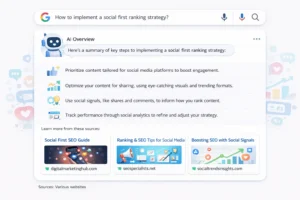

Knowledge Graph Works

The diagram below shows multiple meanings of the word (“seal”). Google’s Knowledge Graph uses context and search patterns to pick the intended meaning and show relevant info.

Behind the scenes, Google’s algorithms use the Knowledge Graph to:

  • Disambiguate Entities: Determine which real-world thing you mean (for example, distinguishing the Taj Mahal monument from any other meaning of that name).

  • Collect Key Facts: Quickly gather important facts about that entity (like stats, dates, attributes). For example, it can instantly fetch a city’s population or a movie’s release year.

  • Reveal Connections: Link related topics. For instance, Marie Curie in the graph connects to her Nobel Prizes, discoveries, and relatives. These links help Google suggest related searches.

  • Provide Instant Answers: With this structured data, Google often shows an Answer Box or Knowledge Panel right on the results page. According to Wikipedia, this lets users see the answer “at a glance” via an infobox.

These steps make your search more helpful. Instead of poring over pages, you often get the facts immediately. And as Google adds AI-driven features (like its new AI Overviews), Google’s Knowledge Graph remains the backbone that ensures answers are factual and contextually relevant.

Why the Knowledge Graph Matters for Modern SEO

In modern SEO, Google’s Knowledge Graph is a game-changer. Google now prioritizes understanding intent and the things behind a query. Being part of Google’s Knowledge Graph can greatly boost your site’s visibility and authority. Key benefits include:

  • Visibility & Credibility: Appearing in a Knowledge Panel or rich result immediately highlights your brand. It’s like Google officially endorsing your info.

  • Higher Click-Through Rates: Instant answers and facts draw users in. Pages featured by KG-powered results (like answer boxes) tend to see more clicks.

  • Better User Experience: Quick, relevant info satisfies searchers and keeps them engaged. Knowledge Graph features “offer quick, relevant, easy-to-digest information,” which improves engagement.

  • Authority & E-E-A-T: The KG pulls from trusted sources. If you or your content appear in it, that signals expertise. This aligns with Google’s focus on E-E-A-T (Expertise, Authoritativeness, Trustworthiness).

  • Future-Proof SEO: As search evolves (voice assistants, AI answers, etc.), content optimized around entities will stay relevant. Structured data and clear entity focus help your SEO adapt.

SEO Benefit Why it Matters
Visibility & Credibility Knowledge Panels/rich snippets draw attention and imply trust.
Higher CTR Instant answer boxes lead to more clicks on your site.
User Engagement Quick, relevant info keeps users on your site longer.
Authority & E-E-A-T KG presence indicates expertise, aiding overall rankings.

In short, modern SEO is about topics and entities, not just keywords. The Knowledge Graph sits at the heart of that shift.

How to Optimize for Google’s Knowledge Graph

Boosting your presence in Google’s Knowledge Graph involves both good SEO habits and some entity-focused tactics:

  • Add Structured Data: Use schema markup (like Person, Organization, Product, etc.) to label your content. This helps Google identify and connect your entities on the page.

  • Claim or Improve Your Knowledge Panel: If Google already shows a panel for you or your brand, verify it. You can then suggest edits so Google’s info about you is correct.

  • Build Authoritative Presence: Get your key facts onto trusted sources. For example, if your company or topic qualifies, maintain a Wikipedia entry (and ensure it’s accurate). Google’s Knowledge Graph heavily relies on these sources for data.

  • Create Answer-Driven Content: Write clear, focused content that directly addresses common questions in your field. Use headings, bullet lists, and direct Q&A formats so Google can easily grab facts. This kind of content is more likely to be featured.

  • Optimize Local Listings: If you have a physical business, complete your Google Business Profile. Accurate name, address, hours, and category data ensure Google displays the correct info in local panels.

  • Earn Trustworthy Mentions: Aim for coverage on reputable websites and industry publications. The more high-quality sites mention you (with the same facts), the stronger your entity appears in Google’s eyes.

How to Optimize for Google’s Knowledge Graph

These steps send clear signals to Google’s Knowledge Graph: you are a distinct entity with well-documented facts. Over time, this can help your brand or site appear in more answer boxes and panels.

Knowledge Graph, AI Overviews, and the Future of Search

Google’s search is rapidly evolving with AI. One example is AI Overviews (previously known as the Search Generative Experience). These AI-generated summaries answer search queries by compiling info from multiple sources. They still rely on understanding entities – much like Google’s Knowledge Graph does.

For instance, in 2024 Google rolled out Gemini-powered AI Overviews globally. These summaries give concise answers and even cite their sources. Importantly, Google says no special new SEO tricks are needed for these AI features – just focus on core SEO best practices.

This approach is part of Answer Engine Optimization (AEO) and Generative Engine Optimization (GEO). In practice, make your content easy for both users and machines: use clear headlines, bullet points, and direct answers. An SEO analysis suggests keeping your content concise and well-structured so AI Overviews can easily integrate it.

Notably, Google’s Search Central documentation on AI features confirms this strategy: “Best practices for SEO remain relevant for AI features (such as AI Overviews)”. So keep providing helpful, well-structured content and up-to-date entity information. This will help you appear in Knowledge Panels, featured snippets, and even AI Overviews.

Conclusion

Google’s Knowledge Graph is a powerful part of modern search. By turning search into a network of real-world facts, it gives users instant answers. To leverage it for SEO, focus on these takeaways:

  • Treat Your Brand as an Entity: Make sure Google can clearly identify who you are. Keep your key details accurate and up-to-date.

  • Craft Clear, Structured Content: Use schema, clear headings, and concise lists or Q&As. This makes it easy for Google (and AI) to find your answers.

  • Build and Claim Authority: Maintain your presence on trustworthy sites (and claim your Knowledge Panel if possible). This builds credibility in Google’s graph.

  • Prepare for AI and Voice: Keep answers short and to the point. Include FAQs and bullet answers. This helps both Knowledge Panels and AI Overviews surface your content.

Optimizing for Google’s Knowledge Graph means thinking like a modern answer engine. Keep your content factual, structured, and authoritative, and your site will stand out in search results across the globe.

Are you ready to elevate your SEO? At Elevatech Digital, we combine SEO expertise with the latest AI-driven strategies. Contact our team to start leveraging Google’s Knowledge Graph and AI-powered search features for your brand.

Frequently Asked Questions

  • What exactly is Google’s Knowledge Graph?

    It’s Google’s knowledge base of real-world facts and entities. Google uses it to display instant answers on the results page. For example, Google calls it a “database of billions of facts” and SEO experts describe it as a database of facts about people, places, and things.

  • How does a Knowledge Panel differ from the Knowledge Graph?

    The Knowledge Graph is the underlying database of entities and facts. A Knowledge Panel is the visible info box on the search page (often on the right) that displays some of that information about an entity.

  • Can my business appear in the Knowledge Graph?

    Yes. Google’s Knowledge Graph often includes local businesses. It builds local panels from Google Business Profile data and other sources. Make sure your Google Business Profile is complete (with accurate address, hours, etc.) and that your business info is consistent on authoritative sites.

  • Do I need schema markup to benefit from the Knowledge Graph?

    It’s highly recommended. Schema helps Google’s systems clearly identify the entities on your page and link them to Google’s Knowledge Graph. Structured data makes it much easier for Google to connect your content with the right real-world entities.

  • Are AI Overviews replacing Knowledge Panels?

    Not exactly. AI Overviews are a new way to provide answers using generative AI, while Knowledge Panels are still important. To appear in either, focus on clear, concise facts about your topic — that strategy covers both.

     
Digital PR Drives Social First Ranking

Imagine typing a query into Google and seeing TikTok clips, Reddit threads, and news articles all on page one. Welcome to the era of Social First Ranking, where modern SEO is no longer just about on-page keywords and backlinks, it’s about meeting users on the platforms where they actually spend their time. With 5.66 billion social media identities worldwide (over two-thirds of humanity), audiences often find products and information on multiple channels, and search engines now surface content from those same places. For brands today, adopting a Social First Ranking mindset is crucial.

In this article, we’ll explain how Social First Ranking strategies power modern SEO success for a global audience. You’ll learn why digital PR, social content, and even AI-driven tools must work together to put your brand in front of customers — whether they’re in New York, London, Tokyo or Dubai. We’ll break down the tactics step-by-step, with the latest data and expert insights, so you can craft a truly social-first SEO game plan that resonates worldwide.

global social media marketing

The Rise of Social First Ranking Strategies

In today’s landscape, ranking well means showing up on every relevant platform, not just Google search. Social-first ranking strategies recognize that people discover brands on social media, forums, and AI tools as much as on websites. For example, Google’s results now often include TikTok clips, Instagram carousels, and Reddit discussions. Search Engine Land notes that Google’s AI Overviews (introduced in 2024) pull from TikTok, Reddit, YouTube and other social sources. In short, the line between “search” and “social” is blurring.

Consider these key trends:

  • Multi-Platform Journeys: Consumers frequently move across 11 or more sources (search engines, social apps, forums, etc.) during research. Your brand has to meet them on all those channels.

  • Trust in Community Content: Forums like Reddit now host first-hand reviews and discussions. Search algorithms and AI models pull these “unfiltered opinions” into results. Ignoring these platforms can leave your brand invisible.

  • Video is Vital: Short-form videos (TikTok, Instagram Reels, YouTube Shorts) aren’t just entertainment. They’re a high-impact discovery surface; Google prominently features video snippets and even AI summaries of video content.

  • Holistic SEO: SEO works best when digital PR, social media, and community insights align. As experts note, SEO becomes much more powerful when these elements “work together”.

Modern SEO now feels like broadcasting on multiple channels at once. The table below contrasts traditional SEO with a social-first approach:

Aspect Traditional SEO Social First Ranking Approach
Focus Keywords and backlinks on your site Social engagement, community content, PR
Channels Owned website, blogs, search results Social platforms (TikTok, YouTube), forums, AI Overviews
Content Types Long-form articles, static pages Videos, short posts, user reviews, news stories
Ranking Signals On-page optimization, editorial links Social buzz, brand mentions, AI citations

About 96.9% of internet users in major global markets use at least one social network each month, spending over 18 hours per week on social media. A Social First Ranking approach requires that your brand appears across every channel, tying them together for maximum impact. In short, a Social First Ranking approach ties together all those channels – with PR and content – to make sure your brand is visible everywhere people search.

Digital PR: The Key to Social First Ranking Success

Digital PR sits at the heart of any Social First Ranking approach. Digital PR is essentially the modern upgrade of traditional PR — built for a world where people discover brands via social media and AI answers. It’s about creating stories, data, and expert content that earn attention on credible sites, which in turn boosts your SEO. Unlike old-school PR, digital PR focuses on online visibility and the SEO value of every mention.

For social-first SEO, digital PR plays a central role by feeding the channels that search and AI tools care about. When your brand publishes fresh surveys, expert interviews or detailed studies, it gives search engines and language models something authoritative to find and cite. For example, NP Digital reports that a press release with media coverage generated AI Overview citations in just a few days — showing how quickly authoritative content can influence search results. In short, digital PR is a core element of Social First Ranking strategies.

Some key benefits of Digital PR:

  • High-Quality Backlinks: Getting featured on reputable publications earns powerful backlinks. These editorial links tell Google your site is authoritative.

  • Stronger Authority (E‑E‑A‑T): Expert commentary and media mentions bolster your expertise and trustworthiness. Google’s E‑E‑A‑T framework favors brands known for authoritative content.

  • Increased Visibility: Each mention on a media site puts your brand in front of new audiences, driving referral traffic and brand awareness.

  • Fuel for AI and Search: When AI models crawl the web, they favor sources that are reliable and up-to-date. Digital PR provides exactly that (data, expert quotes, fresh stories), so AI tools are more likely to surface your brand in answers.

Globally, governments and public institutions are also investing in digital transformation and credible online communication. For example, India’s Ministry of Electronics and Information Technology highlights national digital initiatives and trusted digital infrastructure on its official portal. Such institutional digital ecosystems reinforce how authoritative online presence and verified information sources play a growing role in search visibility and trust.

In a true Social First Ranking approach, PR, social content and on-site SEO all work together. Digital PR builds the narrative across social feeds, forums and news outlets so that search and AI can pull your brand into the conversation. Put simply, succeeding at modern SEO means adopting a Social First Ranking mindset.

AI Overviews & Generative Search

In 2024, Google rolled out AI Overviews – AI answer boxes at the top of search results. Rather than showing the traditional 10 blue links, these AI summaries pull information from across the web. Now Google surfaces answers drawing on TikTok, Reddit, Instagram Reels, YouTube and more, effectively treating social posts and videos as credible search answers.

This trend is called Generative Engine Optimization (GEO) – optimizing content for AI-driven answers (see Search Engine Land’s guide here ). In practice, it means giving AI the same authoritative data you’d share with journalists: fresh surveys, expert quotes or research findings. One campaign even saw a press release get quoted by Google’s AI within days.

SEO today means being visible wherever people ask questions. If your audience prefers video or social answers, you need to show up there. Publish useful videos, tutorials or posts (with transcripts and metadata) so that AI tools include them in their summaries.

Think of it this way: SEO isn’t just about Google.com anymore. It’s about being present on Google-in-ChatGPT, Google-on-Instagram, Google-in-Forums. The brands that win are those whose voice and data get cited across all these channels. All of this demonstrates that, under a true Social First Ranking strategy, content from every channel (social, PR, search) feeds into discovery.

Google AI Overviews

Implementing a Social First Ranking Strategy

Putting a social-first plan into action involves blending content creation, community engagement, and outreach. Here’s a step-by-step workflow you can adapt:

  1. Create Authoritative Content: Start with an in-depth piece – a data-driven report, industry survey, or expert guide – on your topic. This becomes your flagship content that others will cite and share.

  2. Produce Multi-Format Assets: Repurpose that content into different formats. For example, publish a blog post, create a YouTube video or TikTok clip, and design an infographic. Diverse formats help you reach more audiences and rank on various platforms.

  3. Engage Online Communities: Share insights from your content in forums and groups. Join relevant subreddits, answer Quora questions or contribute to industry communities. Provide value there and include links to your content when appropriate.

  4. Amplify via Digital PR: Pitch your story or data to journalists, bloggers, and influencers. Aim to get featured in news sites and industry publications – earning backlinks and mentions that boost SEO.

  5. Update and Link-Build: Reach out to websites covering your topic and offer your data or quotes for them to update their content. This natural link-building tactic strengthens your SEO.

  6. Repurpose and Promote Everywhere: Keep the momentum by sharing snippets on social media, sending newsletters, or even running ads. For example, publish your content on a CMS like WordPress to make SEO easier, and ensure your posts include social-sharing metadata.

Each of these steps builds toward a stronger Social First Ranking for your brand. In other words, treat this as one integrated plan: your blog post, social video, community thread and press mention all point back to the same core information. Over time, this synergy improves your Social First Ranking across Google, social search, and AI tools.

Conclusion

The future of SEO is social. By combining digital PR with social-first tactics, you ensure your brand is visible wherever people search or ask questions. A solid Social First Ranking approach means your website, social media, earned media and AI are all working together.

Key takeaways:

  • For Social First Ranking, meet audiences on multiple platforms, from TikTok and YouTube to industry forums.

  • Use digital PR to fuel authoritative content that search engines and AI will cite.

  • Optimize for AI Overviews by providing up-to-date, high-quality answers that get pulled into Google’s AI summaries.

Embrace social channels to give your SEO a global boost. Now it’s your turn: start weaving social, PR, and SEO into one strategy. Share this guide with colleagues, experiment with fresh social content, and watch your brand’s visibility climb worldwide. The path to modern SEO success goes through Social First Ranking – are you ready to join the Social First Ranking movement?

If you’re ready to turn Social First Ranking into real business growth, Elevatech Digital is here to help. We specialize in data-driven Digital PR, AI-ready content strategies, and Modern SEO frameworks designed to position your brand as a trusted authority across search and social platforms. Let’s build a strategy that elevates your visibility, strengthens your authority, and drives measurable results. Connect with Elevatech Digital today and let’s make your brand impossible to miss in the era of Social First Ranking.

Frequently Asked Questions

  • What is a Social First Ranking strategy?

    A Social First Ranking strategy means optimizing for search by prioritizing social media, community content, and digital PR alongside your website. Instead of focusing only on on-page SEO, you make sure your brand appears in the places people use daily (like TikTok, YouTube, forums, etc.). Then search engines and AI tools can pick up your content from those platforms, boosting overall visibility.

  • How does Digital PR help my SEO?

    Digital PR earns coverage and backlinks from authoritative online sources, which are strong ranking signals. It builds your brand’s expertise and trust (supporting Google’s E‑E‑A‑T) by getting you quoted as an expert or featured in media. The result is more people finding your site and better rankings. In fact, one case showed that a timely press release was picked up by Google’s AI overview within days, illustrating how fast PR can boost search visibility.

  • Do social media posts influence Google rankings?

    Indirectly, yes. Google now includes social content in its results — for example, TikTok and Instagram videos and Reddit threads often appear in searches. While Google says likes and shares aren’t direct ranking factors, social posts that gain attention can earn links and traffic. High-engagement content is more likely to be referenced elsewhere, which helps SEO. In short, a strong social presence can amplify your SEO efforts.

  • What are Google AI Overviews, and why do they matter?

    AI Overviews (launched 2024) are Google’s new AI-generated answer boxes at the top of search results. They summarize information by pulling from multiple sources across the web — including news sites, videos, and forum posts. AI Overviews matter because they’re often the first thing users see. To appear there, your content must be thorough and up-to-date. In practice, that means publishing detailed how-tos, research findings, or expert Q&As — Google can then quote your content in the AI Overview, giving you prime real estate on page one.

  • Should our brand try to post on every social platform?

    Not necessarily every platform, but you should be active where your audience is listening. For example, monitor relevant communities (like Reddit or industry forums) to understand what people are asking. One expert says brands should at least listen on Reddit and only post if they have value to add. Don’t force content on a platform if it’s not relevant — instead, meet your customers on the social channels they prefer. Being present in the right social spaces ensures that your brand shows up when people search or ask questions about your products.

Search Everywhere Optimization

Imagine asking Google a question in the morning, chatting with ChatGPT by lunchtime, and searching TikTok for answers by evening. It might sound confusing, but in today’s digital world, people really get information wherever they spend time – not just on Google. This shift has even led experts to coin a new term: Search Everywhere Optimization (sometimes dubbed SEOx). In a nutshell, it means optimizing your content to be found across all channels – social media, voice assistants, app stores, maps, generative AI chatbots, and traditional search engines. It’s the idea that your audience is searching everywhere, so your content should be easy to find everywhere

ranking in search engines

Search Everywhere Optimization expands on the classic SEO playbook. Instead of just worrying about Google rankings, you’re also thinking about visibility on YouTube, TikTok, TikTok Shop, voice assistants (like Siri or Alexa), generative AI tools (ChatGPT, Gemini), maps (Google Maps, Apple Maps), and more. In other words, you’re meeting your audience on every platform where they might “search” or browse. Think of it as SEO 2.0: the same core goal of getting found online, but supercharged for the era of AI and social search. As Rand Fishkin notes, “Search Everywhere Optimization = influence audiences in all the places they go to consume content about your topic”.

Why is this important? Well, search has already fractured. For example, Google research shows 40% of young people now go to apps like TikTok or Instagram for answers instead of a search engine. Meanwhile, generative AI is exploding – ChatGPT alone has about 800 million weekly users worldwide. Tools like Google’s new AI Overviews (Google’s experimental answers at the top of search results) have rolled out to hundreds of millions of users and will reach over a billion people by year’s end. Bottom line: your content needs to work on Instagram, TikTok, voice speakers, AI chatbots – everywhere your customers might look.

In this guide, we’ll break down what Search Everywhere Optimization really means, and how three pieces of the puzzle fit together: Traditional SEO (Search Engine Optimization), Answer Engine Optimization (AEO), and Generative Engine Optimization (GEO). You’ll learn why old-school SEO still matters, what AEO and GEO are, and how to weave them all into a strategy that works globally. Let’s dive in.

Traditional SEO: The Foundation of Being Found

First, let’s start with the basics. Search Engine Optimization (SEO) is the practice of optimizing your website and content to rank well in search engine results (like Google, Bing, DuckDuckGo, etc.). This involves things like choosing the right keywords, creating high-quality content, improving site speed, and earning backlinks. It’s been the bread and butter of online marketing for decades. Even as new platforms rise, traditional SEO remains crucial. After all, most people still begin some portion of their search journey on Google or a similar engine.

For global brands, this means applying good SEO practices for different regions and languages. That could involve optimizing for Baidu (China) or Yandex (Russia), or following Google’s standards in Europe. But the core idea doesn’t change: make your site technically sound, your content authoritative and useful, and your user experience smooth. On-page SEO factors like headings, meta tags, and structured data still help Google (and other engines) understand your content. Off-page signals like backlinks and social mentions continue to build your domain’s credibility. All these basics lay the groundwork so your brand can at least be in the mix when people search globally.

That said, the internet has changed. People don’t only type queries into Google anymore. They also ask their voice assistant at home, browse hashtags on social apps, and even have AI chatbots do the searching for them. The competition for attention is everywhere. This is where Search Everywhere Optimization comes in – it builds on SEO’s foundation and extends it to every corner of the web.

Answer Engine Optimization (AEO): Be the Answer

Enter Answer Engine Optimization (AEO). This is all about directly answering people’s questions on whatever platform they’re on. Think of voice assistants (like Siri, Alexa, Google Assistant) and search features (like Google’s “People Also Ask” or the new AI Overviews). These systems often give users quick answers without them having to click on a link. AEO means structuring your content so that it can be used directly as an answer by these engines.

In practice, that means writing your content to be clear, concise, and scannable. Bullet lists, FAQs, tables, and step-by-step instructions are gold for AEO. You want voice assistants and answer boxes to pick up your content. Key tactics include:

  • Direct answers first: Address common questions head-on. If someone asks “How do I tie a tie?” your content should answer that question in the first few sentences or a quick list.

  • Clear structure: Use headers, lists, and short paragraphs. This helps AI and voice systems “parse” your content easily.

  • Plain language: Use simple, machine-readable language. Avoid slang or overly clever phrasing, because assistants interpret content literally.

  • Schema and markup: Add FAQ or how-to schema markup on your pages. This tells Google and other engines that your content is formatted to answer questions, which can increase the chance it’s used in a snippet or voice answer.

For example, imagine you run a cooking blog. For the query “How to bake banana bread,” a smartly formatted AEO-optimized article would immediately list ingredients and steps. A voice assistant could recite that list. Or a Google AI Overview could extract bullet points as the summary. In fact, Google’s new AI Overviews often pull from pages that have clear, authoritative answers.

By focusing on AEO, you ensure your brand gets featured wherever people are looking for answers. This often means giving away more of the solution upfront (think FAQ sections and knowledge tables), but the payoff is appearing in those coveted answer snippets and voice replies. In many ways, AEO is a natural extension of SEO: instead of aiming solely for a “blue link,” you’re also aiming to be the blue text in the answer box.

Generative Engine Optimization (GEO): Optimizing for AI

If AEO is about answering queries directly, Generative Engine Optimization (GEO) is about being a trusted source for AI-generated answers. Tools like ChatGPT, Google’s Gemini (Bard), Bing Chat (Copilot), and Perplexity don’t give users a list of links; they synthesize answers from multiple sources. GEO means structuring your content so that these language models will cite your site when they generate an answer.

Think of GEO as SEO for a world where computers read and write the answers. Key GEO strategies include:

  • Authoritative content: Provide original research, data, and evidence-backed insights. AI systems tend to cite sources that show they’re credible. For example, Jasper.ai notes that “AI models prioritize factual, well-sourced information”. If you can pack your pages with unique statistics, charts, or case studies, you raise your chances of being the reference an AI model chooses.

  • Clear structure & metadata: Just like AEO, structuring content helps AI understand it. Use headings, bullet points, and schema. This isn’t just for humans – an AI will “look” at your headings and see it’s, say, a step-by-step guide, increasing the likelihood it will quote your list.

  • Citations and transparency: Show your sources and expertise. An AI is more likely to trust a site that clearly states its author, references, and data sources. If a model can verify your content, it’s more likely to include it in its response.

  • Relevance and clarity: Keep your content focused on specific topics or questions. A generative AI will look for the most relevant snippet for a query. If your page is tightly written around one subject, it has a better shot than a broad article.

In short, while traditional SEO competes for page ranking, GEO competes to be the content that AI pulls together. Jasper puts it this way: “Instead of competing for rankings, you’re competing to become the authoritative source that AI platforms trust enough to reference directly in their synthesized answers”.

For example, if someone asks ChatGPT, “What are the benefits of meditation?” a well-optimized article might be cited for its definition, bullet list of benefits, or research references. Every time the AI uses your content to generate an answer, you’re getting exposure (and credibility) — even if the user never clicks through to your site.

Search Everywhere in Action: Combining SEO, AEO, and GEO

Now that we have SEO, AEO, and GEO defined, let’s see how they fit together in Search Everywhere Optimization. Think of them as layers in one big strategy:

  • SEO (Search Engine Optimization): The classic layer. You still want strong keywords, quality backlinks, and fast pages so people can find you when they search on Google, Bing, or other engines.

  • AEO (Answer Engine Optimization): The next layer. You format and structure your content so that voice assistants, chat snippets, and answer boxes can pick it up instantly.

  • GEO (Generative Engine Optimization): The cutting-edge layer. You create highly credible, well-structured content so AI chatbots trust it enough to quote it in their responses.

These layers complement each other. In practice:

  • You write a thorough article on a topic (good for SEO).

  • Within it, you include a clear “definition” section or Q&A (good for AEO).

  • You also cite sources, add charts, and make it authoritative (good for GEO).

No one replaces the other. SEO is still the foundation, because an AI-generated summary often links back to high-ranking pages. GEO and AEO just expand the funnel of discovery. In fact, Semrush research shows using generative AI can expand overall search behavior – people try AI and then still go back to Google for more.

Below is a quick comparison:

  • SEO (Traditional) – Targets search engines (Google/Bing). Metrics: page rankings, organic traffic. Content: keyword-rich pages, backlinks.

  • AEO (Answer Engine) – Targets answer snippets and voice. Metrics: featured snippet appearances, voice search results. Content: direct answers, FAQ sections, structured lists.

  • GEO (Generative AI) – Targets chatbots and AI summaries. Metrics: citations by AI (e.g. how often ChatGPT cites you), mention in AI answers. Content: highly authoritative, evidence-based, well-structured content.

By treating all three as part of one strategy, you get the best of all worlds: your content ranks in search engines, shows up in quick-answer boxes, and even gets cited by AI helpers.

Key principles of Search Everywhere Optimization

In fact, as one SEO thought leader quips, “Search Everywhere Optimization is good enough… the future we all know is coming”. In practice, that means shifting focus from “be number one on Google” to “be helpful everywhere”. According to SparkToro, the new mindset is less about chasing position one, and more about convincing your audience (and the algorithms across platforms) that your content is valuable no matter where it appears

Global Strategies for Search Everywhere

Because our audience is worldwide, a Search Everywhere strategy should be international. Here are some tips:

  • Think multilingual and regional. People in Asia, Europe, and the Middle East use different apps and languages. For instance, Baidu is big in China, Yandex in Russia, and even apps like WeChat or Kakao can be search platforms. Tailor content and keywords for each region.

  • Leverage local networks. Social search matters globally. Asians might search on LINE or Kakao, Europeans on Pinterest or Dailymotion. A brand on Instagram or LinkedIn in one region may find a different platform in another. Research where your target customers “hang out.”

  • Optimize for privacy-friendly search. Privacy-focused engines like DuckDuckGo have users worldwide. Ensure your content still shows up even when people are searching incognito.

  • Voice and AI in other languages. Voice assistants and AI chatbots are rolling out in many languages. Use natural, conversational language in each locale. For example, if you have a Spanish version of your site, structure FAQs so a Spanish-speaking Siri can read them easily.

  • Monitor global analytics. Use tools that track traffic from different regions and platforms. Google Analytics, similarweb, and even custom dashboards can show if traffic is coming from TikTok versus Google or ChatGPT referrals (yes, you can track some AI referrals via UTM links or GA4 data).

Remember, the principle of Search Everywhere is the same everywhere: be discoverable on every platform. Whether your reader is in North America browsing YouTube, in Europe asking Alexa, or in India chatting with Google’s Gemini, your content should feel at home.

Conclusion and Next Steps

In today’s world, search is everywhere, and your strategy needs to be too. Search Everywhere Optimization means broadening your thinking: keep your SEO fundamentals strong, but also make sure your content can be the answer no matter where people look. Use clear answers (AEO) and authoritative data (GEO) so voice assistants, AI chatbots, and social search tools send people your way.

It might feel like a lot, but take it one step at a time. Update one page with an FAQ list, optimize a video title on YouTube, or experiment with a smart speaker and see how it reads your site. The goal is simple: be helpful to you, your audience, whether they’re searching on Google, Siri, or ChatGPT.

Ready to reach customers in every corner of the web? Embrace Search Everywhere Optimization by making your content smart and versatile. For more tips on how AI is changing search, check out our AI Overviews blog post, and when you’re ready, connect with Elevatech Digital – we’ll help craft an omni-channel search strategy for your brand. The future of search is now, and it’s everywhere.

Frequently Asked Questions (FAQs)

  • What exactly is Search Everywhere Optimization?

    It’s the strategy of making your content easy to find across all platforms where people search or browse – not just Google. This includes social media, voice assistants, app stores, maps, and AI chatbots. Think of it as “SEO on steroids” for today’s multi-channel world.

  • How do AEO and GEO fit into this?

    AEO (Answer Engine Optimization) focuses on making your content answer-ready for voice assistants and answer boxes – clear Q&A format, FAQs, etc.. GEO (Generative Engine Optimization) focuses on building highly authoritative content that AI chatbots like ChatGPT and Bing Chat will cite when giving answers. Together with traditional SEO, they form a full-spectrum search strategy.

  • Is this just hype, or do people really search on other platforms?

    It’s very real. For example, Google reports about 40% of young people now use apps like TikTok and Instagram as search engines. And a recent study by Nielsen Norman Group found users are already mixing ChatGPT and Google in their searches. The tools are there, and users are embracing them globally.

  • Does Search Everywhere Optimization replace traditional SEO?

    Not at all – it builds on it. Traditional SEO remains crucial as the foundation. If your site doesn’t rank, it won’t be found by AI either. Search Everywhere simply says: once you have that foundation, expand your reach to include answers and AI. All three strategies work in concert.

  • What’s one quick thing I can do to start?

    Begin by auditing your content for question-focused sections. Can you add a clear FAQ or step-by-step guide to your main pages? Are your headings and bullets formatted nicely? Also claim and optimize your profiles on platforms like Google Business, social media, and video sites. The key is to start thinking beyond Google.

AI Overviews

Imagine typing a complex question into Google and instantly seeing a concise answer at the top of the results page. That’s the power of AI Overviews – Google’s new AI-driven search feature. AI Overviews are generative answers that summarize key information for your query, so you don’t have to click through multiple sites to get the gist. In practice, Google might display an AI Overview right above the usual blue links, providing an AI-generated snapshot of the topic with links to explore further on the web. This saves you time and effort: as Google puts it, AI Overviews “provide a snapshot of key information about a topic” with source links included.

How AI Overviews Work

The image above illustrates an AI Overview on Google. Notice how it gives a clear answer at the top of the page (in this case, explaining a topic or showing relevant details) while still listing traditional search results below. In other words, AI Overviews turn Google into both a search engine and an answer engine. Instead of scrolling through snippets on different sites, you get a quick summary powered by Google’s AI.

The feature is now live in hundreds of countries (Google reports availability in over 200 countries and 40+ languages as of 2025), so it’s increasingly common worldwide. In this article we’ll explore exactly what AI Overviews are, how they work, and why they matter – for both users and anyone concerned about SEO and content visibility.

How AI Overviews Work

Under the hood, AI Overviews rely on Google’s advanced large language models (specifically the Gemini model) and search infrastructure to gather and synthesize information. In simple terms, Google’s AI reads the web for you. When you ask a question, the system performs multiple searches in parallel (a process Google calls query fan-out), then uses its AI to distill a concise answer from diverse sources. For example, TechRepublic explains that AI Overviews “lean on the software giant’s custom large language model, Google Gemini, to provide snapshot-type answers” by pulling relevant data from Google’s index. The result is an answer that blends knowledge from many sites into a unified response.

This broader move toward AI-assisted information delivery also aligns with how public-sector institutions are approaching AI transparency and trust, as outlined by the U.S. National Institute of Standards and Technology (NIST) in its AI Risk Management Framework.

Key features of AI Overviews include:

  • Concise Summaries: The AI generates a brief answer that captures the essential information about your query. This might look like a short paragraph or bullet points, depending on the question.

  • Source Links: Prominent links to the underlying sources are included, so you can “dig deeper” if you want more details. Google actually prioritizes these links to ensure “users can access more in-depth information directly from authoritative websites”.

  • Adjustable Detail: Google even lets users refine the result. You may see options like “Simplify” or “Break it down” to make the language easier or more detailed. This means one AI Overview can adapt to different needs without doing multiple searches.

  • Selective Triggering: Not every search gets an AI Overview. Google’s systems decide when it adds value. In practice, complex or multi-part questions often trigger an Overview, while simple queries may show classic results only. Google’s search team notes that Overviews are reserved for queries “where [Google] feels it can add value beyond the search results”.

Techniques like query fan-out allow the AI to consider many related concepts at once and cite more sources than a typical search result. In effect, AI Overviews can handle multi-step queries: for example, a search for “best yoga studios near me with free trials” might return an AI summary listing studios, distances, and offers, all in one block【11†】. Underneath, the same organic results still appear – it’s not a separate app. This hybrid approach keeps Google’s classic search backbone intact while adding AI-powered summaries.

Benefits of AI Overviews

AI Overviews bring several potential advantages, both to searchers and (surprisingly) to content providers:

  • Faster Answers and Convenience: Instead of scanning multiple pages, you get an instant summary. This saves time and makes Google feel more like a helpful assistant. Many users “appreciated the convenience of obtaining immediate and relevant information” without extra clicks. In practice, AI Overviews help you “get to the gist of a complicated topic or question more quickly”, according to Google.

  • Complex Query Handling: Google can now tackle more nuanced questions in one shot. Where you might have needed several searches before, AI Overviews bundle the info together. For example, they can combine recommendations, comparisons, or step-by-step results (like meal plans or travel itineraries) in one place. This “multi-step reasoning” capability turns Google into a brainstorming partner.

  • Diverse Content Exposure: Interestingly, Google reports that AI Overviews increase the range of sites people visit. Because the AI draws on many sources, users are “visiting a greater diversity of websites” to learn about complex topics. In other words, your content may reach new audiences as part of those source links, rather than only competing for the top spot. Google’s study found that Overviews often link to smaller or less-known sites, broadening discovery.

  • SEO Opportunities: For brands, being included in an AI Overview can be a boon. In fact, data shows that if your site is cited in an AI Overview, you get significantly more clicks compared to when you’re absent. In one industry study, pages mentioned by the AI saw ~35% higher organic click-through versus similar pages that weren’t mentioned. In short, appearing in an AI Overview can amplify your visibility (despite overall CTR declines).

  • Consistent Global Reach: Google has rapidly rolled out AI Overviews worldwide. From its US debut in mid-2024 to “over 200 countries and territories” by 2025, this feature is now global. It supports dozens of languages, so users everywhere are experiencing the benefits. As a content creator, that means your audiences from Europe to Asia are also encountering AI-driven answers.

In essence, AI Overviews make search more interactive and efficient. They’re like having a smart AI SEO guide preview your answers. For curious users and businesses alike, that’s a powerful new tool. (And from a user’s perspective: yes, sometimes it feels like magic – but it’s really just Google’s fancy new summary technology!)

Challenges and Risks of AI Overviews

No technology is perfect, and AI Overviews introduce new challenges alongside their benefits. Key concerns include:

  • Accuracy and Misinformation: AI isn’t infallible. Early AI Overviews sometimes included hallucinations – facts that aren’t true. Famously, Google’s own leader admitted the AI once told people to “eat rocks” or “put glue on pizza” due to misinterpreted forum content. These bizarre errors (picked up from unreliable or satirical sources) highlight that Overviews can produce nonsense if not carefully guarded. Critics warn that relying solely on AI summaries “may perpetuate inaccuracies or oversimplify complex topics”. Google is actively refining its AI, but searchers should remain cautious and double-check important claims.

  • Publisher and Traffic Concerns: Since AI Overviews give users the answer up front, many fear they encourage “zero-click searches” – where people stop at the summary instead of visiting any site. Publishers worry this cuts into page views and ad revenue. In fact, some news organizations have already cited declining referral traffic after Overviews launched. The risk is particularly high for sites that traditionally rely on traffic from informational queries. Google says it’s trying to mitigate this (for example, by adding more links in the Overview), but publishers remain anxious.

  • SEO Impact – Declining Click-Through Rates: Independent studies confirm that click-through rates have dropped on queries with AI Overviews. A recent analysis found that organic CTR plunged by over half when an AI Overview appeared. Another study using actual user data (Pew Research) showed that people were significantly less likely to click on any result link when an AI summary was present. In other words, those #1 ranking pages that once dominated clicks are now much less visible on the page. This shift means websites may see less search traffic for affected queries. On the flip side, if your page is featured in the AI Overview, it can actually see more clicks. Overall, though, SEO performance is being reshaped: even queries that don’t trigger an Overview have seen CTR declines as user habits change.

  • Content Quality and Originality: There are also concerns about intellectual property. AI Overviews essentially recycle information from other pages to form their answer, which led some publishers to sue Google for “regurgitating” their content. Ethically, questions arise about how the AI credits sources and uses copyrighted material. If your content is summarized, you may worry about whether it’s fairly represented and attributed. Google insists that the AI provides credit through links, but this is a new territory for copyright law. Content creators will need to keep an eye on how their work is used and strive to produce unique, authoritative material that even a smart AI can’t simply paraphrase away.

  • User Trust and Misuse: Because AI Overviews are presented so authoritatively, there’s a danger users might trust them implicitly. This is risky especially in areas like health or finance. Google has already restricted Overviews for certain sensitive health topics after issues were flagged, and introduced rules to suppress unhelpful results from forums. Nevertheless, misinformation can still slip through. Users must learn to interpret these answers critically, and Google must keep tightening its guardrails.

In summary, AI Overviews introduce a search paradox: they make finding info faster, but can sideline websites and potentially propagate errors. Both users and SEO professionals must adapt. On the bright side, Google acknowledges these issues and is iterating rapidly. Ongoing refinements (like better source filtering and allowing user feedback) aim to minimize the downsides. Still, it’s important for everyone to use these AI answers wisely and for creators to adjust strategy accordingly.

AI Overviews vs. Traditional Search (Featured Snippets)

It helps to contrast AI Overviews with the older “featured snippet” results:

  • Source of Content: A featured snippet copies a piece of text directly from one high-ranking page. By contrast, an AI Overview synthesizes information from many sources, generating a new answer. This means Overviews consolidate broader knowledge, whereas snippets show a quoted excerpt.

  • Appearance and Interaction: Both appear above organic results, but AI Overviews often occupy more space (multi-paragraph or list) and may include interactive options (like “simplify”). Featured snippets are static text. Overviews usually have a “Upvote/Downvote” or follow-up icons (see image) to collect user feedback.

  • Optimization: Snippets can be targeted by explicitly structuring content (e.g. using FAQ schema or concise Q&A format). AI Overviews, on the other hand, are chosen automatically and Google says no special markup is needed. In other words, the way to win in AI Overviews is to write genuinely helpful, authoritative content – basically following good SEO practice as usual.

  • Effect on Clicks: Both can reduce click-through rates, but Overviews tend to have a larger impact because they are more prominent and comprehensive. The click data studies mentioned above highlight how Overviews drive more “zero-click” behavior than classic snippets did.

Overall, think of AI Overviews as a next-generation featured snippet – one that’s dynamically generated and richer in sources.

Impact on Search & SEO Strategy

The rise of AI Overviews is a game-changer for search behavior and SEO. Key takeaways for content creators and marketers:

  • Adapting Content Focus: Since AI Overviews often target informative, longer queries, focus on creating deep, user-centric content. Answer users’ nuanced questions with clarity. Remember that Google’s guidance is to keep applying SEO fundamentals – good titles, structured content, readable text – because the AI still sources from what’s already on the page. Also ensure your pages clearly address specific queries; Google’s AI prefers fact-based, question-oriented queries.

  • Earning AI Citations: If an AI Overview cites your page, you benefit. Monitor your search performance and identify queries where you could be cited. Structured data and FAQs (though not required) might help highlight key facts for the AI to use. Visibility is key: studies show brands mentioned by the AI get up to 35% more organic clicks. In contrast, pages not mentioned in an AI response suffer bigger declines. So aim to be a clear authority on topics in your niche.

  • Diversifying Traffic Sources: Given the drop in CTR for traditional search results, don’t rely solely on organic traffic from search. Explore other channels – social, email newsletters, direct outreach – to engage audiences. This way, even if search referrals dip, your site can still reach people. Also, use analytics to watch for shifts; Google Search Console now reports AI feature traffic together with web clicks.

  • Global and Vertical Variations: Note that AI Overviews are not uniform across regions and topics. Semrush data indicates that in 2025 the prevalence of Overviews varied by query type – initially over 90% were for informational searches, but now many transactional and navigational queries also trigger them. Also, some industries (like science or technology) see them more than others. Stay updated on how your specific market is affected.

  • Monitor User Engagement: Because Google suggests that clicks from AI-driven results tend to have higher engagement, measure quality, not just quantity. If you still get traffic, track metrics like time-on-page and conversions – these may actually improve if users are more engaged with the content they do click.

In short, AI Overviews are reshaping the SEO landscape. While zero-click behavior is rising, Google isn’t offering any easy workarounds – in fact, no new SEO magic bullet is needed. The best strategy is to double down on high-quality, authoritative content that serves the user’s needs. That approach has always been Google’s advice, and it remains true in this new AI era.

Timeline AI Overviews Milestones
May 2023 Launched (as part of Search Generative Experience) at Google I/O
May 2024 Officially named “AI Overviews” and released in the US
Aug 2024 Expanded to UK, India, Japan, and more (multilingual support)
Oct 2024 Rolled out globally to 100+ countries
May 2025 Available in 200+ countries and 40+ languages

Conclusion

AI Overviews represent a significant shift in how we use search engines. They let users get instant answers from Google’s AI, which is great for fast information but can disrupt traditional traffic patterns. The technology is still evolving: Google continues to refine it to reduce errors and balance the needs of content creators and users. For you, the key is to stay informed and adaptable. Make sure your content is authoritative, well-structured, and useful – the kind that both AI and readers trust. Keep an eye on your analytics for CTR changes, and don’t panic: even Google says that following basic SEO best practices is the best way to appear in AI-driven results.

In the global context, AI Overviews are part of a larger trend of AI helping people find answers faster. This affects audiences everywhere, from tech hubs in California to startups in Bangalore. By understanding these AI summaries’ benefits and challenges, you can better navigate SEO strategy in 2025 and beyond.

Ready to navigate the new AI-powered search landscape? Learn how your content can thrive in this era. Contact Elevatech Digital for expert SEO and AI search strategy guidance, and stay ahead in the AI Overviews era!

FAQ

  • What exactly is an AI Overview?

    It’s Google’s AI-generated summary at the top of some search results. Think of it as a concise answer box powered by Google Gemini that summarizes what the web says on your question.

  • Are AI Overviews accurate?

    Generally, they provide useful overviews, but they can still make mistakes. Google acknowledges early errors (like nonsensical suggestions) and continues improving the system. Always use the source links provided and trust your judgment for critical topics.

  • Can I disable AI Overviews?

    Currently, Google doesn’t offer a simple off-switch for all users. Some search settings or filters (like choosing “Web” in Google Labs) may reduce them, but for now they are part of the standard experience in supported regions.

  • How do AI Overviews affect my SEO?

    They can reduce click-through rates for queries they cover, so expect some organic traffic shifts. However, the fundamentals remain the same: create high-quality, relevant content. According to Google, no new SEO tricks are needed – just keep following best practices. If your content is cited by the AI, you might even see more clicks

  • Are AI Overviews available globally?

    Yes. After the U.S. launch in 2024, Google expanded the feature worldwide. It’s now active in over 200 countries and supports 40+ languages. Coverage continues to grow, so it’s likely in use almost everywhere.

What Is LLMs.txt? LLM Optimization Guide

Imagine this: you’ve built a killer website that ranks on page one in Google, but when a customer asks ChatGPT or Siri for a recommendation, your brand name never comes up. That’s because AI-powered search works differently – it doesn’t just crawl pages, it reads and summarizes them. AI assistants may serve answers without ever showing a link to your site. In India’s fast-moving digital scene, that’s a major blind spot. LLM Optimization is the new playbook for this world: it means structuring your site and even adding an /llms.txt file so that AI models know which of your pages truly represent your brand. The figure below highlights how traditional search (left) and AI search (right) differ in approach.

Today’s smartphone-savvy Indians often ask their phones or chatbots questions rather than typing Google queries. That means even if you’re a big name on Google, you might be invisible in an AI answer. LLM Optimization helps your brand get noticed by these AI systems. For example, as SEO experts at thinkdmg explain, an LLMs.txt file is like a “guidance file” for large language models – it tells AI which content represents your brand, expertise, and authority. In practice, implementing LLM optimization is about curating your website so generative AI finds and cites the right information about you.

What Is LLMs.txt and Why Does It Matter?

At its core, LLMs.txt is a simple text file you put in your website’s root directory (e.g., yourdomain.com/llms.txt). It’s similar to a sitemap, but specifically for AI. In Neil Patel’s words, LLMs.txt “lets you control how AI crawlers – such as GPTBot, ClaudeBot, and Google-Extended – use your content for model training”. Instead of saying “don’t go here” (like robots.txt), it says “this is my best stuff, start here when you’re answering questions about me.” Essentially, LLMs.txt tells ChatGPT and others, “These pages are priority for understanding our brand”.

Why does this matter for LLM Optimization? Without guidance, an AI might pull facts from an outdated blog post or ignore your key service pages. As one marketing blog puts it, AI assistants often rely on the “first thing they find,” which may not reflect your current offerings. By using LLMs.txt, you give AI a roadmap – think of it as a curated site map for AI to follow. This can help ensure that if an AI is summarizing your business (say, answering “What does YourBrand do?”), it points to the right, authoritative pages. In sum, LLM Optimization (which includes using LLMs.txt) adds a new layer of content strategy on top of SEO: one focused on AI comprehension and citation.

LLM SEO: Enhancing Brand Authority in AI Search

Traditional SEO targets search engines like Google. LLM SEO (or Answer Engine Optimization) targets AI-driven answers. While the two overlap, they’re not identical. For example, a robots.txt file tells Googlebot what to crawl, and a sitemap.xml lists all your pages for indexing (normal SEO). An LLMs.txt file guides AI models instead – highlighting which of those pages are best for summarizing your brand. The table below from thinkdmg shows the difference:

File Type Purpose AI Search Impact
robots.txt Crawl control Minimal (AI may ignore)
sitemap.xml Lists URLs Indirect (helps AI find canonical pages)
LLMs.txt Guide AI to key content High (influences summaries, citations, brand recall)

robots.txt, sitemap.xml, and llms.txt difference

As the table suggests, LLMs.txt has a “High” impact on AI search by influencing which pages AI cites. Think of it this way: if Google is the librarian organizing books, ChatGPT is the reader skimming them. A well-crafted LLMs.txt file says, “Reader, start with chapter 1 and 2 – they best tell my story.” This kind of LLM Optimization doesn’t directly bump your Google rank, but it means AI assistants are more likely to see your content as the trustworthy source. In crowded markets (like fintech or fashion in India), that can make customers “hear” your brand in an AI answer instead of a competitor.

How LLM Optimization Builds Brand Authority

Why bother with LLM SEO? The answer is brand authority and visibility. When an AI answers a user’s question, being included in that answer reinforces your brand’s reputation. For instance, Brainz Digital notes that “users are getting what they need without ever visiting a website. For brands, that means you don’t just need to rank – you need to be the result”. If an AI cites your content or quotes your site, it’s like a mini endorsement: your brand enters the conversation.

Key benefits of LLM Optimization include:

  • Increased AI-generated exposure: By highlighting your best pages, you raise the chance an AI will “pull a quote” from your site. Brainz Digital reports that “websites adopting llms.txt have seen higher impressions and visibility in AI-generated overviews, which can translate to more brand awareness”. In other words, even if the user doesn’t click through, they now know your brand.

  • Better accuracy and trust: AI chatbots might otherwise grab info from a random blog or outdated page. By guiding them to your authoritative guides and FAQs, you help ensure “AI get[s] accurate info straight from you”. That positions your brand as an expert in the AI’s “mind,” increasing brand recall and trust.

  • Voice search and zero-click answers: Many Indians use voice assistants (60% by some reports) or mobile chatbots to search. If Siri or Google’s new AI mode answers in your niche, you want your company featured. LLM SEO targets those “zero-click” interactions, where being in the answer is as good as a click.

Put simply, LLM optimization is about making sure AI assistants can’t ignore you. If a competitor’s name appears on ChatGPT when answering questions about your industry, they’re building authority – and you’re missing out. As Neil Patel puts it, allowing AI to use your content may “strengthen your presence in AI-generated answers”, while blocking it might protect content but at the cost of visibility. For most brands, the goal will be to be included in those AI-driven conversations.

Best Practices for LLM Optimization

So how do you actually optimize? Here are practical steps to boost your AI relevance:

  • Create an llms.txt file at your domain root. Just like robots.txt, place yourdomain.com/llms.txt. In it, list your priority pages (services, cornerstone articles, product guides) and note any you want to exclude (login pages, thin blog posts). For example, you might allow AI bots full access to your /services/ pages but disallow old /news/archives/.

  • Highlight cornerstone content. Include lines like:

    User-agent: GPTBot
    Allow: /services/
    Allow: /guides/
    Disallow: /signup/

    This tells GPTBot (OpenAI’s web crawler) to fetch your service pages first. (You can do similarly for Google-Extended or ClaudeBot.)

  • Embrace structure and clarity. AI loves well-structured content. Use clear headings, bullet lists, tables, and Q&A sections on your important pages. (In fact, one study found sites that added FAQs, tables, and structured comparisons saw more AI referrals.) This isn’t unique to AI – good for Google too – but it especially helps an LLM pick out facts.

  • Maintain fresh, authoritative content. Focus on in-depth articles, industry data, and unique insights. A bot scanning for “best practices” will trust a recent well-researched guide over a generic summary. If you have research, reports, or proprietary figures (especially India-relevant data), highlight them prominently.

  • Exclusions and privacy. If you have premium content (like gated articles) or anything you don’t want AI reusing, block it in llms.txt. For example, financial firms might disallow internal doc paths. This way, you protect sensitive info while guiding AI to public assets.

  • Tag and microformat data. Where relevant, use structured data (schema markup) on your pages. AI models often parse that too. For instance, mark up FAQ schema so an AI can easily extract Q&As.

  • Monitor and update. LLMs.txt is easy to change. Periodically review your analytics: if certain pages become outdated or new flagship content emerges, update the file. Also, watch for announcements: as Neil Patel notes, “more organizations [are] asking for clarity around AI access”, so standards may evolve.

At Elevatech Digital, our IT and SEO specialists treat LLM optimization like any strategic project. We map our clients’ key offerings and ensure those URLs are favored in llms.txt. Then we audit content structure on those pages – adding tables, FAQ sections, and strong headings – to make them LLM optimization friendly. It’s a team effort: content strategists, developers, and even data analysts (to track AI traffic) all play a role.

Traditional SEO vs AI SEO: A New Landscape

You might wonder: isn’t this just SEO again? Partly yes, but think of LLM optimization as a new lane on the SEO highway. Traditional SEO still matters – Google’s ranking algorithms still reward E-E-A-T and mobile-friendly pages. But AI SEO (sometimes called AEO, Answer Engine Optimization) focuses on getting into the answer, not just the list.

Interestingly, the efforts overlap. Brainz Digital notes that content which ranks well on Google often becomes the source of ChatGPT answers. So by building great content, you often gain in both arenas. In fact, they say, “optimizing for AI and for Google…go hand-in-hand”. LLM optimization isn’t about skipping SEO; it’s a complement. You’re essentially saying: “Hey AI bot, here’s our best content—please include us in your answer.”

Taditional SEO vs AI LLM SEO

One analogy: imagine a popular blog post on Google. Without llms.txt, an AI might scan it and take one line out of context. With llms.txt and clear formatting, it’s more likely to take the correct lines or bullets. In practice, this means an AI’s answer might cite your brand directly. As one SEO expert quipped, without LLM guidance, your site is like a silent party guest – someone else might speak for you.

LLM Optimization in the Indian Context

In India’s booming digital market, optimizing for AI search is forward-thinking. Remember, Google’s native-language AI Search is already live here. In late 2025 Google announced 7 new Indian languages (Bengali, Marathi, Tamil, Telugu, etc.) for its AI Search Mode, citing “incredible” adoption by Indian users. This means millions more Indians are asking complex questions in their own tongue and expecting AI answers. If your content is only in English, or not localized, you could be missing out.

Plus, Indian internet users are almost exclusively on mobile. A condensed answer in a voice search is gold. A report even highlights that Indian startups are betting big on local-language SEO: for example, language tech startup Reverie (which helps websites SEO-enable in multiple Indian languages) raised ₹190 crore from Reliance to push regional content on the web. This tells us companies see massive value in speaking to Bharat in its native languages.

For local businesses and startups, LLM optimization means not just translating content, but also ensuring those translations are included in your LLMs.txt roadmap. Think about it: if someone asks an AI in Hindi about the best insurance plans, would it cite an English blog or a properly SEO’d Hindi guide? By adopting LLM SEO strategies now – adding LLMs.txt files, structuring content, and even creating Hindi/Marathi/Tamil versions of key pages – Indian brands can get ahead of the curve.

A Reality Check: Data and Expert Views

Before you get too excited, remember: LLM optimization is new. Does it really move the needle? The verdict is still out. A recent Search Engine Land study monitored 10 websites across industries. Only two sites saw any AI traffic bump after adding LLMs.txt, and those increases were due to big content upgrades and PR, not the file itself. The other eight sites saw no measurable change. In short, LLMs.txt wasn’t a magic bullet; it was the new content and fixes that drove results.

Even Google’s own experts are cautious. John Mueller has noted that “None of the AI services have said they’re using llms.txt… you can tell by server logs that they don’t even check for it.”. In other words, many AI bots today simply ignore LLMs.txt. This could change as the standard evolves, but for now it means LLM optimization is mostly about future-proofing.

Industry leaders summarize it well: use LLMs.txt and AI-friendly content as infrastructure, not a shortcut. One SEO analyst compares it to a sitemap: useful to have, but not a quick growth lever. As they advise, “The hour spent implementing llms.txt is often better spent restructuring pages with extractable data, publishing functional assets, fixing SEO issues, or earning press coverage”. In other words, focus first on great content, then add LLM optimizations on top.

The balanced approach? Adding an LLMs.txt file is low-cost and low-risk – it won’t hurt your existing SEO. But set your expectations: it’s one part of a broader strategy. The real ROI still comes from content that truly answers user questions (blogs, toolkits, comparison charts) and from building domain authority the old-fashioned way. In that sense, LLM Optimization is like planting seeds. It may take time before the AI garden grows.

Conclusion: Be the Brand They Mention

In an AI-powered world, being invisible is easy. But if you follow traditional SEO wisdom and adapt it for AI, you ensure your brand isn’t left out of the conversation. LLM Optimization – including a well-crafted LLMs.txt and AI-friendly content – doesn’t replace your core SEO efforts, but it strengthens them. It’s about securing your place in the AI-generated narratives that customers read or hear first, especially on mobile.

Have questions or experiences with LLM optimization? Drop a comment! Share how your brand is navigating this new SEO frontier. After all, the next big wave of traffic might just be a chatbot question away.

Read Also: AI & SEO: Expert Insights on Using AI Without Hurting Google Rankings

FAQs About LLM optimization

  • What is LLMs.txt and do I need one?

    An LLMs.txt file (placed at yourdomain.com/llms.txt) is a text file designed to guide AI crawlers (like OpenAI’s GPTBot or Google’s AI bots) to the most important content on your site. You specify which pages are allowed or disallowed for AI usage. It doesn’t affect Google rankings directly, but it gives you control over how your content enters AI training datasets and answers. Major AI companies support it as a consent standard. For most businesses, having an LLMs.txt is a good practice – it won’t hurt, and it could help AI cite your best material.

  • How do I create an LLMs.txt file?

    Simply create a plain text file named llms.txt in your website’s root folder. Use directives similar to robots.txt, but for AI bots. For example:

     
    User-agent: GPTBot Allow: / User-agent: Google-Extended Disallow: /private/

    This tells GPTBot to use any public content, while Google’s AI should skip your “/private/” folder. In the file you can list all AI user-agents you care about (check AI providers’ docs for names). Include or exclude pages to match your brand priorities. Then upload it and it’s public – any AI (or person) can fetch it at https://yourdomain.com/llms.txt . Keep it updated if your content strategy changes.

  • Does LLM Optimization improve Google SEO rankings?

    Not directly. LLM Optimization is about AI search visibility, not the traditional Google ranking factors. Google hasn’t made LLMs.txt a ranking signal. However, the process overlaps with SEO best practices. For example, cleaning up your site structure, creating helpful FAQs, and focusing on authoritative content (as part of LLM optimization) also align with Google’s Helpful Content and E-E-A-T guidelines. In sum, LLM Optimization complements SEO: it won’t magically boost your search rank, but it will make your content more AI-friendly, which could indirectly drive brand searches and citations.

  • How is LLMs.txt different from robots.txt?

    Good question! robots.txt is for search engines like Google or Bing – it tells them which pages to crawl or avoid. LLMs.txt is for AI models – it tells them which content you want them to use. Robots.txt says “Don’t crawl this page” or “Only crawl here.” LLMs.txt says “Start with these pages for understanding our brand”. Robots.txt controls indexing; LLMs.txt controls training and answer usage. You can (and should) have both files: one guides search engines, the other guides AI assistants.

  • How can I measure success with LLM Optimization?

    Since AI search is new, metrics are evolving. Look for increases in AI-driven traffic or referrals. Some analytics tools now report visits labeled “ChatGPT” or “ClaudeBot.” You can also search for your brand name in AI chatbots or voice assistants and see if your site is cited. Improved brand recall surveys or anecdotal mentions in social media (“This AI recommended YourBrand!”) are good signs too. Over time, you should track if more of your content is surfacing in zero-click searches. Remember though, LLM Optimization is a longer-term play; don’t expect instant lifts in a dashboard like traditional SEO.

     
AI SEO India

Imagine harnessing AI to create SEO-friendly content at lightning speed — sounds exciting, right? But in the quest for rank, you must tread carefully. In 2024, Google’s guidance clarified that AI-generated content isn’t banned; it’s simply judged by the same rules as any content. In other words, AI SEO isn’t a dark art, but a tool. If used wisely — to help people with original, useful information — it’s allowed. Abuse it purely to game rankings (by churning out spammy text) and Google’s spam filters will snatch the victory flag away. Think of Google’s stance like this: AI is a pen in your hand, not a magic wand. Use it to craft valuable content for your readers, and it won’t hurt your Google rankings.

What is AI SEO and Why It Matters to You

AI SEO combines artificial intelligence tools (like ChatGPT, Jasper, or Bard) with SEO strategy. Imagine asking an AI to draft a blog post outline or to suggest keywords — it’s like having a brainstorming buddy that never sleeps. Many young Indian entrepreneurs and content creators are excited: “Finally, a tool that can save us hours of work!” But remember, SEO isn’t just about pumping out words. It’s about solving user problems. For example, if your target audience in Bengaluru searches in Kannada for “best smartphone under ₹20,000”, AI can help generate content ideas or translate concepts. However, a machine alone won’t know the nuances of “local SEO” for Bangalore vs. Mumbai. The key is using AI with your human insight.

Let’s keep it practical. In India, SEO is mobile-first: over half of our 886 million internet users browse on phones. Many speak in regional languages (Hindi, Tamil, Bengali, etc.). We also talk into our phones — roughly one in five Indians uses voice search. AI SEO means tailoring content to these realities. For instance, you might use AI to suggest regional keyword phrases or to optimize for voice queries (a technique called Answer Engine Optimization). Just don’t forget to add your “desi tadka”: local currency (₹), Indian examples (say, referencing a popular Bollywood brand or IPL team), and a conversational style that resonates. When done right, AI SEO can make your content faster and fresher – but remember, Google rewards people-first content, not keyword stuffing.

Google’s Guidelines: No Free Pass, Just Fair Play

Contrary to hype, Google doesn’t have a witch-hunt against AI content. The Google Search Central team explicitly said: “Appropriate use of AI or automation is not against our guidelines. This means that it is not used to generate content primarily to manipulate search rankings.”. In plain English, it’s fine to use AI tools to draft your content — as long as you’re not tricking Google. They emphasize, “Using AI doesn’t give content any special gains. It’s just content. If it is useful, helpful, original, and satisfies aspects of E-E-A-T, it might do well in Search”. In a witty analogy: ChatGPT won’t hand you a golden ticket to Google’s first page, but it won’t automatically throw you in the penalty box either.

The bottom line: Google cares what you write, not how you wrote it. If AI helps you produce high-quality, well-researched content faster, you’re using it “appropriately.” But if you “see AI as an inexpensive, easy way to game search engine rankings, then no” — you’re headed for trouble. For example, duplicating information from other sites or generating low-value text just to hit keywords will hurt you. Instead, use AI to brainstorm ideas, write drafts, or analyze data — then refine and fact-check everything with your expertise.

Best Practices for Humanizing AI SEO Content

  • Put people first. Follow Google’s people-first content advice. Ask yourself, “Would my audience learn something meaningful?” If yes, use AI; if it’s just filler, scrap it.

  • Maintain E-E-A-T. Demonstrate Expertise, Experience, Authoritativeness, Trustworthiness in your content. For instance, add personal anecdotes or case studies that only you or local experts know.

  • Keep it original. Use AI for ideas, but write the final copy yourself. Add local examples: mention, say, the latest Bollywood smash or a popular tech startup in India. Original context is the masala that spices up bland AI text.

  • Audit for accuracy. AI can hallucinate facts. Always verify statistics or claims. Indian readers trust content from credible sources like gov.in or news sites, so cite them.

  • Mind the style. Write in a conversational, polished tone (think GQ India style). Use “you” and “I,” sprinkle in humor or analogies (e.g. comparing SEO to cricket strategies), and keep sentences varied and punchy. This engages young pros and avoids the robotic vibe.

  • Use keywords naturally. Maintain the ~1.5% density for AI SEO, but don’t force it. Google’s on the lookout for keyword stuffing. Instead, weave “AI SEO” and related terms into headings and sentences seamlessly. E.g., “As an SEO expert, I often use AI tools to optimize content…”

  • Disclose AI when needed. If it makes sense (say, you’ve heavily used AI to write an article), consider adding a note or byline. Google suggests that if readers might wonder “How was this created?”, a brief disclosure can build trust. Nothing beats honesty to show authoritativeness.

Table: AI-Generated vs. Human-Crafted Content

Aspect AI-Generated Content Human-Crafted Content
Speed Very fast (seconds to draft) Slower (time for research, writing, editing)
Originality Generic, risk of overlap with other content Unique voice, cultural references, personal insights
Contextual Relevance May miss local nuances (e.g. Indian cultural context) Knows regional trends, local examples (e.g. ₹, festivals)
Quality (E-E-A-T) Depends on prompt; can lack depth or credibility Can explicitly cite experts/gov data, show true expertise
SEO Value Helps generate ideas and structure, but raw output needs optimization Naturally aligned with target audience and search intent
Risk of Penalty If misused (spammy filler), flagged by Google’s spam filters Lower (assuming content is helpful and original)

This table highlights why blending AI and human effort is powerful. AI SEO isn’t replacement for expertise; it’s an accelerator. Think of AI like a sous-chef: great for prep and ideas, but the head chef’s touch (your knowledge and creativity) gives the dish its flavor.

AI-Generated vs. Human-Crafted Content

The rise of smartphones means mobile-first SEO is king in India. Think local – like optimizing for voice search while on the go.

Mobile-First and Voice-First SEO in India

In India, mobile is everything. As of 2024, about 57% of our web traffic comes from smartphones. If your site isn’t blazing fast and mobile-friendly, you’re already an outsider. Google’s mobile-first indexing means the mobile site is what Google ranks. In practice, that means: compress images, use responsive design, and ensure menus are tappable with a thumb.

But there’s another twist: voice search. With Siri, Google Assistant and Alexa now speaking Hindi, Tamil, and more, we often ask our phones questions instead of typing. IAMAI reports that about 15% of Indian users (roughly 140 million people!) use voice commands to access the internet. So “AI SEO” today must consider how people speak. For example, a person might text-search “best biryani Delhi ₹200” but voice-search “which place serves good biryani in Delhi under two hundred rupees?” An AI tool can help you find these long-tail, conversational queries, but you need to ensure your content actually answers them clearly. This is also known as Answer Engine Optimization — crafting content that directly addresses user questions.

Tip: Structure some content in Q&A format or bullet points so it looks like a direct answer. Use HTML FAQ schema for such sections. For example:

  • Q: “What is AI SEO and should I use AI to write blog posts?”

  • A: “AI SEO combines artificial intelligence tools with search optimization strategies. You can use AI to draft content ideas faster, but make sure to edit with your own expertise…”

By doing this, you’re more likely to snag the featured snippet or voice answer on Google. Just remember to keep it local and relevant — mention Indian cities, currency (₹ lakh/crore, crores), festivals, or trending topics where apt.

Integrating AI Tools – A Checklist

  • Brainstorm & Research: Use AI to gather topic ideas or find trending questions (e.g. “India voice search statistics 2024”).

  • Outline & Draft: Have AI create a structured outline or first draft. This saves time, but never skip fact-checking.

  • Enrich with Expertise: Add your unique perspective. For example, if you run an SEO agency in Mumbai (like our team at Elevatech Digital), share a brief anecdote about local SEO success.

  • Optimize Keywords: Check that AI SEO, related phrases (e.g., “voice search optimization”, “E-E-A-T content”), and synonyms appear naturally. But vary your wording to avoid repetition.

  • Localization: If targeting India, consider adding regional FAQs (like “क्या Google AI content को पसंद करता है?” for Hindi users) or mention local case studies.

  • Technical SEO: Let AI SEO audit some basics (like meta tag suggestions), but personally ensure page speed, structured data, and mobile UX are top-notch.

Conclusion: Mastering AI SEO Without Penalties

Wrapping it up, AI SEO is a powerful trend, but treat it like power tools — helpful in skilled hands, dangerous if misused. Google’s message is clear: focus on helpful, human-centered content. Use AI to boost efficiency and spark creativity, but keep the helm firmly in your hands. Remember the golden rule: if you created the content primarily to benefit readers, Google will reward you. After all, even the smartest AI can’t replace your voice or your understanding of the Indian audience.

Ready to experiment? Try blending AI-driven insights with your creativity today. Monitor your Google rankings, refine your strategy, and share what works on your blog – we’d love to hear your story. 🚀

Read Also: How to Make Your Content Discoverable in Generative AI Search Results

Frequently Asked Questions (FAQs)

  • How can I use AI in SEO without hurting rankings?

    Use AI for brainstorming, drafting, or optimizing, then refine manually. Emphasize original value — add personal anecdotes, cite credible Indian sources (like gov.in, IAMAI), and answer user queries fully. Avoid keyword stuffing or low-effort mass-generation. Always double-check facts and maintain a natural, engaging tone as if speaking to your reader.

  • Does Google penalize AI-generated content?

    No, Google doesn’t ban AI-written content by default. As Google advises, “AI isn’t against our guidelines” as long as you’re not using it to manipulate rankings. Focus on quality: if your AI-assisted article is useful, unique, and follows E-E-A-T principles, Google treats it like any other helpful content.

  • Can AI write SEO meta descriptions?

    Yes, AI can draft meta descriptions, but treat them as a first pass. A good meta should be concise, enticing, and keyword-optimized (~155 characters with AI SEO). After AI suggests one, tweak it to match your brand voice and ensure it’s 100% accurate. Remember, the meta description helps with clicks, not ranking directly, so make it catchy and relevant to your Indian audience’s interests.

  • Should I optimize for voice search in India?

    Absolutely. With ~15% of Indian internet users on voice assistants, optimizing for natural language queries is key. Include conversational phrases and answer common questions clearly. For example, if you’re writing about digital payments, consider queries like “कैसे मोबाइल से भुगतान करें?” (Hindi for “How to pay via mobile?”). Structuring content with clear Q&A or bullet points helps voice assistants pull your answers.

  • What is E-E-A-T and why is it important?

    E-E-A-T stands for Experience, Expertise, Authoritativeness, Trustworthiness. Google’s algorithms look for these qualities to assess content. While AI can help with writing, you build E-E-A-T by showcasing real expertise (e.g., sharing case studies or citing experts) and trustworthy information. Original insights — something only a human with local knowledge can add — boost your content’s credibility.